
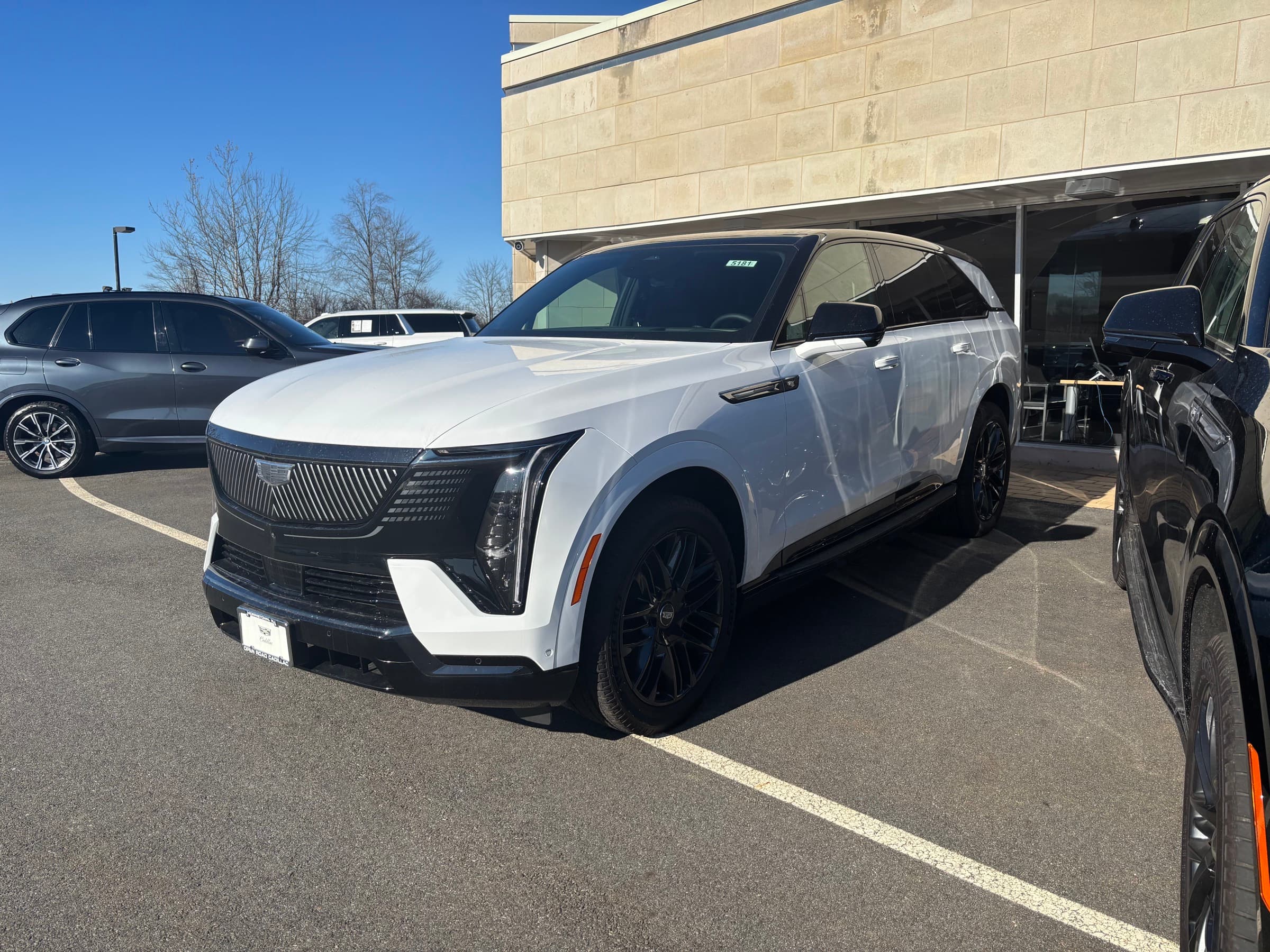
REVIEWS / Luxury Electric SUVs
NEW2026 Cadillac Escalade IQ Review
MotorTrend's 2026 SUV of the Year is the most convincing electric Escalade case yet — 205 kWh, a Cadillac-estimated 460-465 miles, and a 558-mile Edmunds test result — but the real 2026 decisions are IQ vs IQL vs the gas truck, and whether your charging life is ready for it.
Published June 1, 2026 / Updated June 4, 2026
Expert verdict
The 2026 Cadillac Escalade IQ is the rare six-figure EV that beats its range anxiety with brute force: a 205-kWh battery, a Cadillac-estimated 465 miles (460 for the new long-body IQL), an 800-volt architecture that recovered 149 miles in 15 minutes in MotorTrend's testing, and 750 horsepower in Velocity Max. MotorTrend named it the 2026 SUV of the Year; Car and Driver scored it 7.5/10 and Edmunds drove one 558 miles on a charge — the longest result in its real-world test history. Cadillac's base MSRPs run $127,405 to $151,205 before the $2,895 destination freight charge. The smart buy is the IQL Luxury at $130,405 if you carry adults in row three; the open questions are charging at home, resale, and whether you should keep your gas Escalade — all resolved below.
HIGHS
- Verified range royalty: 558 mi in Edmunds' real-world test, 415 mi in MotorTrend's road-trip test
- 800-volt charging recovered 149 miles in 15 minutes in MotorTrend's testing (352-kW peak)
- 750-hp Velocity Max; 4.5-second 0-60 measured by both Car and Driver and MotorTrend
- 2026 MotorTrend SUV of the Year, with a 55-inch-display cabin every outlet praises
- Standard Super Cruise on all trims with a 3-year OnStar plan included
- Vehicle-to-home backup power and a lockable 12.2-cu-ft eTrunk the gas Escalade can't offer
LOWS
- $130,300-$154,100 delivered, with no federal credit, no national incentives, and unknown resale
- No Apple CarPlay or Android Auto, and reviewers call the native UX overcomplicated
- Inefficient by EV standards — about 2 mi/kWh observed (InsideEVs); 43 kWh/100 mi (Edmunds)
- No EPA range or crash-test ratings exist; key figures are Cadillac estimates
- Standard-body third row is tight (32.3 in. legroom) for a 224-inch-long vehicle
- 19.2-kW home charging requires a professionally installed 100-amp circuit
AT A GLANCE
- Score
- 8.5
- Price
- $127K - $151K
- Horsepower
- 750 hp
- 0-60
- 4.5s
- Drivetrain
- AWD
- Body
- SUV
Buyer Verdict
The fast answer before you compare specs.
Built for shoppers who want the recommendation first and the details right after.
Buy it if
- The 2026 Cadillac Escalade IQ is the definitive American luxury EV: 205 kWh, a Cadillac-estimated 460-465 miles (Edmunds measured 558), 750-hp Velocity Max, and MotorTrend's 2026 SUV of the Year award. The smart buy is the IQL Luxury at $130,405 plus the $2,895 destination — the long body's adult-usable third row beats any trim upgrade. Switch from your gas Escalade only if you can install 100-amp home charging; skip it entirely if you tow heavy and far, park on the street, or cannot stomach first-generation resale risk.
- Best for: Buyers who want the definitive American luxury EV — maximum presence, a 460-465-mile Cadillac-estimated range that tests even longer, and a cabin built around a 55-inch display — and who have (or will install) the 100-amp home charging that makes a 205-kWh battery effortless to live with.
- Our trim pick: IQL Luxury from $130,405.
Skip it if
- $130,300-$154,100 delivered, with no federal credit, no national incentives, and unknown resale
- No Apple CarPlay or Android Auto, and reviewers call the native UX overcomplicated
- Inefficient by EV standards — about 2 mi/kWh observed (InsideEVs); 43 kWh/100 mi (Edmunds)
Closest rivals
- Lucid Gravity
The engineer's three-row EV
- Rivian R1S
Adventure-brand alternative
- Mercedes-Benz EQS SUV
Old-money electric luxury
Quick take
If you are searching for a 2026 Cadillac Escalade IQ review, you have found plenty of spec recitations and awards coverage and almost no decision help. The pages that rank — Car and Driver, Edmunds, MotorTrend, Electrek, InsideEVs — will tell you it has a 205-kWh battery, 750 horsepower with Velocity Max, a 55-inch pillar-to-pillar display, and a Cadillac-estimated 465 miles of range. What they mostly do not answer: whether a long-time gas Escalade owner should actually switch, what living with a battery this size means for your garage and your road trips, and how the IQ vs IQL vs gas Escalade money really stacks. This Research Desk review is built to answer those three questions. The 2026 lineup spans eight configurations — IQ and the new long-wheelbase IQL, each in Luxury, Sport, Premium Luxury, and Premium Sport — from $127,405 to $151,205 before Cadillac's $2,895 destination charge.
This is a buyer-research review built from Cadillac's official specifications, pricing, and press materials on cadillac.com and the Cadillac pressroom, NHTSA's recall and complaint databases (checked June 10, 2026), and the published, attributed test results of Car and Driver, MotorTrend, Edmunds, Electrek, and InsideEVs. It is not a MotorRank instrumented road test. We have not independently measured acceleration, range, charging speed, or cabin noise, and we do not publish reliability scores, repair costs, or resale percentages we cannot source. One basis note matters more here than usual: the Escalade IQ has no EPA range or efficiency rating at all — fueleconomy.gov carries no listing for it, and Cadillac's own spec sheet says 'EPA estimate not yet available' — so every range figure in this review is either Cadillac's estimate or a named outlet's measured result, and we label which is which.
Driving impressions
Why the Escalade IQ matters
The Escalade IQ matters because it is the first electric vehicle engineered around how Americans actually fail to plan: instead of asking you to manage a 280-mile battery carefully, it hands you a 205-kWh pack — roughly double a Rivian R1S Max pack and triple a typical crossover EV — and simply outlasts your bladder. Edmunds drove one 558 miles on a single charge, the longest result in the history of its real-world EV range test. MotorTrend made it the 2026 SUV of the Year and wrote 'Welcome back, Cadillac.' And it arrives with the Escalade franchise's full cultural weight: Cadillac says the Escalade has been the best-selling full-size luxury SUV in North America since 2014, and the IQ adds what the gas truck never had — silence, 750 horsepower, vehicle-to-home backup power, and a turning circle tighter than its size has any right to allow, thanks to up to 10 degrees of rear steering.
What to watch before you buy
Watch three things before you sign. First, your electrical panel: the 19.2-kW onboard AC charging that makes a 205-kWh battery practical at home requires a professionally installed 100-amp charging station — on an ordinary cord the official rate is about 15 miles of range per hour, which is not a serious way to live with this vehicle. Second, the software trade: there is no Apple CarPlay or Android Auto, period — MotorTrend, Edmunds, and InsideEVs all flag it — and Electrek's 2,650-mile road trip praised the range while calling the user experience 'beyond complicated and unnecessarily so.' Third, the money: the federal EV tax credit ended September 30, 2025, GM Authority's May 2026 deal sweep found no national lease or APR program on this truck, and the destination charge quietly rose from $2,390 to $2,895 — so price the real delivered number, not the sticker you remember from launch coverage.
SERP audit: who ranks for this review, and the gap they leave
Before writing a word of advice we audited the live Google results for the query buyers actually type — 2026 Cadillac Escalade IQ review. The first organic result is Car and Driver's model hub (a 7.5/10 review with instrumented test data), followed by Electrek's road-trip video review, Edmunds' model page, Carscoops, a family-angle review at TheCarMom, MotorTrend's buyer's guide, Cadillac's own configurator, InsideEVs' Sport review, Consumer Reports' gated overview, KBB, Road and Track's instrumented test, MotorTrend's SUV of the Year essay, and US News. Reddit threads about the SUV of the Year award and dealer landing pages fill the rest of page one.
Here is the gap. Every ranking page recites the same spec sheet — 205 kWh, 750 horsepower, 55-inch screen — and almost none of them resolves the three decisions a real shopper faces. Nobody walks the IQ vs IQL vs gas Escalade math on one page, even though the IQL is the single biggest 2026 change and the gas truck starts about $37,000 lower. Nobody explains the home-charging reality of a battery this size — the 100-amp circuit, the dual onboard charge rates, and what a road trip actually costs at DC fast chargers. And nobody tells a 20-year gas Escalade loyalist plainly whether to switch now or wait. Car and Driver buries its trim advice in one sentence; Edmunds' best contribution (the record 558-mile range test) lives on a separate news URL most shoppers never find; MotorTrend's award essay is persuasion, not purchase guidance.
So this review is organized to close exactly those gaps: the full eight-configuration price ladder with the destination-fee increase documented, an IQ-or-IQL verdict, a charging-life section written for someone who has never owned an EV, the gas-versus-electric Escalade family decision, and cross-shop calls against the Lucid Gravity, Rivian R1S, and Mercedes EQS SUV that end in a decision. Every Cadillac-official figure was checked against cadillac.com and the Cadillac pressroom on June 10, 2026, and every test number is attributed to the outlet that measured it.
Bottom line up front: is the 2026 Escalade IQ worth buying?
Yes — for the buyer it was actually built for: someone who wants the most American possible luxury EV, has (or will install) serious home charging, and values presence, cabin, and effortless range over efficiency and agility. The strengths are real and independently verified: MotorTrend named it the 2026 SUV of the Year over the entire field; Edmunds drove one 558 miles on a charge, the best result it has ever recorded; Car and Driver clocked 4.5 seconds to 60 mph from a vehicle it weighed at 9,120 pounds; and the cabin — the 55-inch display, the available Executive Second Row, the AKG audio — drew praise from every outlet that sat in it. InsideEVs' verdict is the cleanest one-liner on the internet: 'Some cars are just better as EVs. And America's greatest vehicle is one of them.'
Our research-basis score is 8.5 out of 10, sitting between MotorTrend's effective rave and Car and Driver's more reserved 7.5. The scorecard rewards the interior (9.4), comfort (9.3), and technology (8.8) and marks down value (6.8) and reliability confidence (7.0) — the latter is editorial judgment about a first-generation electric platform with no long-term owner record, not a measured score, because no such data exists yet. The honest counterweights: it costs $130,300 to $154,100 delivered before options, it is enormous even by American standards, other luxury EVs are quicker and far more efficient, there is no CarPlay, and nobody knows what a six-figure electric Escalade will be worth in five years. For most buyers the smart configuration is the IQL Luxury at $130,405 plus destination; the section below explains why.
Official 2026 pricing: all eight configurations, and the destination-fee increase nobody mentions
Here is the full Cadillac-official base-MSRP ladder, verified against cadillac.com on June 10, 2026. Standard-length Escalade IQ: Luxury $127,405; Sport $127,905; Premium Luxury $147,705; Premium Sport $148,205. Long-wheelbase Escalade IQL: Luxury $130,405; Sport $130,905; Premium Luxury $150,705; Premium Sport $151,205. Cadillac's own disclaimer is explicit that these MSRPs exclude the destination freight charge, tax, title, license, and dealer fees — and that the dealer sets the final price.
The destination charge is the number that moved. GM Authority documented the Escalade IQ's destination freight charge rising from $2,390 to $2,895 for 2026 — which is exactly why Car and Driver and MotorTrend both now list the truck at $130,300 to $154,100: those are the same eight base MSRPs with $2,895 folded in. When Cadillac revealed the IQL in March 2025, the official release quoted '$132,695 including destination freight charge' for the base IQL — the same vehicle that now lands at $133,300 delivered. Nothing about the truck changed; the fee did. Compare quotes on the delivered number, and do not let a dealer present the freight increase as a markup you negotiated away.
Two structural notes for budgeting. First, the options that matter are few and chunky: the Executive Second Row package is $7,500 and is exclusive to the Premium Luxury and Premium Sport trims, rear-seat entertainment screens run $1,995, the console refrigerator $1,750, and GM Energy's PowerShift home charger $1,999 plus professional installation — all per GM Authority's order-guide breakdown. Second, there is no federal help: the $7,500 clean-vehicle tax credit ended for all purchases after September 30, 2025, under the 2025 tax law, and the Escalade IQ's price exceeded the old $80,000 SUV cap anyway. The sticker is the sticker.
IQ or IQL? The decision the 2026 model year actually added
The IQL is the headline 2026 change — MotorTrend's buyer's guide lists it as the year's news — and it is a more meaningful upgrade than the modest $3,000 premium suggests. Both bodies share the 136.2-inch wheelbase, the 205-kWh battery, the 750-horsepower Velocity Max drivetrain, and the same trim structure; the IQL stretches overall length to an official 228.5 inches, all of it behind the rear axle. Cadillac's spec sheet puts the payoff where families will feel it: third-row legroom grows from 32.3 to 36.7 inches — more than four inches — and third-row headroom adds an inch. Cargo behind the third row grows from 23.7 to 24.2 cubic feet, maximum cargo from 119.2 to 125.2, and both keep the 12.2-cubic-foot lockable eTrunk under the hood.
The costs of the stretch are small but honest: the IQL gives up 500 pounds of tow rating (a Cadillac-estimated 7,500 pounds versus the IQ's 8,000), gives up five miles of estimated range (460 versus 465), and asks slightly more of parking garages — 228.5 inches is longer than a Chevrolet Suburban. Our call: if the third row is for children, occasional guests, or cargo flexibility, the standard IQ is plenty — its 32.3-inch third row is the one real packaging weakness every reviewer notes, but kids fit fine. If adults will ride in row three even monthly, the IQL Luxury at $130,405 is the best $3,000 you can spend on this truck and our recommended configuration outright.
Trim walk: Luxury, Sport, and the $20,300 Premium question
Cadillac made the bottom of this ladder unusually easy. Luxury and Sport are equipment twins separated by $500 of styling — Luxury wears brightwork and Sport goes monochrome with gloss-black accents — and both include the hardware that defines the truck: the 205-kWh battery, dual-motor AWD with Velocity Max, adaptive air suspension with Magnetic Ride Control, up to 10 degrees of rear steering, the 55-inch display, the 12.6-inch rear screens on Premium configurations aside, and Super Cruise hands-free driving with a three-year OnStar plan on every trim. There is no powertrain walk and no range walk: the $127,405 Luxury moves, rides, and charges exactly like the $151,205 IQL Premium Sport.
The Premium Luxury and Premium Sport step costs $20,300 and is where the equipment list gets indulgent: richer cabin trim and seating, the larger AKG speaker complement (Cadillac's IQL materials list a 21-speaker AKG Studio system standard and an AKG Studio Reference setup of up to 38 speakers — 42 with the Executive package), night vision, and — critically — exclusive access to the $7,500 Executive Second Row package with massaging, 14-way-power chairs, 12.6-inch personal screens, stowable tray tables, dual wireless phone chargers, and a rear command center. Car and Driver's recommendation is the IQL Premium Luxury for exactly that back-seat-first logic, and if you are buying this truck to be driven in rather than to drive, Car and Driver is right.
Our verdict by buyer type: best value, the IQ Luxury at $127,405 — nothing meaningful is missing. Best family buy and our overall pick, the IQL Luxury at $130,405, which spends the next $3,000 on third-row legroom instead of trim. Best chauffeur or executive spec, the IQL Premium Luxury with the Executive Second Row, at roughly $161,100 delivered before extras. The trim to skip: the IQ Premium Sport for buyers who do not want the Executive row — you are paying the $20,300 for ambience you can sample at the dealer and decide on honestly. Every spec of this truck already makes the statement; the Premium tier just gilds it.
Range: what 205 kWh actually buys, and why there is no EPA number
Start with the basis, because every other review blurs it: the Escalade IQ has no EPA range rating. Fueleconomy.gov carries no listing for the 2025 or 2026 Escalade IQ at all — we checked on June 10, 2026 — and the footnote on Cadillac's own spec sheet reads 'EPA estimate not yet available.' Like GM's other heaviest EVs, this truck sits outside the light-duty program that produces window-sticker range numbers. The figures Cadillac publishes — 465 miles for the IQ, 460 for the IQL — are Cadillac estimates based on development testing consistent with the SAE J1634 procedure, and we treat them as manufacturer claims, not government ratings.
Here is why we still take them seriously: the third-party results are extraordinary. Edmunds drove an Escalade IQ 558 miles on a single charge in its standardized real-world range test — the longest result of any EV Edmunds has ever tested, beating GM's own Silverado EV and Hummer EV stablemates. MotorTrend logged 415 miles in its tougher 70-mph Road-Trip Range test. Car and Driver, whose 75-mph highway test is the most conservative of the set, still recorded 380 miles and observed 57 MPGe. Electrek's 2,650-mile Michigan-to-Florida run reported over 200 miles of range remaining at a 50 percent charge on the interstate. Whichever methodology you trust, the practical answer is the same: this is a 380-to-550-mile EV depending on speed and weather, and range anxiety is simply not part of its ownership experience.
The honest counterpoint is efficiency. The IQ achieves its range with mass, not finesse: Edmunds measured consumption of 43 kWh per 100 miles — hungrier than a Rivian R1S — and InsideEVs observed roughly 2 miles per kWh, about half what a good midsize EV returns. You will pay for that at public chargers (more on costs below), and it is the fair version of the criticism that this 9,000-pound approach to range is inelegant. It is also, as MotorTrend's SUV of the Year essay argued, exactly the solution American buyers respond to.
Charging life: the section to read before you fall in love
Home charging is where a 205-kWh battery gets real. Cadillac's official charging table lists two AC rates: roughly 15 miles of range per hour on the included dual-level cord at 7.7 kW, and roughly 36 miles per hour at the full 19.2-kW onboard rate — which, per Cadillac's own footnote, requires a professionally installed 100-amp dedicated charge station. That difference is the whole ballgame. At 19.2 kW you can restore a heavy day's driving overnight without thinking; at 7.7 kW a deeply discharged pack can take more than a full day to fill. Before you order the truck, get an electrician's quote for a 100-amp circuit — in some homes it is a routine job, in others it means a panel upgrade — and budget for GM Energy's $1,999 PowerShift charger or an equivalent 19.2-kW-capable unit. This is the single most common unpleasant surprise for first-time EV buyers at this battery size, and no ranking review walks you through it.
On the road, the news is genuinely good. The IQ's 800-volt DC architecture is officially rated for up to 116 miles of range in 10 minutes at a capable fast charger, and MotorTrend's instrumented charging test validated the claim: a peak of 352 kW, 149 miles recovered in 15 minutes, and 262 miles in 30. Electrek's 2,650-mile road trip averaged under 28 minutes per stop across 15 sessions — about 7 hours of total charging over four days — and concluded the truck is a 'viable option' for full-electric road-tripping. The caveats from the same trip: 350-kW-class chargers are still unevenly distributed (Electrek saw peaks only in the high 200s at many stops), and Tesla Superchargers — accessible to GM vehicles via adapter — ran slower for this 800-volt pack and drew the reviewer's sharpest infrastructure criticism. Plan trips around high-power CCS stations and the experience is excellent; assume every charger is equal and you will occasionally be disappointed.
What does it cost? At home, a full 205-kWh fill is the cheapest way to buy 400-plus miles this truck will ever see, at whatever your utility's rate is. On the road, DC fast charging is not cheap: Electrek's documented road-trip total was about $750 in charging over 2,650 miles — roughly 28 cents per mile, which is gas-SUV territory. The honest framing: the Escalade IQ saves you real money only if most of your miles start in your own garage. That is true of most EVs; it is doubly true of one this thirsty.
Performance: 9,000 pounds, 4.5 seconds, and the limits of physics
The official numbers first: dual motors making 680 horsepower and 615 pound-feet in normal driving, rising to 750 horsepower and 785 pound-feet in the driver-selectable Velocity Max mode — Cadillac-official figures from GM testing. Cadillac estimates 0-60 in 4.7 seconds for the IQL; both Car and Driver and MotorTrend independently measured a standard IQ at 4.5 seconds, with MotorTrend's SUV of the Year test adding a 13.0-second quarter mile at 109.4 mph, a 131-foot stop from 60 mph, and 0.71 g of grip — from a truck MotorTrend's scales put at 8,991 pounds and Car and Driver's at 9,120. Those acceleration numbers would have embarrassed sports sedans a decade ago.
Context keeps them honest. Car and Driver's central reservation is that other electric luxury SUVs are quicker — a Lucid Gravity, Rivian R1S quad, or BMW iX M70 will all out-sprint it — and MotorTrend's judges noted it 'torque-steers at full throttle,' which is a strange sensation in a vehicle this size. The far more relevant daily-driving truth is the chassis: air springs with Magnetic Ride Control 4.0, independent suspension at both ends, and rear steering that turns up to 10 degrees, shrinking the curb-to-curb turning circle to an official 39.86 feet — tighter than many midsize SUVs. Electrek called the ride 'beyond smooth and quiet'; InsideEVs compared the experience to 'riding in the luxury car of a bullet train.' This is a vehicle tuned for serenity that happens to be violently fast in a straight line, and that is precisely the right calibration for what it is.
Towing is a real capability with an honest asterisk. The IQ is rated for a Cadillac-estimated 8,000 pounds and the IQL for 7,500 — competitive with the gas Escalade — but as with every EV, towing consumes range at a steep rate, and neither Cadillac nor the major outlets have published a standardized towing-range figure for this truck. If you tow long distances regularly, treat the range math as unproven until someone measures it, and plan on substantially more charging stops.
The gas-Escalade-owner question: should you switch?
This is the question the entire first page of Google skips, so here is the family math. A 2026 gas Escalade starts at $93,695 with destination per Kelley Blue Book — about $36,600 less than the cheapest delivered IQ — and a comparably equipped gas Premium Luxury still undercuts its IQ equivalent by tens of thousands. The gas truck refuels anywhere in five minutes, tows with no range anxiety, and carries two decades of known ownership behavior. The EPA rates it at 15 mpg city and 19 highway; at that thirst, a high-mileage owner hands the difference back at the pump over the years, but the up-front gap is real and the IQ never gets a federal credit to close it.
What the IQ gives a switcher that the gas truck cannot: silence and smoothness every reviewer ranks above the gas model's, 750 horsepower versus the standard truck's 420 (the supercharged Escalade-V costs $170,595), one-pedal driving, the 55-inch-display cabin, standard Super Cruise, a tighter turning circle from rear steering the gas truck does not offer at any price, and vehicle-to-home backup power that can run a properly equipped house through an outage via GM Energy's V2H bundle — an Escalade that is also a generator. MotorTrend's award essay is essentially one long argument that the IQ is the better Escalade, full stop.
Our verdict, plainly: switch now if you have home charging (or will install the 100-amp setup), your towing is occasional, and the $35,000-plus premium does not move your decision — the IQ is the better vehicle to live with, and its range removes the usual EV adjustment period almost entirely. Stay with gas — for now — if you park on the street, tow heavy and far, drive five-state weeks on no schedule, or simply will not spend $130,000-plus on a first-generation platform with unknown resale. There is no wrong answer here, only a wrong match to your infrastructure.
Interior and technology: the 55-inch cabin, and the CarPlay problem
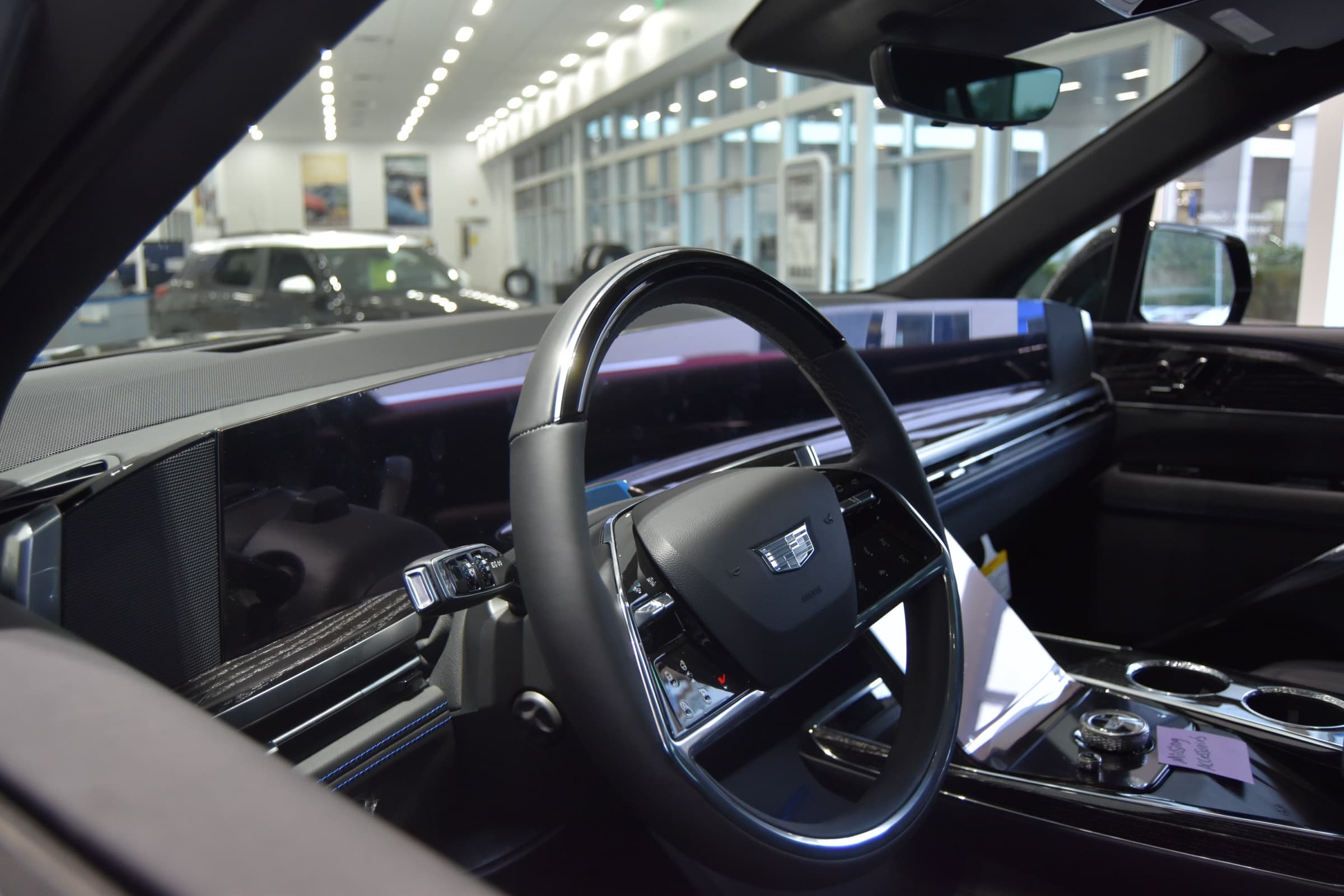
The cabin is the Escalade IQ's strongest single card. The curved, pillar-to-pillar 55-inch total-diagonal display dominates a dashboard that every major outlet praised — Edmunds called the screen experience immersive, InsideEVs called the materials first-rate and the cabin 'unbelievably comfortable and plush.' The equipment depth is official and standard-rich: Google-built infotainment with voice control, navigation, and an app store; AKG audio with Dolby Atmos; available 5G Wi-Fi; HD streaming for passengers; a power-folding third row; and Super Cruise hands-free driver assistance standard on every trim with a three-year OnStar Super Cruise plan included — after which, per Cadillac's own fine print, a paid plan is required. Budget for that subscription as a real ownership cost.
Now the criticism, because it is unusually unanimous. There is no Apple CarPlay and no Android Auto — by GM's deliberate choice — and MotorTrend, Edmunds, and InsideEVs all list it among the truck's few real flaws. Electrek's longer-term road-trip review went further, calling the overall user experience 'so beyond complicated and unnecessarily so' and admitting the reviewer repeatedly had to search the internet to operate basic functions; the digital rear-view mirror was singled out as 'utterly useless' once the rear camera got dirty. Our advice is practical: the native system is genuinely capable, but spend twenty minutes of your test drive using only the software — phone projection is not coming to rescue you, and a $130,000 vehicle should be judged on the interface you will actually live with.
The Executive Second Row package deserves its own sentence: $7,500, Premium trims only, and it converts the middle row into massaging, heated and ventilated, 14-way-power chairs with 12.6-inch personal screens, tray tables, dual wireless charging, headrest speakers, and a rear command center. If the Escalade IQ is a back-seat vehicle in your household, it is the best money on the options sheet; if it is a driver's vehicle, skip it and bank the cost of the panel upgrade your garage may need.
Cargo, the eTrunk, and the practicality fine print
The official cargo numbers are huge in absolute terms: 23.7 cubic feet behind the standard IQ's third row (24.2 in the IQL), 119.2 cubic feet maximum in the IQ (125.2 IQL), plus a 12.2-cubic-foot powered, lockable eTrunk under the hood — secure storage no gas Escalade offers. The eTrunk is the sleeper feature for daily life: valuables, charging cables, and airport luggage live there, out of sight, without sacrificing the cabin. The power-folding third row drops flat, and the load floor is van-vast.
The fine print is geometry. Car and Driver's sharpest criticism is that the IQ is 'not as spacious as the exterior footprint suggests' — the thick floor over the battery and the swoopier roofline cost the electric truck some of the gas Escalade's boxy efficiency, and the standard body's 32.3-inch third-row legroom is genuinely tight for adults. MotorTrend's judges also dinged the 'clunky second-row mechanism' when reconfiguring seats. And the size itself is a daily consideration Car and Driver summarized as 'oversized even for America': the IQL is 228.5 inches long and 94.1 inches wide with mirrors, the curb weight is around 9,000 pounds on both outlets' scales, and while the rear steering makes parking maneuvers easier than physics suggests, standard garages, parking decks, and tire budgets all deserve a measuring tape before you order. One official footnote worth quoting verbatim from Cadillac: the 24-inch wheels' 'lower-profile tires wear faster,' and road damage to them 'is not covered by the GM New Vehicle Limited Warranty.'
Ownership, warranty, and the resale question nobody can answer yet
The warranty structure, per Cadillac's published coverage as summarized by Car and Driver: four years or 50,000 miles of bumper-to-bumper coverage, six years or 70,000 miles on the powertrain, and — the number that matters most on a 205-kWh vehicle — eight years or 100,000 miles on the electric propulsion battery, with the first dealer maintenance visit complimentary. Confirm the exact terms in the warranty booklet at purchase. That battery coverage is the industry-standard federal minimum, not an outlier, but on a pack this large it is protecting the single most valuable component GM has ever bolted into a consumer SUV, and it transfers with the vehicle.
On reliability we will be precise about what is and is not known. NHTSA lists exactly one recall for the 2026 Escalade IQ as of June 10, 2026 — campaign 26V114000, a compliance recall covering dozens of GM models whose radios were not set to auto-download the electronic owner's manual; the remedy is a free dealer radio reset, with owner letters mailed April 16, 2026. NHTSA shows zero recalls for the 2025 model year and zero complaints on file for the 2026 (three minor complaints exist for 2025, covering wheels, seats, and an electrical issue). That is a clean early record, and it is also only about eighteen months of data on a first-generation platform; we do not publish reliability scores we cannot source, and none exist yet for this truck.
Resale is the honest open question. Nobody — not us, not the outlets ranking above us — has verified residual data for a six-figure electric Escalade, and the recent history of luxury EV depreciation plus the September 2025 end of federal EV incentives makes confident predictions impossible. The structural positives: the Escalade nameplate is the strongest in its segment, supply is not piled on dealer lots at fire-sale prices, and GM Authority's May 2026 incentive sweep found essentially no discounts — $1,000 first-responder and military offers and a $500 educator credit were the only programs running, which signals Cadillac is not buying sales. The structural negative: every first-generation luxury EV before it has depreciated faster than its gas equivalent. If you finance, model your exit conservatively; if you lease, you transfer that risk to GM — which is exactly why we lean toward leasing on this truck even without a subvented national program.
Safety: Super Cruise standard, crash ratings absent
The active-safety story is strong and official: Super Cruise hands-free driver assistance is standard on every 2026 Escalade IQ and IQL trim — with the three-year OnStar Super Cruise plan included — alongside Cadillac's full suite of standard driver-assistance features. Reviewers consistently rank Super Cruise among the best hands-free systems on sale; Electrek's road-trip review called it 'one of the best in the biz,' and on a vehicle this large, the camera-monitored hands-free highway driving meaningfully reduces fatigue. Night vision is available on Premium trims.
The passive-safety story is simply unwritten: NHTSA lists no crash-test ratings for the Escalade IQ — we checked the agency's database on June 10, 2026 — and vehicles in this weight class are generally not tested by either NHTSA or IIHS. We will not assign a safety conclusion the agencies have not produced. What physics offers in mass advantage for occupants, it takes back in stopping distance, tire grip, and what 9,000 pounds means for whatever it hits; MotorTrend's measured 131-foot stop from 60 mph is genuinely good for the weight, and still a number to respect. Our safety score reflects the equipment list and the absence of independent crash data, in that order.
Cross-shop: Lucid Gravity, Rivian R1S, Mercedes EQS SUV, and the truck in your own driveway
Choose the Escalade IQ over the Lucid Gravity if presence, cabin theater, and effortless range matter more than driving dynamics and efficiency — the Gravity is the engineer's choice, dramatically more efficient and agile from a much smaller battery, and our full Lucid Gravity review calls it the best-driving three-row EV on sale. The Gravity counters with a tighter cabin and a far thinner service network than Cadillac's dealer body; the Escalade counters with the bigger battery, the bigger badge, and the bigger everything. Choose the Rivian R1S if your life includes dirt, towing into the backcountry, or a preference for adventure-brand restraint over Cadillac maximalism — it is quicker in quad-motor form and far more efficient, but its real-world range trails by 150-plus miles and its third row and cargo cannot match the IQL's.
The Mercedes-Benz EQS SUV is the old-money alternative: quieter styling, a hyperscreen of its own, and heavy depreciation that makes lightly used examples a conspicuous value — but it is a size class smaller in presence and a fraction of the Escalade's range, and nobody mistakes one for an Escalade. The fourth rival is the one already in your driveway: the gas 2026 Escalade at $93,695 to start remains the rational pick for street parkers, heavy towers, and anyone unwilling to wear first-generation depreciation risk — our full family-decision section above resolves that one buyer type at a time. And if what you actually want is a luxury electric SUV rather than this much SUV, our Polestar 3 review covers the right-sized, driver-flavored end of the same market for roughly half the money.
How to buy one: deal reality in June 2026
Set expectations first: there is no deal. GM Authority's May 2026 sweep of Cadillac's national programs found no lease support, no APR offer, and no cash on the Escalade IQ — only $1,000 first-responder and military discounts and a $500 educator program, with delivery deadlines in early June. The federal clean-vehicle credit ended September 30, 2025, and never applied to this truck's price class anyway. That means your negotiation is conventional: dealer margin, your trade, and patience. The good news inside that reality is that supply has normalized since launch — eight configurations are orderable, and the truck no longer carries launch-window markup energy at most stores; if one near you does, another Cadillac dealer wants the sale.
Practical steps that matter more on this vehicle than most. Get the delivered price in writing with the $2,895 destination charge itemized — the fee rose for 2026, and quotes that look high may simply be honest. Have your electrician quote the 100-amp charging circuit before you sign, not after; it is part of the purchase price in every way that matters. If you lease, scrutinize the residual — with no national program, captive lease pricing varies, and the residual percentage is the number that decides whether leasing transfers depreciation risk to GM at an acceptable monthly cost. And insure it before delivery day: a 9,000-pound, $140,000 EV with 24-inch tires is not priced like your last Escalade, and we would rather you hear that from your agent than from us after the fact — get the quote, we cannot price it for you.
Who should wait
Three buyer types should sit this model year out. First, anyone without a realistic path to 19.2-kW home charging: the truck technically works on lesser circuits and public chargers, but the ownership experience that won SUV of the Year assumes you wake up full every morning — without that, you own the least efficient EV on sale and rent your range at 28 cents a mile. Second, the resale-sensitive: a first-generation, six-figure luxury EV with no residual track record is the definition of depreciation uncertainty, and twelve more months will produce real auction data, real owner-reliability signal, and possibly the lease support that does not exist today. Third, heavy towers: until someone publishes standardized towing-range tests, the 8,000-pound rating is a capability claim without a range number attached, and a gas Escalade or heavy-duty truck remains the proven tool.
What might reward waiting: GM's charging ecosystem is moving fast (native NACS ports are arriving across the industry, and adapter-based Tesla Supercharger access today is slower for this 800-volt pack than its CCS peak, per Electrek's road-trip experience), year-two pricing and incentives historically soften, and the software criticisms every outlet raises are the kind GM can — and historically does — patch over the air. None of that is a reason the right buyer should not sign today; all of it is a reason the marginal buyer gets a better truck, or a better deal, in 2027.
The verdict: which Escalade IQ to buy, and who should look elsewhere
The 2026 Cadillac Escalade IQ is the most complete argument yet that the electric version of an American icon can be the better version: more power, more silence, more cabin, a tighter turning circle, backup power for your house, and enough verified real-world range — 558 miles in Edmunds' test, 415 in MotorTrend's, 380 in Car and Driver's worst case — to make range anxiety someone else's problem. MotorTrend did not name it SUV of the Year as a participation trophy. It is also a 9,000-pound, $130,300-to-$154,100 delivered statement with no EPA rating, no CarPlay, no federal credit, no discounts, and no resale history. Both of those sentences are true, and a good buying decision holds them at once.
Our advice in one breath: most buyers should order the IQL Luxury at $130,405 plus the $2,895 destination — the third row adults can use is worth more than any trim upgrade. Value buyers take the IQ Luxury at $127,405 and lose nothing mechanical. Executive households take the IQL Premium Luxury with the $7,500 Executive Second Row and stop pretending the driver matters most. Gas-Escalade loyalists with home charging should switch and will not look back; street parkers and heavy towers should not, yet. And if you read this far and realized you want the best-driving electric three-row rather than the most magnificent one, read our Lucid Gravity review before you sign anything. This is a research-basis review built from Cadillac's official specifications and the attributed testing of Car and Driver, MotorTrend, Edmunds, Electrek, and InsideEVs; we will update it with MotorRank instrumented testing, real-world charging data, and resale evidence as they exist.
Specs Snapshot
The numbers shoppers compare first.
Key numbers to compare against alternatives before you commit.
| Base price | $127K - $151K |
|---|---|
| Horsepower | 750 hp |
| 0-60 mph | 4.5 sec |
| Drivetrain | AWD |
| Transmission | Automatic |
| Fuel type | Electric |
Media Proof
Exterior and interior visuals with source receipts.
Every asset shown here links back to its source and license so the page can gain trust without borrowing competitor media.
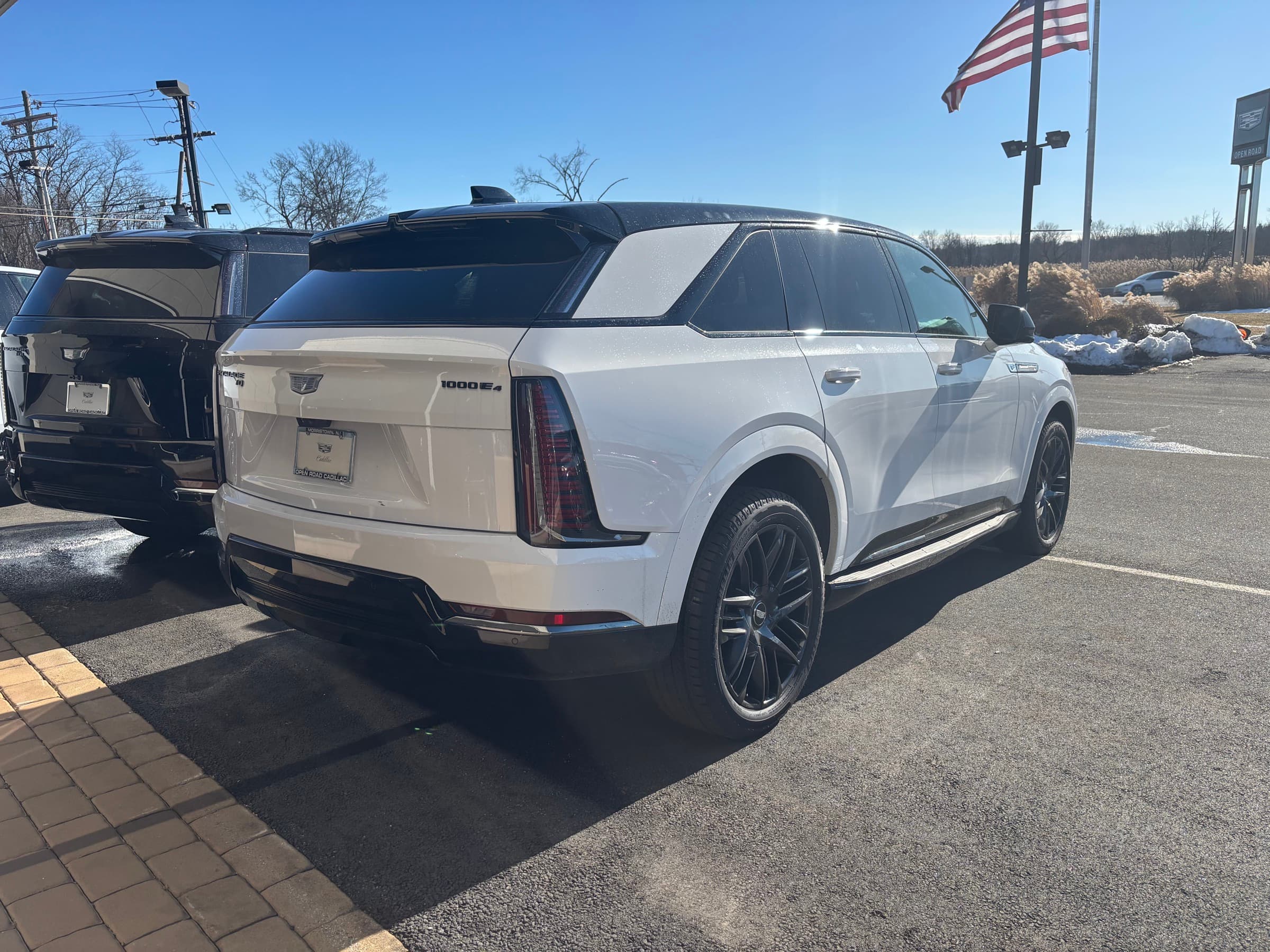
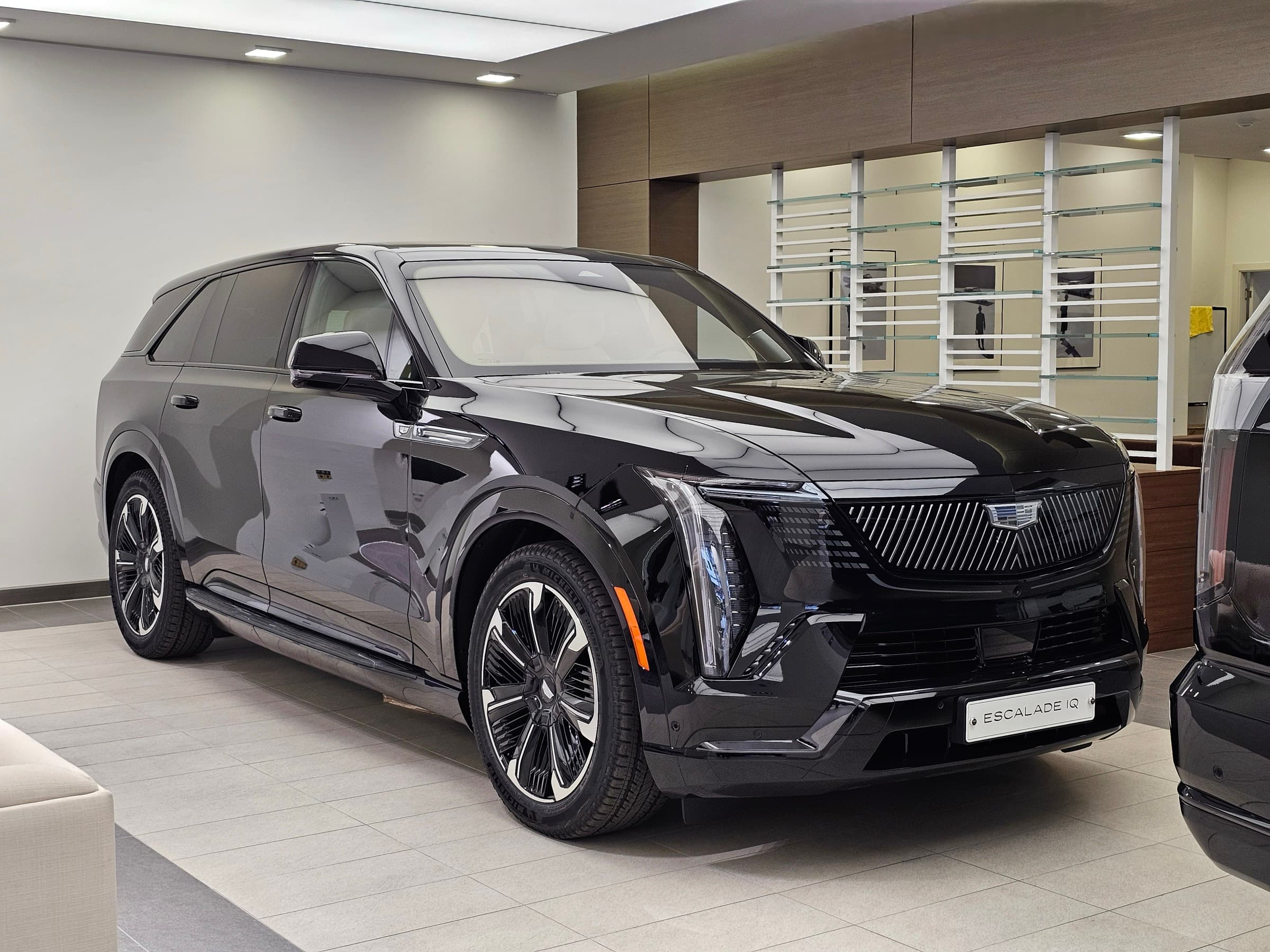
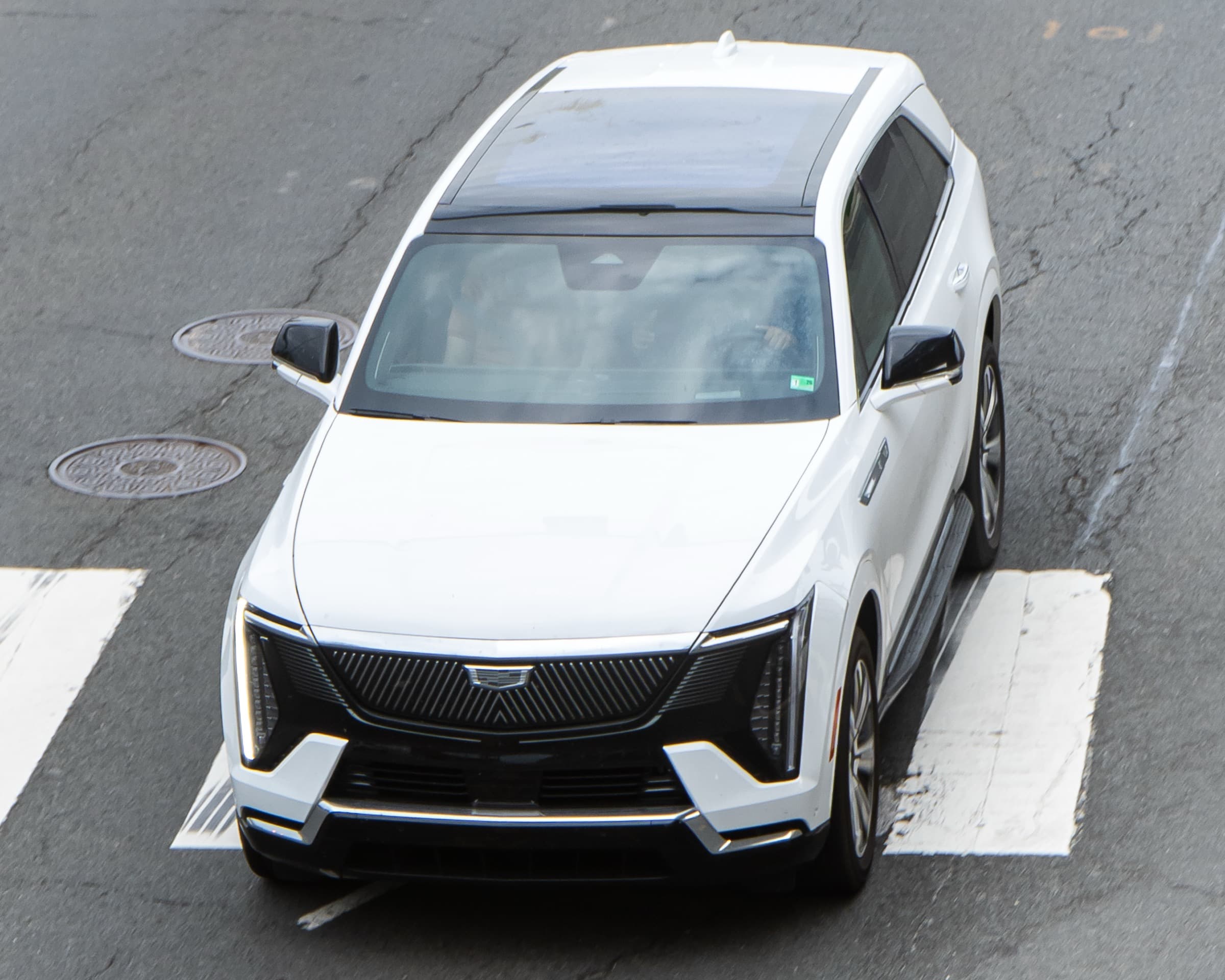
Source Receipts
Source pages, creator credits, and reuse licenses are visible for editorial trust and legal hygiene.
Interior
Cabin views before you choose a trim.
The cabin is the Escalade IQ's strongest card: a curved, pillar-to-pillar 55-inch total-diagonal display, AKG audio with Dolby Atmos, standard Super Cruise, and an available $7,500 Executive Second Row with massaging 14-way chairs and 12.6-inch personal screens. The honest catches every outlet flags: no Apple CarPlay or Android Auto, and a native interface Electrek's road-trip review called 'beyond complicated and unnecessarily so.'
Interior Source Receipts
Research basis
Updated June 10, 2026
Built from Cadillac's official 2026 Escalade IQ and IQL specifications and pricing on cadillac.com, the Cadillac pressroom's IQL release and preliminary spec tables, NHTSA's recall and complaint databases (checked June 10, 2026), and the published test results of Car and Driver, MotorTrend (including its 2026 SUV of the Year instrumented testing), Edmunds, Electrek, and InsideEVs. All eight base MSRPs were verified against cadillac.com, and the $2,895 destination charge against GM Authority's order-guide reporting.
The Escalade IQ has no EPA range or efficiency rating — fueleconomy.gov carries no listing and Cadillac's spec sheet states 'EPA estimate not yet available' — so the 465-mile (IQ) and 460-mile (IQL) figures are Cadillac estimates, and all measured range, acceleration, and charging numbers are attributed to the outlet that produced them. MotorRank has not yet instrumented-tested the Escalade IQ; ride, software, and charging-experience impressions are attributed and labeled preview basis.
Update when MotorRank runs instrumented range, charging, and road testing, when NHTSA or IIHS publish any applicable ratings, when verified residual-value data exists for the first model years, and if Cadillac adds native NACS charging or a V-Series variant.
Which 2026 CADILLAC ESCALADE IQ to Buy
Which trim is right for you?
IQ Luxury
$127,405
The entry point — and barely a sacrifice: the same 205-kWh battery, 750-hp Velocity Max, 55-inch display, air suspension, and standard Super Cruise as every other trim.
IQ Sport
$127,905
Identical hardware to Luxury with gloss-black trim and monochrome badging for $500 — pick it on looks alone.
IQL Luxury
$130,405
Our pick for real seven-seat use: the long body adds 4.4 inches of third-row legroom and more cargo for $3,000 over the standard IQ.
Our pick
IQL Sport
$130,905
The long body with the blacked-out Sport look — same $500 styling walk, same hardware underneath.
IQ Premium Luxury
$147,705
The $20,300 Premium step buys the loaded cabin and unlocks the $7,500 Executive Second Row — justify it with the back seat, not the badge.
IQ Premium Sport
$148,205
The Premium equipment list in the Sport's dark trim — the spec most press fleets carry, and the look most buyers photograph.
IQL Premium Luxury
$150,705
Car and Driver's recommended configuration: the long body, the full equipment list, and Executive Second Row availability.
IQL Premium Sport
$151,205
The top of the ladder before options — MotorTrend's SUV of the Year test truck stickered at $154,315 delivered.
Performance
- Horsepower
- 750hp
- 0–60 mph
- 4.5s
Scorecard
- Performance8.6
- Comfort9.3
- Value6.8
- Ownership7.5
- Technology8.8
- Safety8
- Reliability7
- Interior9.4
Shopping Tools
Next steps for 2026 Cadillac Escalade IQ shoppers.
Research tools to help you move from browsing to buying.
Compare rivals
Line up the closest alternatives before you commit.
Check deal signals
Review pricing pressure, incentives, and value angles.
Read owner signal
Balance the expert take with ownership patterns.
Cross-shop first
The Gravity is the engineer's answer to the same question: dramatically more efficient, better to drive, and quicker, from a far smaller battery. Read it before deciding whether you want the best-driving electric three-row or the most magnificent one.
Open vehicle hub
Keep specs, reliability, rankings, and review links together.
Compare Against
Cross-shop before you commit.
The closest alternatives in this price range, with our read on each.
The engineer's three-row EV
Lucid Gravity
Dramatically more efficient, quicker, and better to drive from a far smaller battery — the driver's choice. The Escalade IQ answers with range margin, cabin theater, standard Super Cruise, and a real dealer network.
Adventure-brand alternative
Rivian R1S
More agile, more efficient, and genuinely trail-capable with quieter styling. The Escalade IQ counters with 150-plus more miles of tested range, a far roomier third row and cargo hold, and the luxury statement Rivian deliberately avoids.
Old-money electric luxury
Mercedes-Benz EQS SUV
Subtler, smaller, and steeply depreciated — a lightly used one is the segment's quiet value. But it cannot approach the Escalade IQ's range, presence, or three-row space, and nobody mistakes it for an Escalade.
The family decision
Cadillac Escalade (gas)
Starts about $36,600 lower, refuels anywhere in minutes, and carries proven resale. The IQ is quieter, far quicker, tighter-turning, and cheaper to run from a home charger — the better Escalade if your garage is ready.
Buyer FAQ
2026 Cadillac Escalade IQ buyer questions, answered.
28
buyer answers
Question Map
Decision
Should you buy the 2026 Cadillac Escalade IQ?
MotorTrend's SUV of the Year solves EV range with brute force — so the decision turns on your charging life, your towing, and your tolerance for first-generation risk.
Is the 2026 Cadillac Escalade IQ any good?
Yes — it is MotorTrend's 2026 SUV of the Year, and Car and Driver rates it 7.5/10 — though it is huge, thirsty, and expensive.+
The major outlets agree on the strengths: extraordinary real-world range (Edmunds measured 558 miles, the longest in its test history), genuinely fast charging (149 miles in 15 minutes in MotorTrend's test), a measured 4.5-second 0-60, and a cabin every reviewer praises. MotorTrend named it the 2026 SUV of the Year and wrote 'Welcome back, Cadillac'; InsideEVs concluded 'some cars are just better as EVs.' Car and Driver is the measured voice at 7.5/10, noting rivals are quicker and the body is 'oversized even for America.' Our research-basis score is 8.5. It is a superb vehicle for the right buyer and an irrational one for everyone else.
Who is the 2026 Escalade IQ right for?
Buyers who want maximum American luxury EV, have home charging, and put presence and range above efficiency.+
The target buyer wants the statement and the silence: a household with a garage that can take a 100-amp charging circuit, road trips measured in states, passengers who matter as much as the driver, and a budget where $130,300-$154,100 delivered is a choice rather than a stretch. It also fits long-time gas Escalade owners ready to switch — the IQ is quieter, far quicker, tighter-turning, and can back up your house through GM Energy's vehicle-to-home hardware. It is wrong for street parkers, efficiency-minded buyers (it consumes roughly twice what a good midsize EV does), frequent heavy towers, and anyone who needs CarPlay.
Who should skip the Escalade IQ?
Street parkers, heavy towers, resale-sensitive buyers, and anyone who would miss Apple CarPlay daily.+
Skip it if you cannot charge at home — public-charging-only ownership of a 205-kWh, roughly-2-mi/kWh vehicle is expensive and tedious, with Electrek's road trip averaging about 28 cents a mile at DC fast chargers. Skip it if you tow heavy and far: the 8,000-pound rating is real, but no outlet has published towing-range tests, and range drops steeply with a trailer on any EV. Skip it if depreciation keeps you up at night — no verified residual data exists for a six-figure electric Escalade. And skip it if phone projection is non-negotiable: there is no CarPlay or Android Auto at any price.
Why does the Escalade IQ matter right now?
It is the first luxury EV that makes range anxiety irrelevant — and it just won the industry's biggest SUV award.+
The Escalade IQ is the proof case that an American icon can electrify without shrinking: Cadillac says the Escalade has been the best-selling full-size luxury SUV in North America since 2014, and the IQ adds 750 horsepower, a 460-465-mile Cadillac-estimated range that independent tests validate and exceed, and a cabin organized around a 55-inch display. MotorTrend's 2026 SUV of the Year award put it at the top of the conversation, and the 2026 IQL expansion makes it a genuine family-fleet decision for the first time. Search interest in this review is enormous, and the buying answers are scattered — which is exactly why this page exists.
2026 Changes
What changed for 2026 — and IQ vs IQL, resolved
The long-wheelbase IQL is the year's headline; the destination fee quietly rose too. Here is which body to buy.
What is new for the 2026 Escalade IQ?
The long-body IQL joins the lineup; the destination charge rose from $2,390 to $2,895; the core truck carries over.+
Two changes matter. First, the Escalade IQL: a long-body variant in the same four trims, stretching overall length to an official 228.5 inches with third-row legroom up from 32.3 to 36.7 inches and maximum cargo from 119.2 to 125.2 cubic feet — MotorTrend's buyer's guide lists it as the year's news. Second, the money: GM Authority documented the destination freight charge rising from $2,390 to $2,895, so delivered prices climbed about $500 with no equipment change. The drivetrain, battery, range estimates, and trim structure carry over from the 2025 launch year.
Should you buy the IQ or the IQL?
IQL if adults ever ride in row three — the $3,000 premium buys 4.4 inches of third-row legroom. IQ for everyone else.+
The IQL costs $3,000 more trim-for-trim ($130,405 vs $127,405 at the base) and spends all of it on the back of the cabin: 36.7 inches of third-row legroom versus the IQ's tight 32.3, an extra inch of third-row headroom, and 125.2 versus 119.2 cubic feet of maximum cargo — official Cadillac figures. The trade-offs are a 7,500- versus 8,000-pound tow rating, 460 versus 465 miles of estimated range, and 4.2 more inches of parking length. Our call: the IQL Luxury is the best configuration in the lineup if your third row sees adult use even monthly. If row three is for kids and cargo, the standard IQ loses nothing you will notice.
What is the difference between the 2025 and 2026 Escalade IQ?
Mechanically nothing — 2026 adds the IQL body choice and a higher destination fee, so a discounted 2025 is the same truck.+
The 2025 model year was the Escalade IQ's first, and the 2026 standard-body truck is a carryover of it: same 205-kWh battery, same 680/750-hp outputs, same estimated range, same cabin. The 2026 news is the IQL variant and the $505 destination increase. That makes a leftover or lightly used 2025 a rational value play — NHTSA shows zero recalls on the 2025 model year and only three minor complaints — as long as you do not need the IQL's stretched third row, which has no 2025 equivalent.
Is the Escalade IQ selling well?
Cadillac does not break out IQ-specific sales in what we reviewed, but pricing behavior says demand is healthy.+
We will not quote sales figures we have not verified, and Cadillac's public materials lean on franchise claims (best-selling full-size luxury SUV in North America since 2014) rather than IQ-specific volumes. The market signals we can verify point to healthy demand: GM Authority's May 2026 incentive sweep found no national discounts, lease support, or APR programs on the truck — manufacturers do not withhold incentives from slow sellers — and Cadillac expanded rather than trimmed the lineup for 2026 with the IQL. Treat deep dealer discounts as store-level events, not a national pattern, as of June 2026.
Real Cost
Price, destination, and what you will actually pay
Eight configurations from $127,405 to $151,205 before the $2,895 destination charge — with no tax credit and, right now, no deals.
How much does the 2026 Cadillac Escalade IQ cost?
Base MSRPs run $127,405-$151,205; add the $2,895 destination for real delivered prices of $130,300-$154,100.+
Cadillac's official base prices, verified June 10, 2026: IQ Luxury $127,405; IQ Sport $127,905; IQ Premium Luxury $147,705; IQ Premium Sport $148,205; IQL Luxury $130,405; IQL Sport $130,905; IQL Premium Luxury $150,705; IQL Premium Sport $151,205. All exclude the $2,895 destination freight charge — which rose from $2,390, per GM Authority — plus tax, title, license, and dealer fees. That is why Car and Driver and MotorTrend list the range as $130,300-$154,100: same trucks, destination included. MotorTrend's SUV of the Year test vehicle, an IQL Premium Sport with options, stickered at $154,315.
Does the Escalade IQ qualify for the federal EV tax credit?
No. The federal credit ended for all purchases after September 30, 2025 — and this truck never qualified anyway.+
There is no federal purchase help: the $7,500 new clean-vehicle credit terminated for vehicles acquired after September 30, 2025, under the 2025 tax law, and even while it existed the Escalade IQ's pricing sat far above the $80,000 MSRP cap for SUVs. The lease pass-through that once let luxury EVs capture commercial credits ended on the same date. Budget the full sticker, check whether your state or utility offers EV or home-charger rebates (several still do), and treat any dealer talk of federal credits on this truck as a red flag.
Are there any Escalade IQ lease deals or discounts?
Essentially none as of mid-2026 — GM Authority found only $1,000 military/first-responder and $500 educator programs.+
GM Authority's May 2026 sweep of Cadillac's national programs found no lease support, no subsidized APR, and no customer cash on the Escalade IQ or IQL — only $1,000 first-responder and military discounts and a $500 educator credit with early-June delivery deadlines. So your real negotiation is conventional dealer margin and your trade. We still lean toward leasing on this truck if the captive's residual is reasonable, because a lease transfers the genuinely unknown depreciation risk of a first-generation six-figure EV to GM — but compare the money factor carefully, since no national subvention is propping the payment up.
What do the options actually cost?
The Executive Second Row is $7,500 (Premium trims only); rear entertainment $1,995; the fridge $1,750; the home charger $1,999 plus installation.+
Per GM Authority's order-guide breakdown: the Executive Second Row Seating package — massaging, heated and ventilated 14-way-power chairs, 12.6-inch personal screens, tray tables, dual wireless chargers, a rear command center — costs $7,500 and is exclusive to Premium Luxury and Premium Sport. Rear-seat entertainment screens are $1,995, the console refrigerator $1,750, and GM Energy's PowerShift 19.2-kW-capable home charger $1,999 before professional installation of its required 100-amp circuit. Budget the charger and electrical work as part of the purchase: they are the difference between effortless ownership and a 15-mile-per-hour trickle.
Range
How far does it really go?
Cadillac estimates 465 miles (460 IQL); Edmunds measured 558. There is no EPA number — here is what to trust.
What is the 2026 Escalade IQ's real range?
Cadillac estimates 465 miles (IQ) / 460 (IQL); tests ran 380 mi (C/D, 75 mph) to 558 mi (Edmunds).+
Cadillac's official estimates are 465 miles for the IQ and 460 for the IQL on a full charge, based on development testing consistent with SAE J1634. Independent results bracket them: Edmunds drove one 558 miles in its real-world loop — the longest of any EV it has ever tested; MotorTrend's 70-mph Road-Trip Range test returned 415 miles; Car and Driver's 75-mph highway test, the harshest method, recorded 380 miles. Practical translation: plan on roughly 380-420 highway miles at American interstate speeds, more in mixed driving — a margin so large that daily range planning simply stops being a thing.
Why doesn't the Escalade IQ have an EPA range rating?
It is too heavy for the EPA's light-duty labeling program — fueleconomy.gov has no listing, so all official range is Cadillac-estimated.+
Check fueleconomy.gov and you will find no Escalade IQ at all for 2025 or 2026 — we verified on June 10, 2026 — and the footnote on Cadillac's own spec table says 'EPA estimate not yet available.' Like GM's other heaviest EVs, the roughly 9,000-pound Escalade IQ falls outside the light-duty program that produces window-sticker range and MPGe figures. That does not make the range claims wrong — independent tests met or beat them — but it means no government-standardized number exists, comparison-site 'EPA range' fields for this truck are mislabeled, and the burden of proof sits with the outlets that actually measured it.
How efficient is it — and what does charging cost?
Not very: about 2 mi/kWh observed (InsideEVs), 43 kWh/100 mi (Edmunds). Cheap at home, gas-money on road trips.+
The IQ achieves its range with battery mass, not efficiency. Edmunds measured 43 kWh per 100 miles — hungrier than a Rivian R1S — and InsideEVs observed roughly 2 miles per kWh, about half what a good midsize EV returns. At home that still pencils: 205 kWh at residential rates is the cheapest 400-plus miles this truck will ever buy. On the road it does not: Electrek's documented 2,650-mile trip spent about $750 on DC fast charging — roughly 28 cents per mile, comparable to fueling a gas SUV. The ownership math only favors the IQ if most of your miles begin in your own garage.
Charging
Charging life with a 205-kWh battery
The 800-volt pack fast-charges brilliantly — but home charging needs a 100-amp circuit, and not all public plugs are equal.
How fast does the Escalade IQ charge at a DC fast charger?
Officially up to 116 miles in 10 minutes; MotorTrend measured a 352-kW peak and 149 miles recovered in 15 minutes.+
Cadillac's official claim is up to 116 miles of range in 10 minutes at a capable public DC fast charger, and MotorTrend's instrumented charging test validated it: a peak rate of 352 kW, 149 miles recovered in 15 minutes, and 262 miles in 30. The qualifier is 'capable' — those numbers require 350-kW-class hardware, which is still unevenly distributed. Electrek's road trip saw peaks only in the high 200s at many stops yet still averaged under 28 minutes per session across 15 stops. Route through high-power CCS stations and this is one of the fastest-charging EVs on sale; at older 150-kW units, a pack this size takes patience.
What home charging setup does the Escalade IQ need?
A professionally installed 100-amp circuit for the full 19.2-kW rate (~36 mi/hour); the included cord manages only ~15 mi/hour.+
Cadillac's charging table lists two home rates: roughly 15 miles of range per hour from the included dual-level cord at 7.7 kW, and roughly 36 miles per hour at the truck's full 19.2-kW onboard AC rate — which Cadillac's footnote says requires a professionally installed 100-amp dedicated charge station, such as GM Energy's $1,999 PowerShift unit. On a 205-kWh battery this is not a nicety: at 7.7 kW a deep charge takes more than a day, while at 19.2 kW you wake up full after any normal day. Get an electrician's quote before you order — some panels take the circuit easily, others need an upgrade worth thousands.
Can the Escalade IQ use Tesla Superchargers?
Yes, via GM's NACS adapter — but the 800-volt pack charges well below its peak there, per Electrek's road-trip experience.+
GM vehicles, the Escalade IQ included, can access Tesla Superchargers using GM's approved NACS adapter. The practical catch is speed: the IQ's 800-volt architecture hits its headline rates on 350-kW-class CCS hardware, and Electrek's road-trip review specifically criticized Tesla stations for limited third-party access and slower charging for this truck, while praising Mercedes-Benz's charging network as 'abundant, dependable, fast.' Treat Supercharger access as a useful safety net that thickens the map, not as your primary fast-charging plan — and note the IQ still uses a native CCS port, with industry-wide native-NACS adoption arriving on future model years.
Can it really power your house?
Yes — vehicle-to-home bidirectional charging is built in, but it requires GM Energy's V2H hardware bundle and a properly equipped home.+
The Escalade IQ and IQL come equipped with vehicle-to-home bidirectional charging capability — official Cadillac equipment, not an option — which can push energy from the 205-kWh pack into a properly equipped house during an outage when paired with the GM Energy V2H Bundle. The honest qualifiers: the V2H hardware and its installation are a separate, real cost; the home-equipment requirements are non-trivial; and how many days a pack this size runs your house depends entirely on your loads. Even so, it is a genuine capability the gas Escalade cannot offer at any price, and for storm-prone regions it converts the battery from indulgence to infrastructure.
Daily Use
Living with it: size, cabin, and the software
Magnificent to ride in, enormous to park, and software-opinionated — what the spec sheet hides (preview basis).
How does the Escalade IQ drive day to day?
Serene and shockingly maneuverable for 9,000 pounds — air springs, MagneRide, and 10 degrees of rear steer do the work (attributed).+
On preview basis, attributed to the outlets that have driven it: the IQ rides on air springs with Magnetic Ride Control 4.0 and steers its rear wheels up to 10 degrees, producing an official 39.86-foot turning circle that makes parking-lot behavior feel a size class smaller. Electrek called the ride 'beyond smooth and quiet'; InsideEVs likened it to 'riding in the luxury car of a bullet train'; MotorTrend measured a 131-foot stop from 60 mph and noted torque steer at full throttle as a quirk. The constant is mass: 8,991-9,120 pounds on the two outlets' scales. It shrinks around you, but it never gets small.
Will it fit in a garage — and how big is it really?
The IQ is huge and the 228.5-inch IQL is longer than a Suburban — measure your garage and parking deck before ordering.+
Official dimensions for the IQL: 228.5 inches long, 94.1 inches wide with mirrors (85.3 folded), 76.1 inches tall, on a 136.2-inch wheelbase; the standard IQ is about four inches shorter. Car and Driver's blunt summary — 'oversized even for America' — is the right caution: many residential garage bays run 240 inches deep or less, and parking decks, drive-throughs, and tight urban streets all deserve thought. The rear steering genuinely helps in maneuvers, and the official 39.86-foot turning circle is remarkable for the length, but no software shrinks 9,000 pounds and nearly 19 feet of Cadillac. Measure first.
How practical is the cargo and third row?
Big numbers — 119.2-125.2 cu ft max plus a 12.2-cu-ft eTrunk — but the standard IQ's 32.3-in third row is tight for adults.+
Official figures: the IQ holds 23.7 cubic feet behind the third row and 119.2 maximum; the IQL grows those to 24.2 and 125.2; both add a 12.2-cubic-foot powered, lockable eTrunk under the hood that is perfect for valuables and charging cables. The catches are real: Car and Driver notes the cabin is less spacious than the footprint suggests because the battery raises the floor, the standard IQ's 32.3 inches of third-row legroom is the packaging weak point (the IQL's 36.7 fixes it), and MotorTrend dinged the clunky second-row folding mechanism. Families who load strollers, dogs, or adults in row three should test-fit before choosing the body.
Ownership
Warranty, recalls, reliability, and resale
A clean early record and standard EV battery coverage — set against zero long-term data and an unwritten resale story.
What warranty does the 2026 Escalade IQ have?
4 yr/50k basic, 6 yr/70k powertrain, and 8 yr/100k on the propulsion battery, per Cadillac's published coverage.+
Per Cadillac's published coverage as summarized by Car and Driver: a four-year/50,000-mile limited warranty, six years/70,000 miles of powertrain coverage, eight years/100,000 miles on the electric propulsion battery, and a complimentary first dealer maintenance visit. The battery term is the industry-standard federal minimum rather than an outlier, but on a 205-kWh pack it covers the most valuable single component in any consumer GM vehicle, and it transfers to subsequent owners. Confirm exact terms in the warranty booklet at purchase, and remember Cadillac's own footnote: damage to the 24-inch wheels' low-profile tires from road hazards is not covered.
Does the 2026 Escalade IQ have any recalls or reliability problems?
One minor compliance recall (26V114000, a free radio reset) and zero NHTSA complaints for 2026 as of June 10, 2026.+
NHTSA lists exactly one recall on the 2026 Escalade IQ as of June 10, 2026: campaign 26V114000, a multi-model GM compliance recall for radios that failed to auto-download the electronic owner's manual; the remedy is a free dealer radio reset, with letters mailed April 16, 2026. The 2025 model year shows zero recalls and three minor complaints (wheels, seats, one electrical report). That is a genuinely clean opening eighteen months — and it is also only eighteen months. No long-term owner-reliability data exists for this platform, we do not invent scores, and a cautious buyer treats the first-generation drivetrain and software as the open questions they are.
What will the Escalade IQ be worth in five years?
Unknown — no verified residual data exists, and luxury-EV depreciation history argues for caution or a lease.+
We will not invent a residual percentage: no verified resale data exists for a six-figure electric Escalade this early, and the question is the biggest financial unknown in the purchase. The cautionary pattern is that first-generation luxury EVs — the EQS prominently among them — have depreciated faster than gas equivalents. The countervailing signals: the Escalade nameplate is the segment's strongest, and Cadillac is running essentially zero incentives, which protects near-term values. Our practical guidance: lease if the residual is fair, transferring the risk to GM; if you buy, model your exit conservatively and plan to hold long enough for the curve to flatten.
Compare
What should you cross-shop before signing?
Straight choose-this-if verdicts against the EV rivals — and the gas truck in your own driveway.
Escalade IQ or Lucid Gravity?
IQ for presence, range margin, and the dealer network; Gravity for driving, efficiency, and packaging genius.+
These are opposite philosophies of the same mission. The Gravity does more with less — far better efficiency from a much smaller battery, sharper dynamics than anything its size, and clever packaging — and our full Lucid Gravity review rates it the best-driving electric three-row on sale. The Escalade IQ does more with more: a 205-kWh pack whose worst tested range roughly matches rivals' best, a cabin and presence nothing else approaches, standard Super Cruise, and Cadillac's nationwide dealer body versus Lucid's thin service network. Drivers should buy the Lucid; owners who are driven, or who simply want the statement, should buy the Cadillac.
Escalade IQ or Rivian R1S?
R1S for adventure image, agility, and efficiency; Escalade IQ for range, third-row space, and luxury theater.+
The R1S is the adventure-brand alternative: quicker in quad-motor form, dramatically more efficient, genuinely capable off pavement, and styled with a restraint the Cadillac rejects on principle. The Escalade IQ answers with the things a luxury flagship buyer actually uses: 150-plus more miles of real-world range (Edmunds' 558-mile IQ result versus low-400s R1S Max claims), a vastly roomier third row and cargo hold — especially as an IQL — the 55-inch-display cabin, and standard hands-free Super Cruise. Families who road-trip far and carry people choose the Cadillac; buyers who want one vehicle for trailheads and town choose the Rivian.
Escalade IQ or the gas Escalade?
The IQ is the better vehicle if you have home charging; the $93,695-to-start gas truck wins on price, towing flexibility, and proven resale.+
The family decision in one paragraph: the gas 2026 Escalade starts at $93,695 with destination (per Kelley Blue Book) — roughly $36,600 under the cheapest delivered IQ — refuels in minutes anywhere, tows without range math, and has two decades of known resale behavior; it also returns 15/19 mpg and can never be as quiet, as quick (short of the $170,595 Escalade-V), or as technologically current as the IQ. Switch to the IQ if you can install 100-amp home charging and your towing is occasional — every outlet that has driven both calls the electric truck the better Escalade. Stay with gas if you park on the street, tow heavy and far, or refuse first-generation depreciation risk.
Ready to buy?
Configure your 2026 Cadillac Escalade IQ.
Get matched with a Cadillac dealer or build your spec sheet from scratch.