
REVIEWS / Sport Hybrid Coupes
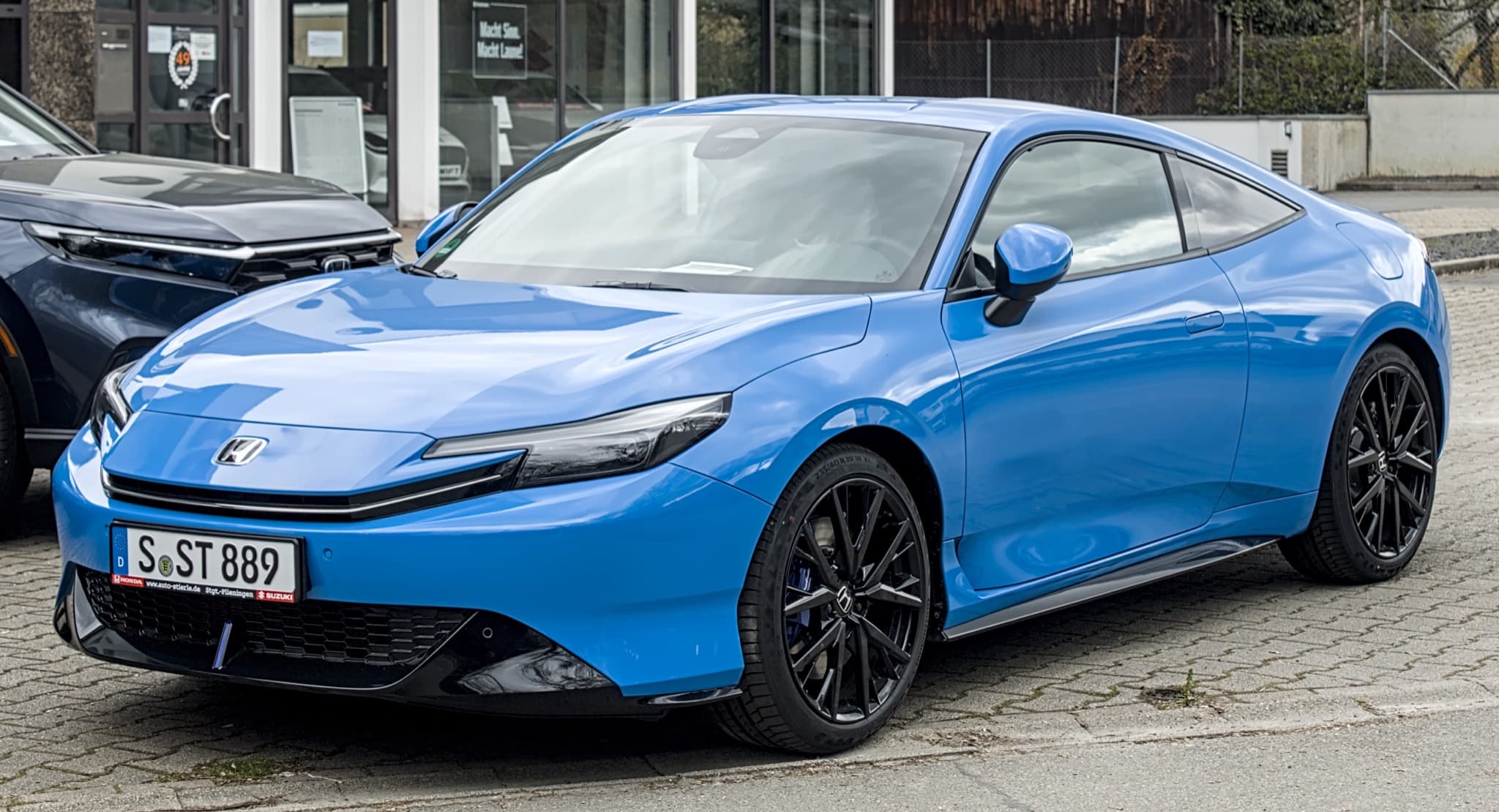
NEW2026 Honda Prelude Review
Honda's most famous coupe nameplate returns after 25 years as a 200-horsepower hybrid 2+2 wearing Civic Type R chassis hardware. The internet argues about whether it is a real sports car; the question that actually matters is whether it is worth $43,195 to you — and that depends on which of two very different buyers you are.
Published June 1, 2026 / Updated June 4, 2026
Expert verdict
The 2026 Honda Prelude is a grand tourer, not a sports car, and once you accept that, it is a genuinely good one: Civic Type R dual-axis front suspension, adaptive dampers, and Brembo brakes under a beautifully finished 2+2 liftback body, powered by the Civic Hybrid's 200-horsepower two-motor system that returned 44 mpg combined on the EPA cycle and 35 mpg in Car and Driver's real-world testing. Honda sells it in one well-equipped trim at $42,000 — $43,195 with the mandatory $1,195 destination charge — plus a $42,500 Two-Tone appearance version. Buy it if you want the best-handling 44-mpg car on sale and a coupe you can live with every day; skip it if you want a manual gearbox, straight-line speed, or a track car, because a Civic Si, Civic Type R, or Toyota GR86 serves that buyer better.
HIGHS
- Civic Type R chassis hardware is real: dual-axis front struts, adaptive dampers, Brembo brakes, wide tracks
- Tested grip and braking near Type R levels — 0.97-1.02 g and 104-152 ft stops across three outlets (on optional summer tires)
- EPA 44 mpg combined on regular fuel; Car and Driver observed 35 mpg in hard real-world use
- Exquisite build quality from the Type R's Japanese production line, with a premium two-tone cabin option
- Everything standard: adaptive dampers, leather, Bose, Google built-in, full Honda Sensing, 10 airbags
- 8-year/100,000-mile hybrid battery warranty and a powertrain already proven in three Honda hybrid lines
LOWS
- Worst power-per-dollar in its cross-shop set: 200 hp and 6.4-7.2-sec 0-60s at $43,195 delivered
- S+ Shift simulated gears slow the car by up to a second to 60 when engaged (C/D and MT both measured it)
- Manual seats with no lumbar in a $43,000 car; 9-inch touchscreen feels borrowed from cheaper Hondas
- Token rear seat (32.0 in. of legroom, non-leather) — a 2+2 in name only
- Headline handling requires the ~$1,200 dealer-installed summer tires; standard all-seasons undersell the chassis
- No NHTSA/IIHS crash ratings, no owner data, and no resale history yet for the first-year revival
AT A GLANCE
- Score
- 7.8
- Price
- $42K - $44.4K
- Horsepower
- 200 hp
- 0-60
- 6.5s
- Drivetrain
- FWD
- Body
- Coupe
Buyer Verdict
The fast answer before you compare specs.
Built for shoppers who want the recommendation first and the details right after.
Buy it if
- The 2026 Honda Prelude is worth its $43,195 delivered price for one specific buyer: the daily driver who wants a beautifully finished, genuinely sharp-handling 44-mpg coupe and does not care that a Civic Si is just as quick for about $10,000 less. Buy the $42,000 base Hybrid, budget roughly $1,200 for the summer tires if grip is the point, and skip the car entirely if you want a manual, real speed, or a track tool — that buyer belongs in a Civic Si, Civic Type R, or Toyota GR86.
- Best for: Design-driven daily drivers and empty-nest enthusiasts who want one beautifully finished, genuinely sharp-handling coupe that commutes at 44 mpg — and who would rather have Type R suspension and Brembo brakes than Type R horsepower or a manual gearbox.
- Our trim pick: Hybrid from $42,000.
Skip it if
- Worst power-per-dollar in its cross-shop set: 200 hp and 6.4-7.2-sec 0-60s at $43,195 delivered
- S+ Shift simulated gears slow the car by up to a second to 60 when engaged (C/D and MT both measured it)
- Manual seats with no lumbar in a $43,000 car; 9-inch touchscreen feels borrowed from cheaper Hondas
Closest rivals
- Honda Civic Type R
In-family performance upgrade
- Toyota GR Corolla
All-weather speed at the same money
- Ford Mustang
The traditionalist coupe
Quick take
If you have searched for a 2026 Honda Prelude review, you have already met the argument: YouTube reviewers and forum threads shouting about simulated gearshifts and a $43,195 price for 200 horsepower, while Car and Driver, Edmunds, MotorTrend, and Consumer Reports each tested the car and came away somewhere between charmed and conflicted. What almost none of those pages does is answer the actual buying questions: who this car is genuinely for, whether the price holds up against the alternatives, and what ownership looks like. This Research Desk review is built to do exactly that. The facts first, all Honda-official: the sixth-generation Prelude is a two-door, four-seat hybrid liftback that pairs the Civic Hybrid's 2.0-liter two-motor system (200 horsepower, 232 pound-feet) with the Civic Type R's dual-axis front suspension, adaptive dampers, dual-pinion steering, and Brembo front brakes. It is built in Japan on the same production line as the Type R, EPA-rated at 46/41/44 mpg, and sold in one well-equipped trim at $42,000 before the $1,195 destination charge.
This is a buyer-research review built from Honda's official 2026 Prelude press kit, pricing, and warranty terms, the EPA's published fuel-economy rating on fueleconomy.gov, an NHTSA recall check run on June 10, 2026, and the instrumented test results and driving impressions of Car and Driver, MotorTrend, Edmunds, and Consumer Reports — each number attributed to the outlet that measured it. It is not a MotorRank instrumented road test. We have not independently measured acceleration, braking, grip, or real-world fuel economy, and we do not publish reliability scores, repair costs, or resale percentages we cannot source. Where a figure is Honda-official we say so; where it is a third party's measured result we name them; where something is unknown — like long-term resale for a revived nameplate — we tell you it is unknown.
Driving impressions
Why the Prelude matters
The Prelude matters because nothing else like it exists. Affordable two-door coupes have nearly vanished — Honda itself sold three front-drive coupes in 2001 and zero from 2021 until this car arrived — and the Prelude is the only new vehicle you can buy that combines genuine performance-car chassis hardware with hybrid fuel economy in the mid-40s. It also matters as a signal: Honda's 1970s passenger-car lineup was Civic, Accord, and Prelude, and all three are now back together as hybrids, with the Prelude debuting the S+ Shift simulated-gear system that Honda has confirmed will spread to future hybrids. Search interest reflects the moment — the Prelude pulled roughly 368,000 U.S. searches in its January 2026 launch month and still draws about 201,000 a month — which is exactly why the SERP is crowded with hot takes and thin on actual buyer guidance.
What to watch before you buy
Watch three things before you sign. First, the value question is real: $43,195 delivered buys 200 horsepower and a 6.4-to-7.2-second 0-60 depending on whose test you read, when a 200-hp Civic Si with a manual costs about $10,000 less and a 315-hp Civic Type R costs only a few thousand more. You are paying for finish, chassis, and economy, not speed — be honest with yourself about whether that trade suits you. Second, the standard all-season tires undersell the chassis: both Car and Driver and MotorTrend credited their cars' optional $1,200 dealer-installed Continental summer tires for the excellent grip and braking numbers, so budget for them if handling is the reason you are buying. Third, the seats adjust manually — no power, no lumbar — in a $43,000 car, and the back seat is a parcel shelf with belts; treat the 2+2 as a hatchback with insurance seating, not family seating.
SERP audit: what the internet gets wrong about the Prelude
Before writing a word of advice, we audited the live Google results for the query buyers actually type — 2026 Honda Prelude review. The page is led by a YouTube video pack and Google's AI Overview, followed by TFLcar's video review, Car and Driver's instrumented test (the magazine's March/April 2026 cover-section piece titled Unreality Bites), a Civic forum repost, Edmunds' model hub, Consumer Reports' first drive, UK sites carwow and Top Gear, AutoGuide, Reddit threads, The Drive, MotorTrend's First Test, and a J.D. Power data page. It is a crowded, opinionated SERP — and almost all of it is first-impression content fighting about one question: is this a real sports car?
Here is the gap. Car and Driver's test is excellent on numbers but spends much of its length on a meditation about simulated reality; Edmunds' test is the most buyer-useful page in the top ten but buries its pricing logic mid-article; Consumer Reports is paywalled after the first impressions; MotorTrend ranks sixteenth. Nobody on page one walks a shopper through the actual decision set: the two-trim ladder and what the Two-Tone costs, the out-the-door math, the summer-tire option both test outlets quietly credited for their grip numbers, the warranty and ownership picture, or a straight cross-shop verdict against the Civic Si, Civic Type R, GR86, and GR Corolla. That is the review we wrote. Every Honda figure below was verified against hondanews.com and honda.com, every fuel-economy number against the EPA, and the recall status against NHTSA, all on June 10, 2026.
Bottom line up front: is the 2026 Prelude worth buying?
Yes — for the buyer it was actually built for, who is not the buyer the internet keeps auditioning it against. If you want a beautifully made, distinctive, comfortable two-door that handles like something far more expensive, returns 44 mpg, and asks nothing of you in daily use, the Prelude is arguably a class of one and worth its money. If you want maximum speed or engagement per dollar — a manual gearbox, a clutch, big power — it is the wrong car at this price, and no amount of S+ Shift theater changes that. Edmunds called it a misunderstood but charming grand tourer; Consumer Reports' test staff, less charmed, said it is fine as a shorter-wheelbase Civic Hybrid coupe but should be priced like one. Both are right; they are just describing different buyers.
Our research-basis score is 7.8 out of 10. That reflects real strengths — a chassis every tester praised, Type R hardware that is not marketing fluff, exceptional efficiency for anything this shape, complete standard equipment, and Honda's hybrid track record — set against honest weaknesses: a price-to-power ratio that is the worst in its cross-shop set, manual seats in a $43,000 car, a token rear seat, simulated shifts that slow the car when engaged, and zero published crash-test ratings or resale history for a first-year revival. The smart buy is the $42,000 base car with the summer tires added if you care about grip; the Two-Tone is a $500 style call and nothing more.
What the Prelude actually is: Civic Hybrid heart, Civic Type R bones
Strip away the nameplate nostalgia and the Prelude is a precise parts recipe, and an honest review should tell you exactly which parts. The powertrain is the fourth-generation Honda two-motor hybrid from the Civic, Accord, and CR-V hybrids: a 2.0-liter Atkinson-cycle direct-injection four making 141 horsepower, paired with a 181-horsepower traction motor and a 143-horsepower generator motor, fed by a small 72-cell lithium-ion battery. Combined output is 200 horsepower and 232 pound-feet, all Honda-official. There is no conventional transmission — the traction motor drives the front wheels through a fixed ratio, and a lock-up clutch sends engine torque directly to the wheels at cruising speeds. Most of the time it behaves as a series hybrid: the engine makes electricity, the motor moves the car.
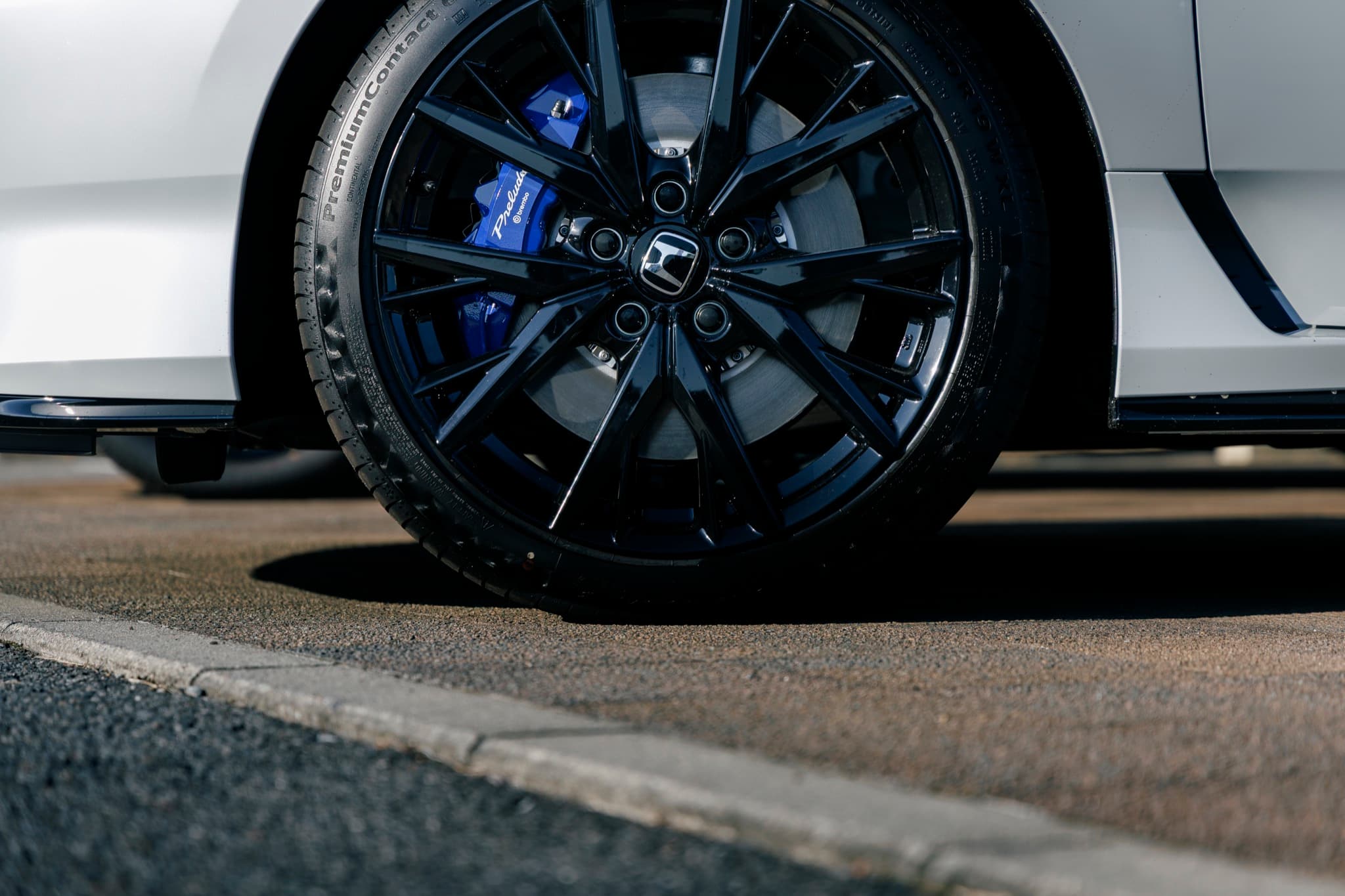
The chassis is where the money went. Honda fitted the Civic Type R's dual-axis strut front suspension — aluminum knuckles, strut forks, and lower arms that nearly eliminate torque steer — plus the Type R's wide front and rear tracks (64.0 and 63.5 inches), its multi-link rear suspension, its dual-pinion variable-ratio steering rack with a quick 2.1 turns lock-to-lock, its Adaptive Damper System retuned for the Prelude, and its actual brakes: 13.8-inch two-piece front rotors with blue Brembo four-piston monobloc calipers and 12.0-inch rears. The body is a 178.4-inch-long, 74.0-inch-wide liftback on a 102.6-inch wheelbase — per MotorTrend, 5.1 inches shorter in wheelbase than a Type R — and it is built at Honda's Yorii plant in Japan on the same line as the Type R itself. None of this is implied capability; it is the same hardware, and every outlet that tested the car confirmed it shows up in how the Prelude corners and stops.
Official pricing: one trim, two flavors, and the destination math
Honda's pricing could not be simpler, which makes the widespread confusion about it inexcusable. There is one mechanical specification. The Prelude Hybrid carries a $42,000 MSRP, and Honda's mandatory $1,195 destination charge brings every car to $43,195 before tax, title, registration, and any dealer additions — that is the number Honda itself publishes as the delivered price. A second version on honda.com, the Hybrid Two-Tone at $42,500, is purely an appearance package: Winter Frost Pearl paint with a black roof and black mirror caps and the two-tone blue-and-white leather interior. Consumer Reports bought one for its test fleet and confirmed everything else is identical.
Two pricing footnotes matter. Premium paint costs extra on top of MSRP — Boost Blue Pearl runs $455 and Winter Frost Pearl $655, per Honda's configurator and the as-tested sheets at Car and Driver and Consumer Reports — so a Two-Tone in its signature color is really a $43,155 car before destination. And the option that actually changes the car is not paint: the high-performance summer tires are a dealer-installed accessory that Car and Driver's test car carried at $1,200. A realistic, fully loaded Prelude — Two-Tone, premium paint, summer tires — lands around $44,350 to $45,000 delivered, which is the honest top of the price range we publish, and still under every as-tested Civic Type R.
The price outrage, fact-checked against 1997
The loudest take in the Prelude discourse is that $43,195 is an insult for 200 horsepower. The historical math says otherwise, and two outlets ran it independently. Car and Driver priced its long-term 1997 Prelude SH at $26,095 — which equates to about $52,785 in today's dollars, nearly $10,000 more than the new car delivered. Edmunds ran the same exercise against the 2001 model year and found a base 2001 Prelude adjusts to almost exactly the new car's price, while the 2001 Type SH adjusts to roughly $47,000 — about what a Civic Type R costs now. The Prelude was never a cheap Civic; it was always the expensive, beautifully built Honda coupe, and the 2026 car sits precisely in its historical slot.
The performance comparison to its ancestor lands the same way. Car and Driver's 1997 Prelude SH — 195 horsepower, five-speed manual — hit 60 mph in 6.9 seconds and ran the quarter-mile in 15.4 seconds at 90 mph. The 2026 hybrid beat both numbers in the magazine's testing (6.5 seconds, 15.3 at 90) while nearly doubling the old car's fuel economy. The legitimate gripe is not the price against history; it is the price against the present, where Honda's own $33,000 Civic Si matches the Prelude's 200 horsepower with a manual gearbox. We unpack that trade in the cross-shop section, because it is a real decision — but make it with the math, not the outrage.
Tested: what Car and Driver, MotorTrend, and Edmunds each measured
Three outlets have published full instrumented tests, and the spread between them is itself useful information. Car and Driver (March/April 2026 issue) recorded 0-60 in 6.5 seconds, the quarter-mile in 15.3 seconds at 90 mph, 70-to-zero braking in an excellent 152 feet, and 0.97 g of skidpad grip from a 3,242-pound car wearing the optional Continental ExtremeContact Sport 02 summer tires. MotorTrend's First Test (May 2026) essentially matched it: 6.4 seconds to 60, 15.2 at 90.7 in the quarter, a striking 104-foot 60-to-zero stop, 0.97 g of lateral grip, and a 25.2-second figure-eight, also on dealer-installed summer rubber. Edmunds, testing in January 2026, measured 7.2 seconds to 60, 15.5 at 88.6, a 113-foot 60-to-zero stop, and 1.02 g on its skidpad at 3,249 pounds.
Read those together and the car comes into focus. Straight-line pace is Civic Si territory — Edmunds measured its last Si at an identical 7.2 seconds, and MotorTrend notes the Prelude is a tick slower than the mechanically related Civic Hybrid — while the grip and braking numbers embarrass cars at twice the price. For calibration, Edmunds' own Civic Type R numbers are 5.5 seconds, 1.05 g, and 109 feet; the Prelude gives up the acceleration but nearly matches the grip and stops shorter than an Si. Every outlet also agreed on the launch technique quirk: the quickest runs come in Sport mode with S+ Shift switched off and the battery charged. Honda's claimed top speed is 116 mph, as reported in Car and Driver's spec panel. MotorRank has not yet instrumented this car; the numbers above belong to the outlets that measured them, and the consistency across three independent tests gives us high confidence in the picture they paint.
S+ Shift, explained honestly: theater that costs you 0-60 time
S+ Shift is the Prelude's headline novelty and its most polarizing feature, so here is precisely what it is, per Honda's own press kit. The hybrid has no gears to shift; S+ Shift simulates a performance 8-speed by coordinating engine rpm and the traction motor — virtual rev-matched downshifts, gear holding, shift shock, and amplified engine sound through the cabin speakers — controlled by a console button and alloy paddles, with a 6,000-rpm virtual tachometer in the 10.2-inch cluster. Sub-systems manage the act: Early Downshift Control blips on braking into corners, Cornering Hold Control keeps virtual revs up mid-corner, and Step Shift Control reproduces the stepped feel of a real transmission in both acceleration and deceleration.
The testers split on whether the act works, and the data is unkind: engaging S+ slowed Car and Driver's 0-60 run from 6.5 to 7.3 seconds, and MotorTrend likewise measured at least a second lost to 60. MotorTrend called the effect not fully convincing; Car and Driver framed the entire car around the idea of accepting a pleasant simulation; Edmunds, more charitably, found that keeping the engine spinning via S+ improves mid-corner throttle response on a track even if it dulls straight-line pace. Our read for buyers: treat S+ Shift as a mood feature, not a performance feature. It is genuinely well executed as theater, it makes back-road driving more engaging, and you will turn it off the moment you want maximum acceleration. If a simulated gearbox offends you on principle, this is not your car — and Honda has confirmed S+ Shift is coming to future hybrids, so this argument is only beginning.
Fuel economy: the number that changes the whole argument
The EPA rates the 2026 Prelude at 46 mpg city, 41 highway, and 44 combined on regular fuel — we verified the listing directly on fueleconomy.gov — and unlike many hybrids, it appears to deliver in the real world: Car and Driver observed 35 mpg overall during its test, which included track work, against the 22 to 26 mpg it typically sees from sport compacts. MotorTrend lists the EPA-cycle range at 466 miles per tank. Those are remarkable numbers for anything with this car's grip, and they are the single clearest justification for the hybrid layout.
Context makes the case sharper. Per Edmunds' comparison, the Civic Type R rates 24 mpg combined, the Toyota GR86 automatic 24, and the Mazda MX-5 29; the Civic Si manages 31. At 12,000 miles a year, a 44-mpg Prelude burns roughly half the fuel of a Type R or GR86 — a real, compounding ownership saving that none of the angrier reviews bother to price in. If your driving is mostly commuting with weekend back-road sessions, the Prelude is the only car in this conversation that does not punish the commute. If you barely drive, the economy argument shrinks, and the cheaper, more visceral rivals get stronger — which is exactly how we would have you frame the decision.
The chassis, and the $1,200 tire decision that changes the car
Every published test of the Prelude reaches the same dynamic verdict from different angles: the chassis is the best thing about the car. Edmunds called the steering feedback among the best in any car at this price and the balance tight and neutral with very little understeer; Car and Driver praised the outstanding initial bite into corners and flat-out great steering feel; MotorTrend found turn-in immediate and body roll well controlled, with the caveat that traction control intervenes early and can only be reduced, never fully disabled. The hardware explains the consensus — dual-axis front struts, a 26.5-millimeter front stabilizer bar, adaptive dampers reading wheel stroke and body acceleration in real time, and the enhanced Agile Handling Assist system making its first Honda appearance. The four drive modes (Comfort, GT, Sport, Individual) meaningfully change damping, steering weight, and sound; Edmunds settled on the default GT mode as the daily sweet spot, and we would too based on the collective descriptions.
Now the caveat that belongs in every Prelude review and appears in almost none: the standard tire is a 235/40R19 all-season, and the headline grip numbers above were all set on the optional high-performance summer tire, a dealer-installed accessory that cost $1,200 on Car and Driver's car. Both Car and Driver and MotorTrend explicitly credited the summer rubber for the 0.97-g grip and the short stops; MotorTrend went as far as calling it a meaningful upgrade that likely played a major role in its braking and handling results. The buyer translation is simple. If the chassis is why you are buying this car, the summer tires are not an accessory, they are the second half of the purchase — budget for them. If you live with winters or just want the look and the economy, the all-seasons are fine and quieter; MotorTrend attributed part of its car's road noise to the performance tires.
Grand tourer or sports car? The identity question, answered
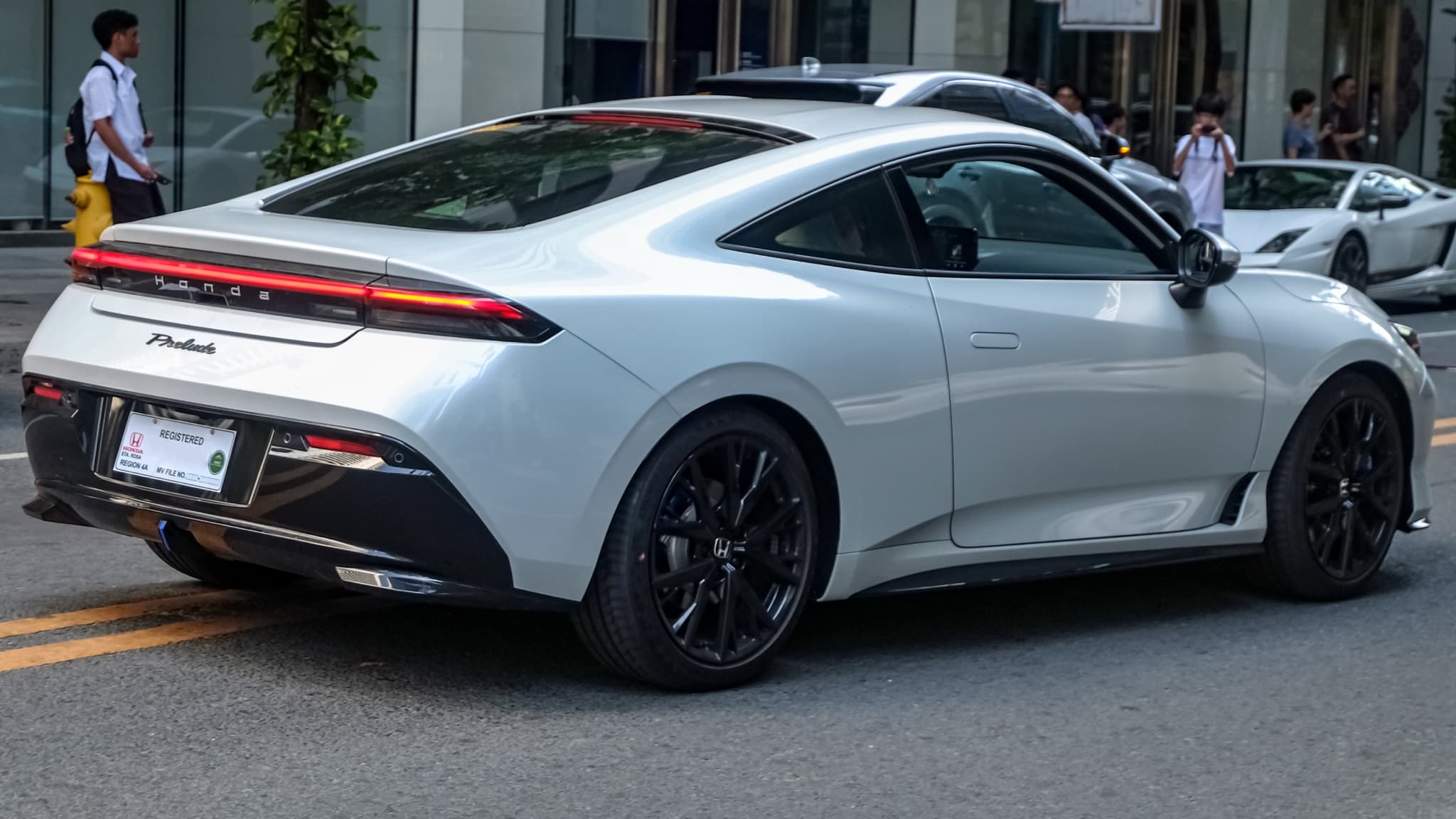
The entire Prelude debate collapses into one definitional argument, so let us settle it. A sports car prioritizes engagement and pace; a grand tourer prioritizes covering distance quickly, comfortably, and with style. By the numbers and by every tester's account, the Prelude is the second thing. Edmunds said it outright — this is more of a front-wheel-drive grand tourer than a front-wheel-drive sports car, and that's OK. Honda itself markets the car on a grand touring experience and tuned it accordingly: supple adaptive damping, a quiet hybrid drivetrain that runs electric around town, seats engineered for long-haul support, and styling that drew comparisons to everything from the Acura RSX to the Porsche 911's rear deck. Car and Driver's verdict line captured the lineage: Prelude name, Prelude character, Civic Hybrid DNA.
History is on the car's side here, and it is the part the angriest takes miss. Honda never built a fire-breathing Prelude — Car and Driver made exactly this point — and every generation was the sophisticated, innovative Honda coupe rather than the fast one. The 2026 car introducing S+ Shift is the same move the 1987 car made introducing four-wheel steering and the 1997 car made with its torque-vectoring ATTS system: technology as the selling point, handling as the substance. MotorTrend's framing is the one cross-shoppers should sit with: it is not raw enough to replace a Civic Si for manual loyalists and not fast enough to be a cheap Type R — it is built for someone who wants the idea of a sporty coupe more than the compromises of a real sports car. If reading that sentence stings, buy the Si or the GR86. If it sounds like your actual life, the Prelude is the better car for it.
Interior and daily livability: premium up front, token in back
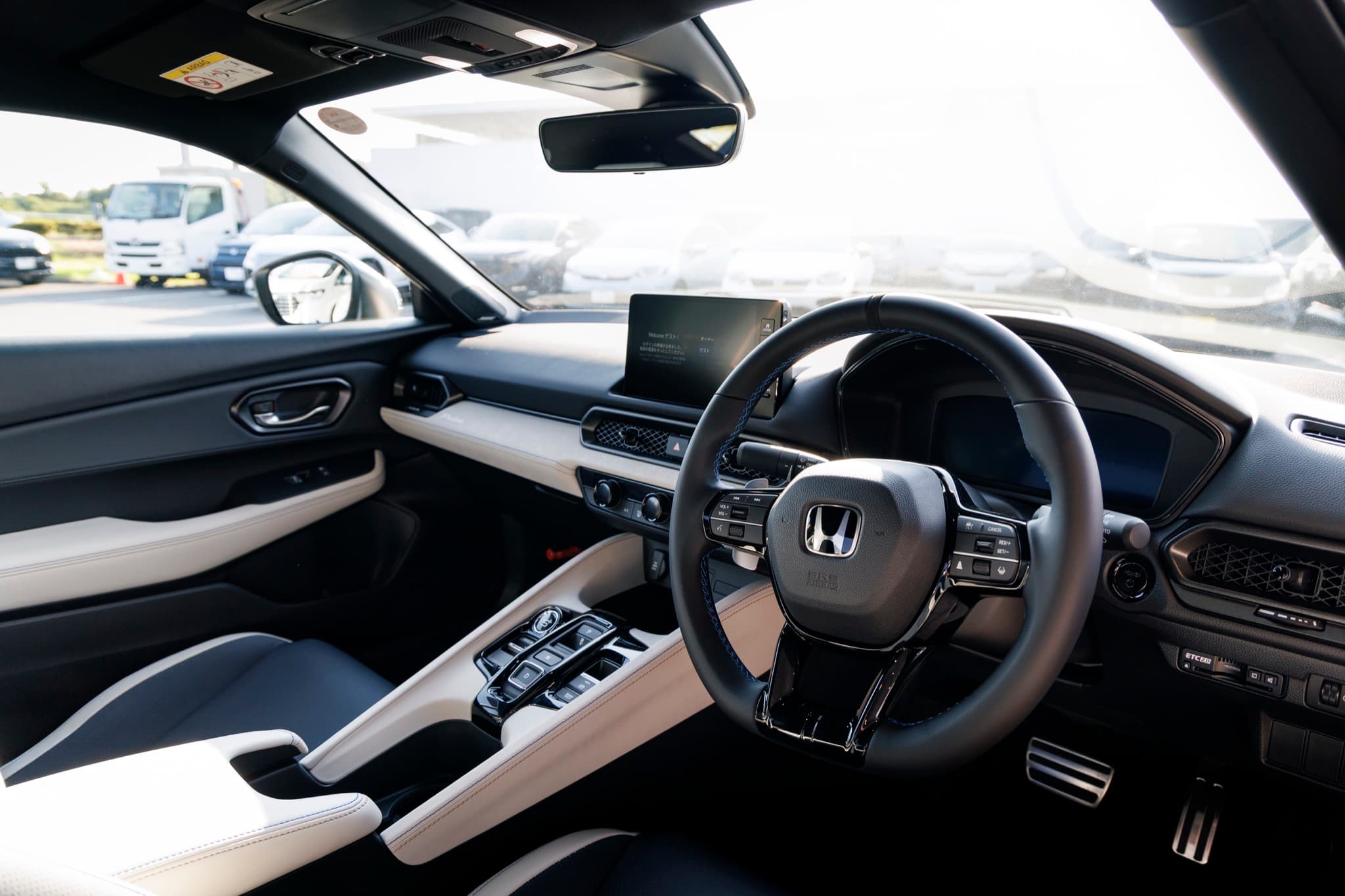
The front half of the cabin is the Prelude's second-best argument after the chassis. The leather sport seats wear a perforated houndstooth pattern lifted from 1980s Hondas, with integrated head restraints, three-stage heating, and asymmetrical bolstering — firmer and more aggressive on the driver's side, softer for the passenger. Edmunds compared the two-tone blue-and-white cabin to Acura's better interiors; Car and Driver called the whole car exquisitely finished. Visibility is a genuine, measurable advantage in this segment: a low cowl, thin A-pillars, and door-mounted mirrors give the Prelude sightlines that no rival coupe matches. The flat-bottom wheel, alloy paddles, and 10.2-inch cluster complete a cockpit that is driver-focused without being gimmicky.
The honest list of compromises: the seats adjust manually with no lumbar support — Car and Driver flagged manual seats at a power-seat price as a headline Low — the 9-inch touchscreen is shared with cars costing half as much, MotorTrend found hollow-sounding doors and a flimsy-feeling hatch in places, and the rear seats are upholstered in non-leather and offer 32.0 inches of legroom under a sharply tapering roof. Honda's official line is 2+2 seating; every tester's translation is kids, briefly, or cargo. The liftback redeems much of it: 15.1 cubic feet behind the seats by Honda's measure — more than a Civic sedan's trunk — a wide hatch opening, and 60/40 folding seatbacks that swallow golf bags or a weekend's luggage. As a two-person car with occasional extras, the packaging works; as anyone's only family car, it does not pretend to.
Technology and safety: well equipped, still unrated
Everything is standard, which simplifies the spec-sheet reading to one paragraph. The 9-inch touchscreen runs Google built-in — Google Maps, Assistant, and the Play Store with a three-year unlimited data plan — alongside wireless Apple CarPlay and Android Auto, a wireless charging pad, two USB-C ports, and an 8-speaker Bose system jointly tuned for this cabin, with door-mounted Super65 drivers and a 7.9-inch subwoofer in the cargo area. HondaLink adds remote start, lock, locate, and stolen-vehicle tracking by subscription. The safety hardware count is unusually deep for a coupe: ten airbags including front knee and rear side bags, Honda's newest ACE body structure, and the full Honda Sensing camera-plus-sonar suite — collision mitigation braking with pedestrian detection, adaptive cruise with low-speed follow, lane keeping, Traffic Jam Assist, traffic-sign recognition, blind-spot monitoring with rear cross-traffic alert, and a Post-Collision Braking system, all standard.
What does not exist yet is independent verification. As of June 10, 2026, NHTSA lists no crash-test ratings, no investigations, and zero recalls for the 2026 Prelude — we queried the agency's database directly rather than assuming — and we found no published IIHS rating for the car. That is normal for a low-volume first-year model, but it means our 8.0 safety score reflects equipment and Honda's structural track record, not measured crashworthiness, and we will update this section when the agencies publish. One equipment note for completeness: there is no power seat, no head-up display, and no 360-degree camera at any price — Honda chose to spend the money on suspension hardware instead, which is either the whole point of the car or evidence against it, depending on the buyer.
Ownership, warranty, and resale: the honest math
Honda's published coverage on the Prelude is the company's standard ladder: a 3-year/36,000-mile new-vehicle limited warranty, a 5-year/60,000-mile powertrain warranty, 5-year corrosion coverage, 3 years of roadside assistance, and — the line that matters most on this car — an 8-year/100,000-mile warranty on the hybrid high-voltage battery. Honda Service Pass adds two years of complimentary scheduled maintenance. Those hybrid terms, plus a powertrain that is not new at all — the same fourth-generation two-motor system has been propelling Civic, Accord, and CR-V hybrids in volume, and the Civic Hybrid was the 2025 North American Car of the Year — are why our reliability outlook is positive despite this being a first-year nameplate. The unknowns are the Prelude-specific parts: the adaptive dampers, the model-exclusive electronics, and the S+ Shift calibration have no field history yet, and Consumer Reports is currently running its purchased Two-Tone through its full road-test and reliability-survey machinery, which will produce the first independent owner data.
Running costs look unusually friendly for something this entertaining: regular fuel, 44 mpg, conventional Honda service intervals, and none of the premium-fuel, track-pad, or staggered-tire taxes the Type R and German coupes levy. The genuine open question is resale. We will not invent a residual percentage — no verified data exists for a nameplate that returned six months ago — but the structural signals cut both ways and you should know them: scarcity (Honda told Edmunds it plans only about 4,000 cars a year) and Honda's brand strength argue for strong values; the precedent of niche two-doors and the polarizing price argue for caution. If resale risk matters to you, the safest play is the base car in a conventional color, kept on the standard wheels — and if you are cross-shopping a used example in a year, this paragraph is why we expect clean ones to be scarce rather than cheap.
Cross-shop: Civic Si, Civic Type R, GR86, GR Corolla, and Mustang
Against Honda's own showroom first, because that is where most Prelude shoppers start. The Civic Si is the value argument: identical 200 horsepower, a genuine six-speed manual, four doors, and roughly $10,000 saved — Edmunds measured both cars at 7.2 seconds to 60 on its track. Buy the Si if engagement per dollar is the mission; buy the Prelude if you want the dramatic body, the hybrid economy, the adaptive dampers, and the nicer cabin. The Civic Type R is the performance argument: 315 horsepower, 5.5 seconds to 60, the sharper track tool, around $47,000 as tested — and, telling for this comparison, both cars roll off the same Japanese production line. Buy the Type R if you will ever see a track day; it is faster everywhere and barely costs more. Buy the Prelude if the Type R's boy-racer wing, firmer ride, and 24-mpg thirst are exactly what you are trying to avoid. Car and Driver's closing wish — that Honda build a Prelude with the Type R drivetrain — tells you the chassis could handle it.
Outside the family: the Toyota GR86 (with the Subaru BRZ twin) is the purist's answer at $32,000 to $37,000 — rear-drive, available manual, the better drift-day and autocross car, and the obvious pick for the driver the Prelude's hybrid leaves cold; it gives back a 24-mpg habit, a louder and cheaper cabin, and less everyday refinement. The Toyota GR Corolla is the maximalist's answer at similar money to the Prelude — 300 turbocharged horsepower, all-wheel drive, and rally-bred aggression in a practical hatch body — the better car for speed in all weather, the worse one for calm, polish, and fuel bills. And the Ford Mustang is the traditionalist's answer: rear-drive, available V8 thunder, real back seats, EcoBoost models in the Prelude's price band — the emotional opposite of a 44-mpg hybrid coupe and the right choice if character means cubic inches. Our one-line router: Si for value, Type R or GR Corolla for speed, GR86 for purity, Mustang for muscle, Prelude for the buyer who wants one beautiful coupe that does the daily commute at 44 mpg and the Sunday road like it costs more than it does.
How to buy one: deal reality at 4,000 cars a year
Supply frames every Prelude negotiation: Honda told Edmunds it expects to sell only about 4,000 a year in the U.S. — deliberate scarcity against the roughly 200,000 Civics Honda moves annually. Low volume cuts both ways. Early demand for the hottest comeback nameplate in years invites dealer markups and accessory-stuffed window stickers, especially on Boost Blue and Two-Tone cars; at the same time, Edmunds' market data in early 2026 showed transaction prices slightly under sticker in at least some regions — its suggested-price tool sampled about $42,588 for a base car and $43,683 for a Two-Tone against delivered MSRPs of $43,195 and $43,695. Translation: this is not a guaranteed-markup car, and a patient buyer should not pay over sticker.
Practical playbook: get the itemized out-the-door number in writing — $43,195 delivered, plus tax, title, registration, your state's doc fee, and any accessories — and make the dealer separate the accessories so you can decline the ones you did not order. Decide on the $1,200 summer-tire question before you negotiate, not after, and note that genuine Honda accessories (the black spoiler, the machine-finished 19s, underbody spoilers) are dealer-installed profit centers that do nothing for the drive. There are no factory incentives typical of a launch-year halo car, so the win conditions are simple: MSRP or below, no junk fees, and the exact color you want even if it means ordering and waiting — at 4,000 cars a year, settling for the wrong spec is the only truly bad deal.
Who should wait
Three buyers should keep their money for now. The first wants crash-test ratings and owner data before spending $43,000: NHTSA and IIHS have published nothing on this car yet, Consumer Reports' full road test and first reliability survey are months away, and a first-model-year wait-and-see is the textbook cautious play even on a proven powertrain. The second is the enthusiast hoping the rumor mill is right about more power: Car and Driver publicly campaigned for a Type R-powered Prelude, and if Honda ever builds a hotter version, the 200-horsepower car's value story changes overnight. We do not report rumors as plans — Honda has announced nothing — but if your regret risk runs that direction, wait a model year and watch.
The third is anyone reading this in winter in a one-car household: the Prelude on summer tires is a three-season proposition, the all-season setup blunts the exact handling you are paying for, and a coupe with a 15.1-cubic-foot hold and vestigial rear seats is a poor only-car for a family. None of these is a knock on the car Honda built; all three are reasons the right time to buy it might be next spring, with ratings published, the first owner reports in, and a clearer picture of whether dealers are discounting. The Prelude rewards patience — scarcity means it will still be special when you get there.
Final verdict: who should actually buy the 2026 Prelude
The 2026 Honda Prelude is the rare new car that is exactly what its maker says it is and exactly what its loudest critics say it is, at the same time. Honda calls it a grand touring sports coupe, and it delivers: genuine Civic Type R chassis hardware that three independent instrumented tests confirmed produces near-Type R grip and braking, wrapped in the best-finished compact Honda in years, returning 44 mpg on regular fuel. The critics call it a $43,195 car with Civic Si acceleration, manual seats, and pretend gearshifts, and that is all true too. The purchase decision is simply which sentence describes your priorities.
Our buying advice in one breath: buy the $42,000 Hybrid — the Two-Tone is a $500 style call — add the roughly $1,200 summer tires if back roads are the point, pay sticker or less, and enjoy the only car on sale that pairs this chassis with this fuel bill. Choose a Civic Si instead if you want the manual and the savings, a Civic Type R or GR Corolla if you want real speed, a GR86 if you want rear-drive purity, and a Mustang if you want eight cylinders of personality. This is a research-basis review built from Honda's official specifications and pricing, EPA data, an NHTSA recall check, and the attributed test results of Car and Driver, MotorTrend, Edmunds, and Consumer Reports; we will update it with MotorRank instrumented testing, crash ratings as agencies publish them, and real-world ownership data as it accumulates.
Specs Snapshot
The numbers shoppers compare first.
Key numbers to compare against alternatives before you commit.
| Base price | $42K - $44.4K |
|---|---|
| Horsepower | 200 hp |
| 0-60 mph | 6.5 sec |
| Top speed | 116 mph |
| Drivetrain | FWD |
| Transmission | Automatic |
| Fuel type | Hybrid |
| Combined MPG/MPGe | 44 |
Media Proof
Exterior and interior visuals with source receipts.
Every asset shown here links back to its source and license so the page can gain trust without borrowing competitor media.
Source Receipts
Source pages, creator credits, and reuse licenses are visible for editorial trust and legal hygiene.
Related Video
2026 Prelude Interior Walkaround
Honda
Embedded from Honda's official YouTube channel as manufacturer reference media for the 2026 Prelude cabin, not an independent MotorRank road test.
Interior
Cabin views before you choose a trim.
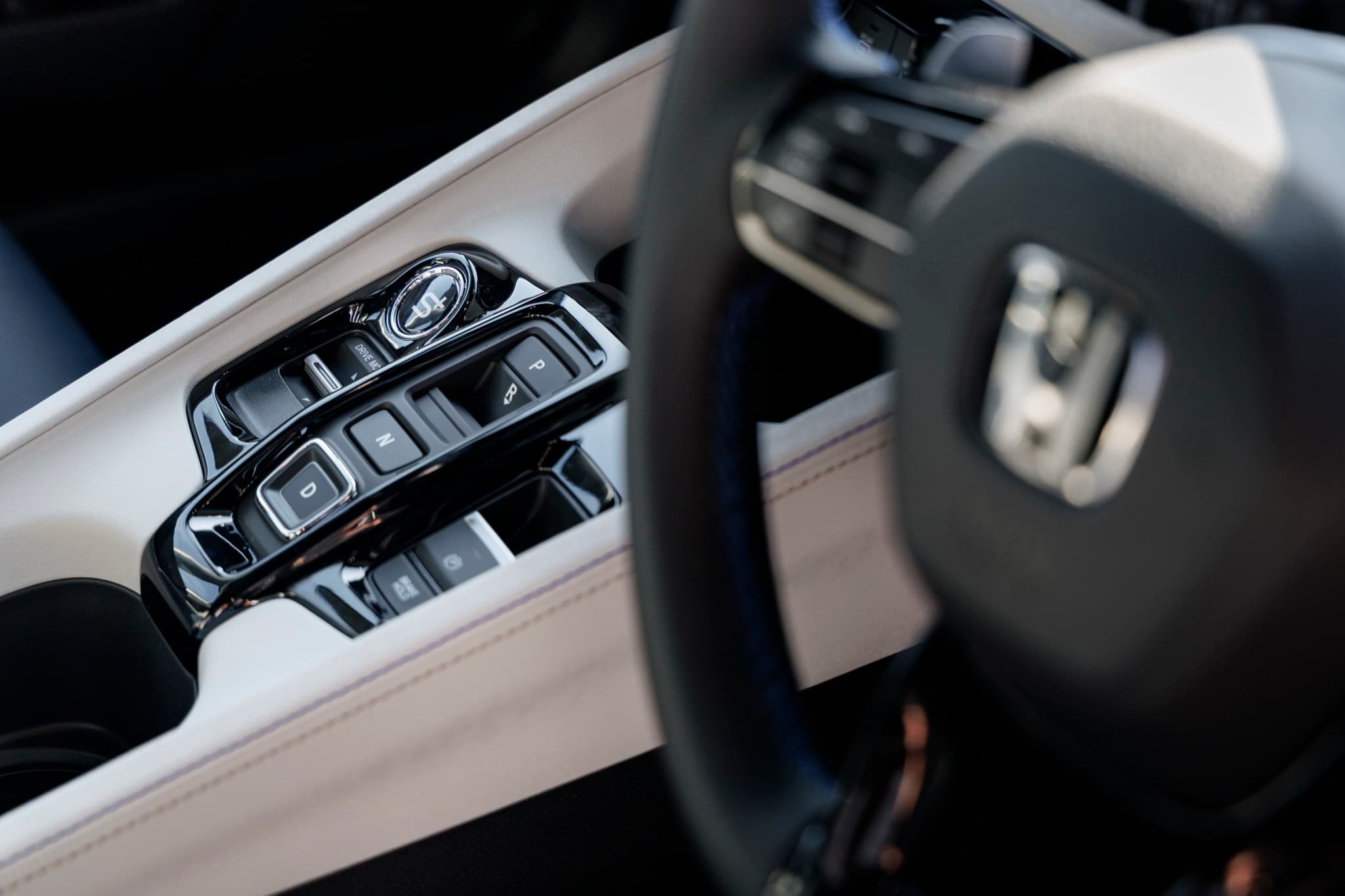
The front cabin is the Prelude's second-best argument after its chassis: leather sport seats in a heritage houndstooth pattern with asymmetrical bolstering, a flat-bottom wheel with alloy paddles, a 10.2-inch digital cluster, and a low-cowl, thin-pillar view out that no rival coupe matches. The honest catches: seat adjustment is manual with no lumbar, the 9-inch screen is shared with far cheaper Hondas, and the non-leather rear seat is for children or cargo.
Interior Source Receipts
Research basis
Updated June 10, 2026
Built from Honda's official 2026 Prelude press kit, pricing release, and published warranty terms on hondanews.com and honda.com, the EPA rating verified on fueleconomy.gov, an NHTSA recall and ratings check run June 10, 2026, and the instrumented tests and driving impressions of Car and Driver, MotorTrend, Edmunds, and Consumer Reports, each attributed.
MSRP figures are Honda's published base prices and exclude the $1,195 destination charge unless stated otherwise. Acceleration, braking, skidpad, and observed-MPG figures belong to the outlet that measured them — note that the three published tests used optional dealer-installed summer tires. MotorRank has not yet instrumented the 2026 Prelude; ride and handling characterizations are attributed preview basis.
Update when NHTSA or IIHS publish crash-test ratings, when Consumer Reports completes its purchased-car road test, after MotorRank's own instrumented test, and if Honda announces pricing or trim changes for 2027.
Which 2026 HONDA PRELUDE to Buy
Which trim is right for you?
Hybrid
$42,000
The whole car in one trim: 200-hp two-motor hybrid, Civic Type R suspension and Brembo brakes, adaptive dampers, leather, Bose, and Honda Sensing — everything is standard.
Our pick
Hybrid Two-Tone
$42,500
A pure appearance package: Winter Frost Pearl paint with a black roof and black mirror caps plus the blue-and-white interior. Mechanically identical to the base car.
Performance
- Horsepower
- 200hp
- 0–60 mph
- 6.5s
- Top Speed
- 116mph
Scorecard
- Performance7.2
- Comfort8.1
- Value6.8
- Ownership8.5
- Technology7.7
- Safety8
- Reliability8.2
- Interior7.9
Shopping Tools
Next steps for 2026 Honda Prelude shoppers.
Research tools to help you move from browsing to buying.
Compare rivals
Line up the closest alternatives before you commit.
Check deal signals
Review pricing pressure, incentives, and value angles.
Read owner signal
Balance the expert take with ownership patterns.
In-family upgrade
The Prelude borrows its suspension, steering, and brakes from the Civic Type R — which costs only a few thousand dollars more and adds 115 horsepower and a manual. Read both before deciding which Honda coupe philosophy is yours.
Open vehicle hub
Keep specs, reliability, rankings, and review links together.
Compare Against
Cross-shop before you commit.
The closest alternatives in this price range, with our read on each.
In-family performance upgrade
Honda Civic Type R
Faster everywhere — 315 hp, a manual, 5.5 to 60 — for only a few thousand more, and it shares the Prelude's production line. The Prelude answers with comfort, subtlety, and 44 mpg against the Type R's 24.
All-weather speed at the same money
Toyota GR Corolla
300 turbo horsepower and AWD make the GR Corolla the serious-speed pick at Prelude money. The Prelude is the calmer, far more efficient, better-finished daily that gives up the drag race.
The traditionalist coupe
Ford Mustang
The Mustang offers rear drive, available V8 character, and usable back seats, with EcoBoost trims at Prelude prices. The Prelude counters with precision, premium finish, and roughly double the fuel economy.
Rear-drive purist alternative
Toyota GR86
Cheaper, lighter, rear-driven, and available with a manual, the GR86 is the better pure toy. The Prelude is the better only-car: nicer cabin, real cargo space, and 44 mpg versus 24.
Buyer FAQ
2026 Honda Prelude buyer questions, answered.
28
buyer answers
Question Map
Decision
Should you buy the 2026 Honda Prelude?
The comeback nameplate is real and the chassis is real — the decision is whether a 44-mpg grand tourer is what you actually want.
Is the 2026 Honda Prelude any good?
Yes — every tester praised the chassis and finish. The argument is about price and pace, not quality.+
All four major outlets that tested it agree the Prelude handles brilliantly and is beautifully built. Edmunds called it a misunderstood but charming grand tourer with steering feedback among the best at any price; Car and Driver measured near-Type R grip and praised the lustrous finish; MotorTrend confirmed solid handling and strong brakes. The criticisms are equally consistent: it is no quicker than a Civic Si, the S+ Shift simulation divides opinion, and Consumer Reports thinks it should cost less. Our research-basis score is 7.8 out of 10 — a good car whose value depends entirely on what you prioritize.
Who is the 2026 Prelude actually for?
Daily drivers who want one gorgeous, sharp-handling coupe at 44 mpg — not manual loyalists or track-day shoppers.+
Honda built a grand tourer: supple adaptive damping, a quiet hybrid drivetrain, long-haul seats, and styling that drew Acura and 911 comparisons from testers. The right buyer commutes daily, loves back roads on weekends, wants premium finish without a luxury badge, and values a 44-mpg fuel bill. MotorTrend's framing is the honest one — it suits someone who wants the idea of a sporty coupe more than the compromises of a real sports car. If you need a clutch pedal, lap times, or usable rear seats, you are a different buyer, and the cross-shop section names your car.
Who should skip the Prelude?
Manual-gearbox loyalists, track-day drivers, families, and anyone optimizing speed per dollar.+
Skip it if a manual transmission is non-negotiable — there is none and no traditional automatic either, just direct drive with simulated shifts. Skip it if you want pace for the money: a $33,000 Civic Si matches its acceleration, and a Civic Type R demolishes it for a few thousand more than the Prelude. Skip it if you track your car — traction control cannot be fully disabled, per MotorTrend — and skip it as an only family car, because the rear seat is token and cargo space, while good for a coupe, is still 15.1 cubic feet. None of these buyers is wrong; they are just not who Honda built this for.
Is it a real Prelude, or just a Civic in a costume?
Historically faithful: every Prelude was the sophisticated, innovative Honda coupe, never the fast one.+
The honest answer is both. Mechanically it is Civic Hybrid power with Civic Type R suspension, steering, and brakes, built on the Type R's production line in Japan. But that parts-bin approach is the Prelude tradition: past generations introduced four-wheel steering and torque-vectoring ATTS while sharing Honda bones, and Car and Driver notes Honda never made a fire-breathing Prelude — they all simply handled great. The 2026 car debuting S+ Shift and dual-axis suspension on a hybrid is the same formula. The 1997 Prelude SH cost the equivalent of $52,785 today and was slower than this car in C/D testing.
Performance
How fast is it really — and what is S+ Shift?
Three independent instrumented tests, one consistent picture: Civic Si pace, near-Type R grip, and a simulated gearbox that costs you time.
How fast is the 2026 Honda Prelude 0-60?
6.4-7.2 seconds depending on the test: MotorTrend 6.4, Car and Driver 6.5, Edmunds 7.2.+
Three outlets published instrumented numbers. MotorTrend ran 0-60 in 6.4 seconds and the quarter-mile in 15.2 at 90.7 mph; Car and Driver clocked 6.5 and 15.3 at 90; Edmunds measured 7.2 and 15.5 at 88.6. The launch technique explains some spread — the quickest runs need a charged battery and Sport mode with S+ Shift off. For context, that is dead-on Civic Si pace, a tick behind the Civic Hybrid per MotorTrend, and well clear of the 1997 Prelude SH's 6.9-second best. Honda's claimed top speed is 116 mph. These are the testers' numbers, not ours.
What is S+ Shift, and does it make the car slower?
A simulated 8-speed with fake rev-matched shifts — and yes, about a second slower to 60 when engaged.+
The hybrid has no gears, so S+ Shift simulates a performance 8-speed: coordinated engine-rpm blips, gear holding, shift shock, paddle control, and amplified engine sound, with a 6,000-rpm virtual tach in the cluster. Honda's press kit details sub-systems that downshift early on braking and hold virtual gears mid-corner. The cost is measured: Car and Driver's 0-60 went from 6.5 to 7.3 seconds with S+ engaged, and MotorTrend lost at least a second too. Edmunds found one real benefit — keeping revs up improves mid-corner throttle response on track. Treat it as well-executed theater, not performance.
How does the Prelude handle compared with the Civic Type R?
Closer than the price gap suggests: 0.97-1.02 g versus the Type R's 1.04-1.05 g in the same outlets' tests.+
This is the Prelude's party trick. It carries the Type R's dual-axis front struts, wide tracks, adaptive dampers, dual-pinion steering, and Brembo brakes, and the numbers follow: 0.97 g at Car and Driver and MotorTrend, 1.02 g at Edmunds, against the Type R's 1.04-1.05 g. Braking is similarly close — Edmunds stopped the Prelude from 60 in 113 feet versus the Type R's 109, and MotorTrend needed just 104 feet. Two caveats: all three tests ran the optional summer tires, and the Type R remains sharper and far quicker. But as a chassis, this is most of a Type R at 44 mpg.
Is the Prelude fun to drive, or just competent?
Genuinely fun in corners — testers praised turn-in and steering — but the powertrain is the limiting factor.+
The consensus across outlets: turn-in is immediate, balance is neutral with little understeer, body roll is well controlled, and the steering is a highlight — Edmunds called the feedback among the best in any car at this price, while noting the 232 pound-feet of instant torque makes city driving effortless. The limits are equally consistent: 200 horsepower runs out before the chassis does, traction control intervenes early and cannot be fully switched off, and MotorTrend wished for more steering feel at the limit. Fun, yes — the type of fun is momentum and precision, not power.
Real Cost
Price, the Two-Tone, and what you will actually pay
One mechanical spec, $43,195 delivered, a $500 appearance upgrade, and a $1,200 tire decision that matters more than either.
How much does the 2026 Honda Prelude cost?
$42,000 MSRP, $43,195 with the mandatory $1,195 destination charge; the Two-Tone is $42,500.+
Honda sells one well-equipped trim: the Prelude Hybrid at $42,000, which is $43,195 delivered with the $1,195 destination charge — Honda's own published figure. The Hybrid Two-Tone adds $500 for Winter Frost Pearl paint with a black roof, black mirror caps, and the blue-and-white interior; Consumer Reports bought one and confirmed it is otherwise identical. Premium paints cost $455 (Boost Blue Pearl) to $655 (Winter Frost Pearl) extra. A loaded car — Two-Tone, premium paint, $1,200 summer tires — lands around $44,350-$45,000 before tax and fees. There are no option packages to decode; that is the whole menu.
Is the Prelude Two-Tone worth the extra $500?
Only as a style call — it adds zero equipment or performance. The blue-and-white cabin is the real draw.+
The Two-Tone is an appearance package, full stop: Winter Frost Pearl white paint, black roof, black mirror caps, and the two-tone blue-and-white leather interior that Edmunds compared to Acura's better cabins. Mechanically and feature-for-feature it matches the base car — same powertrain, same suspension, same electronics. Note the compounding cost: the Winter Frost Pearl paint itself is a $655 premium color, so a Two-Tone as pictured in Honda's marketing is about $43,155 before destination. If the white-and-blue cabin speaks to you, $500 is cheap personality; if not, the base car in Boost Blue gives up nothing.
Are dealers marking up the 2026 Prelude?
Scarcity invites it — only ~4,000 cars a year — but early market data showed prices at or slightly under sticker.+
Honda told Edmunds it plans to sell only about 4,000 Preludes annually, which creates markup conditions on hot colors. But the early evidence cuts the other way: Edmunds' market pricing tool sampled transaction suggestions of about $42,588 for a base car and $43,683 for a Two-Tone — at or slightly below delivered MSRP — in early 2026. Our advice: treat MSRP as the ceiling, get the itemized out-the-door quote in writing, make the dealer separate any pre-installed accessories so you can decline them, and order the exact spec you want rather than paying a premium for whatever is on the lot.
Is the Prelude overpriced for 200 horsepower?
Against history, no — a 1997 Prelude SH equates to $52,785 today. Against the current Civic Si, that is the real debate.+
Two outlets ran the inflation math independently. Car and Driver's 1997 Prelude SH stickered at $26,095, which equates to roughly $52,785 today — far more than the new car. Edmunds found a 2001 base Prelude adjusts to almost exactly today's price. The Prelude was never the cheap Honda coupe. The live question is the present: a Civic Si delivers the same 200 horsepower with a manual for about $10,000 less, so you are explicitly paying for the chassis hardware, the hybrid economy, the styling, and the finish. Whether that is overpriced depends on how much those four things are worth to you — that is the whole Prelude decision.
MPG & Range
Fuel economy: the hybrid's whole argument
EPA 46/41/44 on regular fuel, 35 mpg observed in hard testing, and roughly double the economy of every rival coupe.
What gas mileage does the 2026 Prelude actually get?
EPA 46 city / 41 highway / 44 combined; Car and Driver observed 35 mpg including track use.+
The official EPA rating, which we verified on fueleconomy.gov, is 46 city, 41 highway, 44 combined. Real-world evidence is encouraging: Car and Driver observed 35 mpg across its full test — a regimen that includes acceleration runs and skidpad work that punish economy — where sport compacts typically show it low-to-mid 20s. Around town the Prelude runs electric much of the time, with the 2.0-liter engine acting mainly as a generator; on the highway a lock-up clutch connects the engine directly for efficiency. Unusually for a hybrid, the city number exceeds the highway number — normal for this architecture.
What is the Prelude's driving range per tank?
MotorTrend lists 466 miles of EPA-cycle range — roughly 100 miles more than a GR86 manages.+
MotorTrend's specification panel lists the EPA-cycle range at 466 miles per tank. In practice that means a Prelude commuter refuels every week and a half where a Type R or GR86 owner visits the pump weekly — per Edmunds' figures, those rivals rate just 24 mpg combined. For road trips, 400-plus real-world miles between stops is grand-tourer territory, which suits the car's mission. We have not run our own tank-to-tank measurement; treat the figure as the EPA-cycle calculation it is, with Car and Driver's 35-mpg observed result as the conservative real-world anchor.
How does Prelude economy compare with the Si, Type R, and GR86?
44 mpg combined versus 31 (Si), 24 (Type R), and 24 (GR86 automatic) — no contest.+
Per the EPA figures Edmunds compiled: Prelude 44 mpg combined, Civic Si 31, Civic Type R 24, Toyota GR86 automatic 24, Mazda MX-5 29. That is not an incremental edge; it is a different category of running cost, achieved while matching or beating most of those cars' braking and grip numbers in published tests. The honest counterpoint: if you drive few miles, fuel savings cannot close the fun-per-dollar gap to an Si or GR86, and nobody cross-shopping purely on driving thrills should decide based on mpg. For a daily-driven only-car, though, this line of the spec sheet is the Prelude's whole business case.
Daily Use
Living with it: seats, back seat, cargo, and comfort
A genuinely comfortable daily up front, a token 2+2 in back, and a liftback that out-hauls every rival coupe.
Is the 2026 Prelude comfortable as a daily driver?
Yes — adaptive dampers, supportive seats, and great visibility; firm but never harsh (attributed).+
On attribution, since MotorRank has not yet lived with one: Edmunds drove it across Southern California for days and called the ride sporty but livable, firmer than a Civic Hybrid yet never harsh, settling on the default GT drive mode as the daily sweet spot. The seats earn specific praise — Honda's body-stabilizing design with asymmetric bolstering supports the driver without punishing the passenger — and the low cowl and thin pillars give visibility no rival coupe matches. Two demerits to know: seat adjustment is fully manual with no lumbar support, and MotorTrend noted real road noise on the optional summer tires.
Is the Prelude's back seat usable?
For children and short hops only — 32.0 inches of legroom, limited headroom, and non-leather upholstery.+
Honda calls it 2+2 seating with 32.0 inches of rear legroom. The testers translate: Edmunds calls the rear seat tiny — and notes, surprisingly, it is not leather — with the roofline limiting headroom; MotorTrend calls it largely token +2 seating. Adults fit for a cross-town favor, kids fit fine, and the 60/40 split-folding seatback means the space earns its keep as cargo extension most of the time. If a usable back seat is a real requirement, Edmunds' advice stands: that buyer should look at the four-door Civic Type R, or any sedan. Judge the Prelude as a two-seater with emergency capacity and it never disappoints.
How much cargo space does the Prelude have?
15.1 cubic feet under the liftback — more than a Civic sedan's trunk — plus folding rear seats.+
The first liftback Prelude is the practicality surprise of the segment: 15.1 cubic feet behind the rear seats by Honda's official measure, accessed through a wide hatch, with 60/40 folding seatbacks that open up golf-bag and weekend-luggage space. Edmunds specifically praised being able to load items through the hatch into the folded rear-seat area. For calibration, a Toyota GR86 offers 6.3 cubic feet and an MX-5 about 4.6; nothing the Prelude cross-shops carries close to this much. The load floor sits high-ish and the hatch struts feel light per MotorTrend, but as coupes go, this is as practical as the body style gets.
What annoyances should I expect day to day?
Manual seats, a small touchscreen, some road noise on summer tires, and simulated engine sound you may tire of.+
The recurring small complaints across outlets, so nothing surprises you at delivery: the manual seat adjustment with no lumbar is the most-cited gripe at this price; the 9-inch touchscreen, while quick and simple with Google built-in, is the same unit as much cheaper Hondas; MotorTrend heard hollow-sounding doors and felt a somewhat flimsy hatch; summer tires add road noise; and the enhanced engine sound in sportier modes is synthetic — charming to some testers, eye-rolling to others, and adjustable by drive mode. None are dealbreakers; all are facts. The flip side: physical climate knobs, a volume knob, and Honda's usual ergonomic sanity drew consistent praise.
Ownership
Warranty, reliability, recalls, and resale
Standard Honda coverage plus an 8-year battery warranty and a proven powertrain — with first-year unknowns stated honestly.
What warranty does the 2026 Prelude have?
3yr/36k basic, 5yr/60k powertrain, 8yr/100k hybrid battery, plus 2 years of free scheduled maintenance.+
Honda's published coverage: a 3-year/36,000-mile new-vehicle limited warranty, a 5-year/60,000-mile powertrain warranty, 5-year corrosion coverage, 3 years of roadside assistance, and an 8-year/100,000-mile warranty on the hybrid high-voltage battery — the component that matters most on an electrified car. Honda Service Pass adds two years of complimentary scheduled maintenance. The terms trail Kia and Hyundai's 10-year powertrain headline but match Toyota's basic coverage, and the battery warranty meaningfully de-risks the hybrid premium. Confirm exact terms in the warranty booklet at purchase, as coverage details can change by model year.
Will the 2026 Prelude be reliable?
The powertrain is proven across three Honda hybrid lines; the Prelude-specific hardware has no track record yet.+
We do not publish reliability scores we cannot source, so here is the honest structure of the bet. Favoring it: the two-motor hybrid system is not new — it powers the Civic, Accord, and CR-V hybrids in volume, and the Civic Hybrid won 2025 North American Car of the Year — and Honda's hybrid field record is strong. Unknown: the Prelude-exclusive parts (adaptive damper calibration, S+ Shift electronics, model-specific trim) have zero field history, and first-year builds of any revived nameplate carry more uncertainty than year three. Consumer Reports has bought a Prelude and is testing it now; its survey data will be the first independent answer.
Are there any recalls or crash-test ratings yet?
Zero NHTSA recalls and no NHTSA or IIHS crash ratings published as of June 10, 2026 — we checked.+
We queried NHTSA's database directly on June 10, 2026: zero recalls, no open investigations, and no crash-test ratings published for the 2026 Prelude. We also found no IIHS rating for the car as of this writing. The equipment story is strong on paper — ten standard airbags including front-knee and rear-side bags, Honda's latest ACE body structure, and the full Honda Sensing suite with Traffic Jam Assist — but equipment is not a substitute for measured crashworthiness, and our safety score reflects that gap. We will update this review when either agency publishes results for the Prelude.
Will the Prelude hold its value?
Unknown — no resale history exists for the revived nameplate. Scarcity helps; niche-coupe precedent cautions.+
We will not invent a residual percentage for a car that has been on sale since November 2025. The structural signals: in its favor, deliberate scarcity (about 4,000 cars a year, per Honda via Edmunds), Honda brand strength, and the collector energy around a beloved revived nameplate; against it, the historical softness of niche two-doors once early demand is filled, and a polarizing price. If resale risk worries you, buy the base car in a mainstream color and keep the factory wheels — and watch how the first model year's used listings behave before assuming either outcome. We will add sourced residual data when it exists.
Compare
Prelude vs Civic Si, Type R, GR86, and GR Corolla
Straight choose-this-if verdicts for the four cars every Prelude shopper is actually weighing.
2026 Honda Prelude or Civic Si?
Si for engagement per dollar — same 200 hp, a manual, $10K less. Prelude for economy, finish, and the chassis.+
This is the toughest call because Honda sells both. The Civic Si gives you the same 200 horsepower with a real six-speed manual, four usable doors, and a roughly $10,000 lower price — Edmunds measured both at 7.2 seconds to 60 on its track, and the Si even out-grips the Civic Hybrid the Prelude is based on. The Prelude answers with Type R suspension and brakes, 44 mpg versus 31, adaptive dampers, a far more dramatic body, and a much nicer cabin. Buy the Si if driving engagement and value lead your list; buy the Prelude if you want the style, the economy, and the more sophisticated daily experience.
2026 Prelude or Civic Type R?
Type R for speed and track work — 315 hp and a manual for a few thousand more. Prelude for comfort and 44 mpg.+
The Type R is faster everywhere — 5.5 seconds to 60 versus the Prelude's 6.4-7.2 in Edmunds and MotorTrend testing, with 315 horsepower and one of the best manual gearboxes on sale — and as-tested prices run only a few thousand dollars apart ($45,890 for Edmunds' Type R versus $43,650 for its Prelude). Both come off the same Japanese line. Buy the Type R if you will ever attend a track day or the manual matters; it is the better sports car, full stop. Buy the Prelude if the Type R's firmer ride, bigger wing, premium-fuel 24-mpg appetite, and hot-hatch image are what you are escaping.
2026 Prelude or Toyota GR86?
GR86 for rear-drive purity at $32-37K; Prelude for refinement, practicality, and double the fuel economy.+
The GR86 (and its Subaru BRZ twin) is the purist's pick: rear-wheel drive, an available manual, a playful chassis built for sliding, and a price starting around $10,000 below the Prelude. It is the better toy and the better track-day entry. The Prelude counters with a far nicer interior, vastly better cargo space (15.1 cubic feet versus 6.3), adaptive dampers, a full driver-assist suite, and 44 mpg against the GR86 automatic's 24. Choose the GR86 if driving purity per dollar is the mission and refinement is negotiable; choose the Prelude if the car must also be your comfortable, efficient everyday transport.
2026 Prelude, GR Corolla, or Mustang?
GR Corolla for all-weather speed at similar money; Mustang for V8 character; Prelude for polish and economy.+
At Prelude money, the Toyota GR Corolla offers 300 turbocharged horsepower, all-wheel drive, and rally-bred aggression in a practical hatch — the clearly faster, rowdier car, at the cost of refinement, a coarser cabin, and roughly half the fuel economy. The Ford Mustang is the emotional opposite: rear-drive, available V8 sound, real back seats, with EcoBoost versions in the Prelude's price band — buy it if character means cubic inches and you accept the size and thirst. The Prelude wins on finish, efficiency, and daily polish. Read our GR Corolla and Mustang reviews, then be honest about which personality you will still love in year three.
Ready to buy?
Configure your 2026 Honda Prelude.
Get matched with a Honda dealer or build your spec sheet from scratch.