
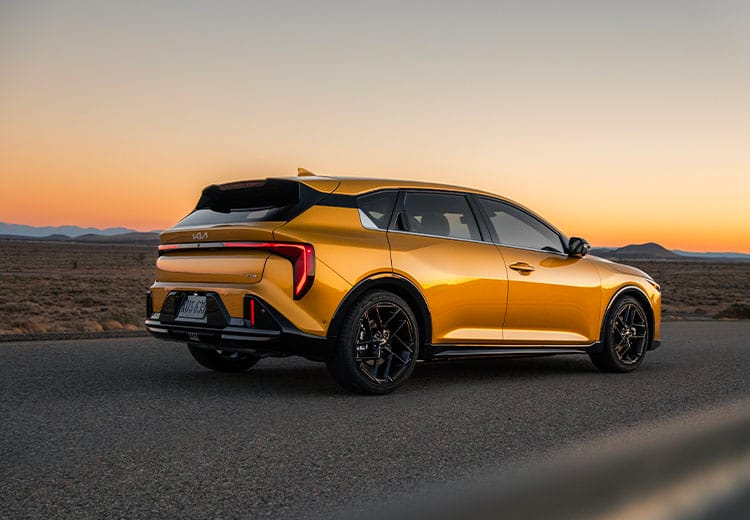
REVIEWS / Compact Cars
NEW2026 Kia K4 Review
The Kia K4 is a serious compact-car value play, especially as a hatchback, but the smartest buy is the EX unless the GT-Line Turbo's 190 hp is worth paying Civic money.
Published June 1, 2026 / Updated June 4, 2026
Expert verdict
Buy the 2026 Kia K4 for warranty value, cabin tech, and useful compact-car pricing. The EX sedan is the clean recommendation; the hatchback is the utility play; the GT-Line Turbo is the fun answer only if you accept the fuel and price trade.
HIGHS
- EX trim keeps the value case strong
- Hatchback body gives the K4 a real cargo advantage
- GT-Line Turbo offers 190 hp and an 8-speed automatic
- Kia warranty coverage is a major ownership advantage
- Official Kia media and press data give the page strong source receipts
LOWS
- No hybrid or AWD option
- Base 147-hp engine is adequate rather than exciting
- GT-Line Turbo can price close to Civic Hybrid and Mazda3 alternatives
- Long-term resale confidence is not as automatic as Civic or Corolla
AT A GLANCE
- Score
- 8.0
- Price
- $23.5K - $30.1K
- Horsepower
- 190 hp
- 0-60
- 7s
- Drivetrain
- FWD
- Body
- Sedan
Buyer Verdict
The fast answer before you compare specs.
Built for shoppers who want the recommendation first and the details right after.
Buy it if
- Buy the 2026 Kia K4 if you want compact-car value, modern screens, strong warranty coverage, and the option of a real hatchback without paying small-SUV money. The EX sedan is the MotorRank pick because it keeps the price and equipment balance clean. The EX hatchback is the utility answer. GT-Line Turbo is the fun answer only if the 190-hp engine and 8-speed automatic matter enough to accept higher price and lower fuel economy.
- Best for: New-car shoppers who want compact pricing, strong warranty coverage, modern cabin tech, and sedan or hatchback utility without jumping to a small SUV.
- Our trim pick: EX Sedan from $25,735.
Skip it if
- No hybrid or AWD option
- Base 147-hp engine is adequate rather than exciting
- GT-Line Turbo can price close to Civic Hybrid and Mazda3 alternatives
Closest rivals
- Honda Civic Hybrid
Hybrid compact benchmark
- Toyota Corolla
Resale and ownership default
- Toyota Camry
Midsize hybrid step-up
Quick take
The 2026 Kia K4 is the compact car for shoppers who still want a new sedan or hatchback instead of defaulting to a small SUV. It replaces the old Forte idea with sharper styling, stronger tech, and a new hatchback body that makes the K4 more useful than the average compact sedan.
This is a MotorRank buyer-research review, not a MotorRank instrumented road test. Kia official specs and Kia America press material supply the powertrain, pricing, MPG, cargo, and warranty baseline; Car and Driver currently leads the main K4 review query; video results supply shopper walkaround context. Third-party acceleration numbers are labeled as third-party context.
Driving impressions
Why the K4 matters
The K4 matters because compact cars are no longer competing only with each other. They are fighting small SUVs, used midsize sedans, and hybrid alternatives. Kia's argument is value, warranty, cabin tech, and body-style flexibility. The hatchback makes that argument stronger because it gives shoppers SUV-like cargo access without SUV price, height, or fuel penalty.
What to watch before you buy
Watch the jump to GT-Line Turbo. The 190-hp turbo engine and 8-speed automatic make the K4 more interesting, but they also push the price close to Honda Civic Hybrid, Mazda3, Hyundai Elantra Hybrid, and lightly used larger sedans. The K4 is strongest when it stays a value car, not when it becomes a pretend sport compact.
SERP audit: how to beat the current K4 leader
The current ranking field for 2026 Kia K4 review is led by Car and Driver's Kia K4 review page. That result is strong because it gives shoppers a fast model overview, current trim prices, fuel-economy context, and a clear 8.5/10 editorial score. It gives the shopper a fast sense of the model, basic pricing, and the broad market verdict, which is why it can hold the top result. The opening to beat it is not authority alone. The opening is decision depth: it does not force the buyer to choose between EX value, hatchback utility, and GT-Line Turbo emotion with enough deal discipline.
A real compact car shopper is not only asking whether the K4 is good. The buyer is deciding trim, powertrain, drivetrain, financing, warranty risk, cargo fit, and whether a rival makes more sense once destination and dealer accessories enter the worksheet. The #1 page can be accurate and still leave the shopper without a buying plan. This page is built around that missing plan.
The kill shot is to keep every recommendation tied to current source proof. Kia's official K4 specs list a 147-hp, 132-lb-ft 2.0-liter engine with IVT on mainstream trims, a 190-hp, 195-lb-ft 1.6-liter turbo with an 8-speed automatic on GT-Line Turbo, front-wheel drive, LX sedan fuel economy of 29 city / 39 highway / 33 combined, and Kia's 10-year/100,000-mile warranty program language. Then the review turns those facts into a trim recommendation, a dealer worksheet, a rival comparison, and a sign-or-walk rule. That is the difference between a model summary and a page that can actually protect a buyer from the wrong contract.
Official specs and the source-of-truth baseline
The source baseline matters because new-model reviews can drift quickly. Manufacturer pages, press releases, and current competitor coverage do not always use the same price basis, destination assumption, or trim naming. For this review, the official data controls the vehicle table wherever the manufacturer has published a number, and third-party tested or marketplace context is labeled as context rather than a MotorRank measurement.
Kia's official K4 specs list a 147-hp, 132-lb-ft 2.0-liter engine with IVT on mainstream trims, a 190-hp, 195-lb-ft 1.6-liter turbo with an 8-speed automatic on GT-Line Turbo, front-wheel drive, LX sedan fuel economy of 29 city / 39 highway / 33 combined, and Kia's 10-year/100,000-mile warranty program language. That official line is the backbone of the review because it tells shoppers what they can verify at the dealer. The shopper should still ask for the current window sticker, current incentives, regional finance terms, and the warranty booklet before signing, but the review does not start from rumors or old model-year assumptions.
The practical rule is simple: if the official page answers the question, use it. If a competitor page adds useful road-test or marketplace context, label it. If a dealer quote changes the out-the-door number, trust the written quote over the brochure. That source discipline is how a review earns confidence without pretending to have performed instrumented testing it has not performed.
MSRP, destination, and the real out-the-door price
Car and Driver's current destination-inclusive K4 range runs about $23,535 to $30,135, while Kia's hatchback press pricing starts the hatch at $24,890 before the $1,195 destination charge. MSRP is only the cleanest starting point. A buyer still has to add destination, taxes, title, registration, documentation fees, accessories, protection packages, finance terms, and any regional incentive rules. The strongest review in this space is the one that says that plainly instead of letting the sticker price do all the work.
Ask the dealer for a written out-the-door quote on the exact VIN or incoming allocation. The quote should separate selling price from destination, factory options, port accessories, dealer accessories, doc fee, tax, title, registration, APR, term, and any backend products. If the store will only talk payment, the deal is not ready to compare against rivals.
The K4 works best when the written quote keeps it clearly cheaper than Civic Hybrid and Mazda3 alternatives; if the turbo trim gets too close, Kia's value advantage weakens. This matters because a strong vehicle can become weak business through a bad worksheet. The K4 should be judged after the paperwork is visible, not after a homepage MSRP or a lease ad. A buyer who forces a clean quote is already ahead of the shopper who stops at the first monthly payment.
Which trim to buy
The MotorRank pick is K4 EX sedan for most buyers, or EX hatchback if cargo access is the reason you are avoiding a small SUV. This is the trim that keeps the vehicle's core value intact instead of turning the review into an upsell ladder. It gets the equipment or powertrain that makes the K4 worth considering while avoiding the part of the range where a rival becomes a stronger answer.
GT-Line Turbo is the alternate when the buyer cares enough about the 190-hp engine and 8-speed automatic to accept higher price and lower MPG. That alternate can be right, but only when the buyer can name the features they will use every week. Comfort, audio, screen size, wheels, trim packages, and driver-assist extras can all be worth money for a long-term owner. They are not worth much when they are only there to make the payment feel premium in the showroom.
Skip LX if the lower payment leaves you with a car that feels too basic, and skip loaded GT-Line Turbo if Civic Hybrid or Mazda3 money would make you happier long term. The trim ladder is where many ranking pages get soft. They describe every version, then dodge the recommendation. A buyer needs a clearer answer: start with the MotorRank pick, price the alternate only if its features solve real needs, and skip the trim that changes the comparison set without improving the week.
Powertrain and performance expectations
Most K4 trims use a 147-hp 2.0-liter four-cylinder with an IVT, while GT-Line Turbo gets the 190-hp turbo engine, 195 lb-ft of torque, and an 8-speed automatic. That is the powertrain story shoppers need before the test drive. It explains whether the vehicle is efficient, quick, smooth, rugged, or simply adequate, and it keeps the buyer from mistaking trim marketing for a different ownership experience.
Performance should be judged by the job. A family crossover needs confident merging, predictable passing, and enough torque that it does not feel strained with people and luggage. A compact car needs calm commuting and enough response to avoid feeling cheap. The K4 should be tested in the situation it will actually live in, not only in a launch video or a spec table.
Do not buy from horsepower alone. Transmission behavior, engine noise, throttle response, hybrid blending, braking feel, and tire choice can matter more every week than the peak number. The right test drive includes a cold start, low-speed traffic, a highway merge, a rough road, and one tight parking-lot maneuver.
MPG, range, and running-cost reality
Kia lists the LX sedan at 29/39/33 mpg and the hatchback EX/GT-Line at 28/34/30, while the GT-Line Turbo hatchback is listed at 26/33/28. MPG is not just an environmental claim; it is a payment-adjacent cost. Over a long loan, the difference between an efficient trim and a thirstier trim can change the ownership math as clearly as a discount or a higher interest rate.
Real-world economy will move with speed, weather, tire compound, roof accessories, hills, traffic, payload, and driver behavior. Hybrids usually show their best work in lower-speed commuting, while highway-heavy buyers can see less dramatic gains. Gas-only shoppers need to watch turbo trims, AWD penalties, wheel packages, and driving style because those details can quietly raise fuel cost.
The buyer should run fuel cost over five years, not one tank. Compare the K4 against its closest rivals using the same annual mileage and local fuel price. If the fuel story is one reason to buy this vehicle, it should survive the spreadsheet after destination, insurance, tires, and maintenance are also visible.
Drivetrain, weather, and where the hardware matters
Every K4 is front-wheel drive, which keeps cost and packaging simple but removes the AWD answer that some small-SUV shoppers expect. Drivetrain is not a badge to collect. It is a response to real roads, real weather, and real use. Front-wheel drive can be the value and MPG answer for mild climates. All-wheel drive can be worth the penalty for snow, steep driveways, gravel, rain, or buyer confidence. Four-wheel-drive language needs even more use-case honesty.
The biggest mistake is paying for hardware without changing capability in a way that matters. AWD does not replace winter tires, and a rugged trim does not make a crossover a rock crawler. Tire choice, ground clearance, approach angles, cooling, tow ratings, and underbody protection decide more than a badge when the road gets messy.
The right question is not whether the most capable version sounds better. The right question is whether your commute, weather, driveway, trips, cargo, and parking routine justify the cost. If they do, pay for the drivetrain. If they do not, keep the build lighter and put the money toward a better trim, better tires, or a shorter loan.
Interior, controls, and daily usability
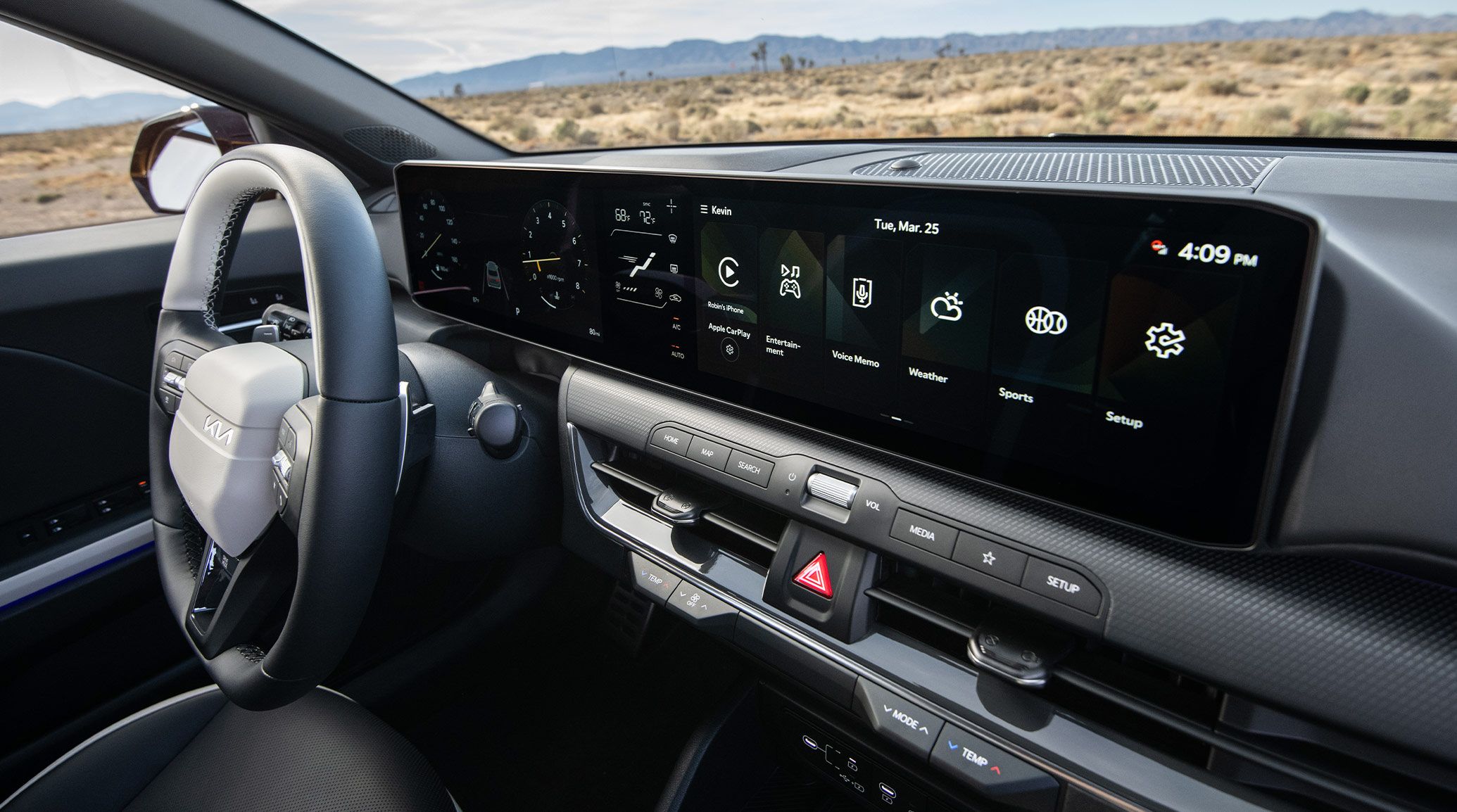
The K4's cabin story is tech and value: a modern dashboard, useful screens, and a bigger-car presentation than the old bargain-compact image suggests. The cabin has to earn the payment because the buyer lives with it every day. Screen size, climate controls, seat comfort, visibility, noise, and phone integration can matter more after six months than the exterior photo that got the click.
Sit in the driver's seat with the car off and work through the routine: phone pairing, map entry, climate change, seat adjustment, mirror adjustment, back-seat access, child-seat or passenger entry, and cargo loading. If any of those steps annoy you in the showroom, they will not become charming during ownership.
The current top ranking pages often describe interior quality in broad adjectives. A better buyer review asks whether the controls make sense, whether the screen creates friction, whether the seats fit your body, and whether the trim upgrade changes something you will touch every day. The K4 should pass that daily-use test before the deal matters.
Cargo, passenger space, and household fit
The sedan keeps compact-car pricing and a normal trunk, while the hatchback creates the stronger utility case with Kia listing up to 59.3 cubic feet of cargo space with the rear seats folded. Cargo numbers help, but the shape matters just as much. A low liftover, wide hatch opening, folding-seat angle, trunk hinge, roofline, and floor height can decide whether the vehicle fits a stroller, dog crate, golf bag, bike, cooler, camera case, or college move.
Bring the object that defines your week. If you routinely carry child gear, sports equipment, tools, luggage, work cases, musical equipment, or a pet crate, load it before signing. A review can tell you the measurement. A loading test tells you whether the K4 actually replaces the vehicle you thought you needed.
Passenger fit is the second half of the same test. Put the tallest regular passenger behind the normal driver, check headroom with the seat adjusted, test child-seat access if relevant, and make sure rear visibility works with the cargo area loaded. A strong deal on the wrong shape is still the wrong purchase.
Safety tech and driver-assist caution
Kia's press material calls out 16 standard ADAS features and up to 29 available ADAS features, and the hatchback page cites an NHTSA 5-Star Safety Rating, but buyers still need to verify trim-level blind-spot, camera, and driver-assist equipment. Safety features are valuable only when the buyer knows which ones are standard, which ones require a package, and which ones change by trim. A page that says a model has safety tech without explaining the trim split is not enough for a shopper comparing real inventory.
Driver-assist systems should be tested, not assumed. Try adaptive cruise, lane keeping, blind-spot alerts, camera views, parking sensors, rear cross-traffic alerts, and automatic emergency braking on a safe route where they can be experienced normally. Alerts that feel helpful to one driver can feel noisy to another.
The buyer should also check insurance quotes. Safety equipment can help confidence, but repair cost, sensor calibration, glass replacement, and trim-specific parts can move premiums. A safer ownership answer includes both protection and cost visibility, especially when the vehicle has cameras, radar, and larger wheels.
Warranty and ownership honesty
Kia's warranty program is one of the K4's main business cases, with the familiar 10-year/100,000-mile powertrain framing and 5-year/60,000-mile limited coverage language that shoppers should verify in the booklet. Warranty coverage is one of the easiest places for shoppers to over-assume. Basic, powertrain, hybrid component, roadside, corrosion, and maintenance terms can differ, and transfer rules may matter if the vehicle is sold used. The dealer should provide the exact 2026 warranty booklet before the contract is final.
This review does not publish fake reliability scores, fake owner ratings, or invented repair forecasts. The honest ownership case is built from the manufacturer's warranty, the brand's historical positioning, powertrain complexity, likely tire and brake costs, insurance quotes, service records, and the purchase price. That is slower than inventing a number, but it is safer.
For the K4, the ownership decision should be boring: keep the trim sensible, understand the warranty, document service, price tires, compare insurance, and avoid add-on products that do not match the vehicle. The page earns trust by saying what is known and what still has to be verified at the desk.
Rivals that can steal the deal
The K4 has to beat Honda Civic, Honda Civic Hybrid, Toyota Corolla, Hyundai Elantra, Mazda3, Toyota Prius, and small SUVs like Kia Seltos or Hyundai Kona depending on body style and final price. A strong recommendation is only real if it names the alternatives that could beat it. The K4 does not exist in a vacuum, and the right rival changes with payment, mileage, family needs, warranty preference, resale confidence, and driving feel.
Cross-shop with written quotes, not impressions. The buyer should price the closest rival at the same equipment level, same finance assumptions, same taxes and fees, and same trade-in treatment. A car that looks cheaper online can lose after destination and packages. A car that looks expensive can win when incentives or resale confidence change the five-year view.
The purpose of the rival set is not to create indecision. It is to prove the recommendation. If the K4 still wins after the rival quote, the buyer can move with confidence. If a rival wins on the actual use case, then the review did its job by keeping the buyer out of the wrong vehicle.
Lease, finance, or cash
Leasing can work when the residual, money factor, mileage allowance, and due-at-signing amount are clean. Financing can work when the APR, term, down payment, and total paid make sense. Cash can work when the buyer still negotiates the price. None of those paths is automatically smarter without the worksheet.
Ask for lease and finance numbers side by side if both are possible. The lease sheet should show residual, money factor, acquisition fee, disposition fee, mileage limit, due at signing, total payments, and any incentives. The finance sheet should show selling price, APR, term, down payment, products, fees, and total cost. A monthly number alone is not enough.
The K4 should be bought through the structure that matches the owner's timeline. Short-term shoppers may prefer a clean lease. Long-term owners may prefer financing with a reasonable term. High-cash buyers still need to reject forced accessories. The purchase path matters because a good vehicle can be made expensive by a weak contract.
Test-drive checklist
Drive the 147-hp EX and the 190-hp GT-Line Turbo before deciding, because the K4 purchase is value-versus-response more than sedan-versus-hatch alone. That is the route before the salesperson starts talking payment. Drive the vehicle where it will live: city traffic, highway ramp, rough pavement, tight parking, driveway angle, and the kind of road that normally exposes ride, noise, visibility, or powertrain irritation.
Use the same checklist on the main rivals. If you drive the K4 on a perfect road and the rival on a bad road, the comparison is already flawed. Test acceleration, braking feel, lane-centering behavior, cabin noise, steering, turning circle, screen response, seat comfort, and whether the cargo area handles normal errands.
Do the quiet test before returning to the showroom. Park, turn the audio off, and ask whether anything bothered you enough that it would still matter in six months. A review can narrow the field, but the test drive should protect the buyer from signing for a car that looks right online and feels wrong every week.
Dealer worksheet and sign-or-walk rule
The dealer worksheet should name the exact vehicle, VIN or allocation, trim, color, options, accessories, selling price, destination, tax, title, registration, doc fee, rate, term, down payment, incentives, and any protection products. If the worksheet is not clear, do not sign. A vague worksheet is not a deal; it is a sales conversation.
Walk if the dealer refuses to separate required fees from optional products, if the online vehicle is not the vehicle being sold, if the trade value changes after the price discussion, or if the finance office adds products after the out-the-door price seemed settled. The strongest buyer is polite, calm, and willing to leave.
The K4 works best when the written quote keeps it clearly cheaper than Civic Hybrid and Mazda3 alternatives; if the turbo trim gets too close, Kia's value advantage weakens. The K4 is strong enough that the buyer should not have to accept messy terms to get it. A good review should make the shopper harder to manipulate, not simply more excited about the car.
Buyer FAQ: fast answers before the quote
The short answer for most shoppers is this: Buy the K4 EX sedan for clean compact-car value, buy the EX hatchback for utility, and buy GT-Line Turbo only if you specifically want the stronger engine. That is the version of the recommendation that belongs above the fold because it turns research into an action. The longer body of the review explains the edge cases, but the core answer should be visible quickly.
The skip answer is just as important: Skip it if you want hybrid MPG, AWD, Honda/Toyota resale confidence, or the sharper steering feel of a Civic or Mazda3. A high-ranking page that never tells anyone to walk away is too soft. Some buyers should choose a rival, a different trim, a different body style, or a lower payment. The review is more useful when it protects those people too.
The video answer matters because many shoppers want to see the vehicle moving before they visit a store. MotorWeek and other YouTube coverage give useful hatchback walkaround context, while MotorRank keeps the buyer answer tied to Kia specs, warranty value, and written price discipline. Video is not proof of MotorRank testing, but it is useful visual context when paired with official specifications, sourced images, and a disciplined buyer guide.
What the current #1 result misses
Car and Driver's Kia K4 review page earns its ranking by being quick, familiar, and broadly complete. The weakness is that broad model hubs often flatten the hard choices. They can list every trim and still leave the shopper unsure which trim to buy, which rival to fear, and where the vehicle stops making financial sense.
it does not force the buyer to choose between EX value, hatchback utility, and GT-Line Turbo emotion with enough deal discipline This review attacks that gap directly. It repeats the important facts only when they affect the buying decision. The rest of the page is built around trim discipline, deal hygiene, rival pressure, and practical ownership. That is where a smaller, sharper review can beat a bigger site on usefulness.
Searchers do not need another page that says the K4 is competitive. They need to know whether to put down a deposit, which trim to request, what quote to demand, which rival to drive next, and what would make them walk. That is the content bar this page is designed to clear.
The final sign-or-walk rule
Sign for the K4 when the trim recommendation, written quote, test drive, warranty terms, and rival comparison all point in the same direction. That means the buyer likes the vehicle, the paperwork is clean, the use case is real, and the alternatives have been checked with the same discipline.
Walk if the trim is being stretched to make the vehicle feel more premium, if the payment is hiding a long term, if the cargo or seating test fails, if the warranty details are being assumed, or if a rival solves the same job for less money or less risk. Walking is not losing the car. It is protecting the decision.
The K4 is strongest as a high-value compact car with a smart trim pick, not as an overbuilt turbo compact trying to outrun better enthusiast choices. That final call should be the anchor of the review. Every specification and competitor note should work toward that decision, not away from it.
Verdict: the buyer plan
The 2026 Kia K4 is worth reviewing at this depth because it sits in a search field where shoppers are getting plenty of information and not always enough judgment. The vehicle has a real lane, but the lane depends on trim, price, and use case. That is why this page is organized around the purchase decision instead of a generic walkaround.
Buy the K4 EX sedan for clean compact-car value, buy the EX hatchback for utility, and buy GT-Line Turbo only if you specifically want the stronger engine. Keep that answer in view when the dealer starts moving the conversation toward color, monthly payment, or inventory pressure. The shopper should already know the trim, the acceptable out-the-door range, the rival to compare, and the reason to walk before sitting in the finance office.
The K4 is strongest as a high-value compact car with a smart trim pick, not as an overbuilt turbo compact trying to outrun better enthusiast choices. The current ranking pages explain the vehicle. This review gives the buyer a plan.
Specs Snapshot
The numbers shoppers compare first.
Key numbers to compare against alternatives before you commit.
| Base price | $23.5K - $30.1K |
|---|---|
| Horsepower | 190 hp |
| 0-60 mph | 7.0 sec |
| Drivetrain | FWD |
| Transmission | Automatic |
| Fuel type | Gas |
| Combined MPG/MPGe | 34 |
Media Proof
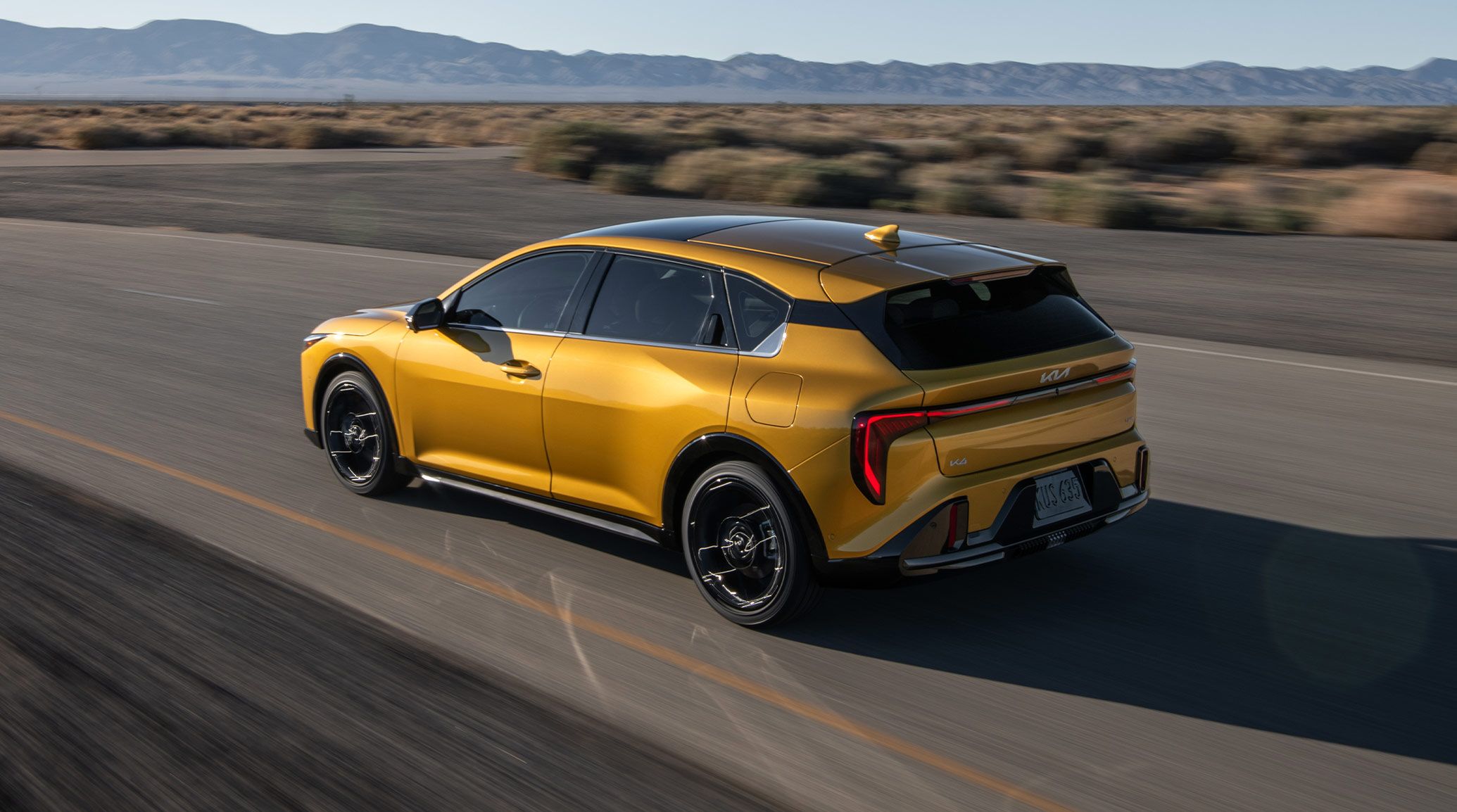
Exterior and interior visuals with source receipts.
Every asset shown here links back to its source and license so the page can gain trust without borrowing competitor media.
Source Receipts
Source pages, creator credits, and reuse licenses are visible for editorial trust and legal hygiene.
Related Video
2026 Kia K4 Hatchback Road Test
MotorWeek / YouTube
Embedded as third-party video context for shoppers who want hatchback walkaround and drive impressions alongside MotorRank's source-backed buyer recommendation.
Interior
Cabin views before you choose a trim.
The K4 cabin is a major part of the value pitch: modern screens, a bigger-car look, and better tech presence than buyers may expect from a compact sedan or hatchback.
Interior Source Receipts
Research basis
Updated June 18, 2026
Built from Kia's official K4 sedan specifications, Kia's K4 Hatchback page, Kia America hatchback pricing release, current SERP checks for '2026 Kia K4 review', and Car and Driver's current #1 review page.
This is a MotorRank buyer-research review, not an instrumented road test. Kia official data anchors MSRP, powertrain, MPG, cargo, and warranty context; third-party test numbers are labeled as outside context.
Refresh after Kia confirms any destination-fee changes, EPA window-sticker changes, or MotorRank obtains instrumented sedan and hatchback test data.
Which 2026 KIA K4 to Buy
Which trim is right for you?
LX Sedan
$23,535
The price anchor, but too basic for many buyers unless the lowest payment is the main goal.
EX Sedan
$25,735
The MotorRank pick for most buyers because it keeps the K4 affordable while improving the daily cabin and tech value.
Our pick
GT-Line Sedan
$26,735
The style and handling step for shoppers who want the sharper look without paying for the turbo engine.
GT-Line Turbo
$29,635
The 190-hp version with the better engine and 8-speed automatic; buy it only if acceleration matters enough to ignore Civic Hybrid pressure.
K4 Hatchback
$26,235
The cargo-flexibility play, with up to about 59 cubic feet folded on Kia's hatchback spec page.
Performance
- Horsepower
- 190hp
- 0–60 mph
- 7.0s
Scorecard
- Performance7.5
- Comfort8
- Value8.6
- Ownership8.7
- Technology8.4
- Safety8.5
- Reliability7.9
- Interior8.2
Shopping Tools
Next steps for 2026 Kia K4 shoppers.
Research tools to help you move from browsing to buying.
Compare rivals
Line up the closest alternatives before you commit.
Check deal signals
Review pricing pressure, incentives, and value angles.
Read owner signal
Balance the expert take with ownership patterns.
Open vehicle hub
Keep specs, reliability, rankings, and review links together.
Compare Against
Cross-shop before you commit.
The closest alternatives in this price range, with our read on each.
Hybrid compact benchmark
Honda Civic Hybrid
More efficient and stronger overall, but costs more than a sensible K4 EX.
Resale and ownership default
Toyota Corolla
Less visually fresh, but safer for conservative long-term ownership.
Midsize hybrid step-up
Toyota Camry
More car and hybrid-only, but a higher price class.
Budget compact sedan
Nissan Sentra
Can undercut the K4, but Kia has the stronger warranty and hatchback lane.
Buyer FAQ
2026 Kia K4 buyer questions, answered.
18
buyer answers
Question Map
Decision
Should you buy the K4?
The K4 is a strong new-car value if you want compact pricing, warranty coverage, and modern tech. It is weaker if you want hybrid MPG or AWD.
Is the 2026 Kia K4 worth buying?
Yes, if you want value and warranty more than hybrid MPG.+
Yes. The K4 gives compact-car shoppers a strong warranty story, modern cabin tech, sedan and hatchback choices, and a price that can stay below many small SUVs. It is not the best fit for hybrid shoppers or AWD shoppers.
Who should skip the K4?
Skip it for hybrid fuel economy, AWD, or top resale confidence.+
Skip the K4 if you want a hybrid, all-wheel drive, Toyota/Honda resale confidence, or the sharper feel of a Civic or Mazda3. Kia wins on value and coverage, not every enthusiast or resale metric.
Is the K4 better as a sedan or hatchback?
Sedan for price; hatchback for usefulness.+
The sedan is the clean price play. The hatchback is the version to buy if cargo access is the reason you would otherwise shop a small SUV. If you carry bulky gear, the hatchback makes the K4 much easier to justify.
Price
Which K4 trim makes sense?
EX is the value pick. GT-Line Turbo is tempting, but it gets close to stronger rivals once the deal is built.
How much does the 2026 Kia K4 cost?
Current destination-inclusive context runs about $23.5K to $30.1K.+
Car and Driver's current trim pricing runs from about $23,535 to $30,135. Kia's hatchback press release lists hatchback pricing from $24,890 before a $1,195 destination charge. Use a written quote for the real number.
Which 2026 K4 trim should I buy?
EX sedan for most buyers; EX hatchback if utility matters.+
Buy EX sedan for the cleanest value. Buy EX hatchback if cargo access is important. Move to GT-Line Turbo only if the 190-hp engine and 8-speed automatic are worth the extra price and lower MPG.
Is GT-Line Turbo worth it?
Only if you specifically want the stronger engine.+
GT-Line Turbo is the most interesting K4 to drive, but it can price close to Civic Hybrid and Mazda3 alternatives. It is worth it if acceleration matters; it is not the default value pick.
Performance
What powertrain should you choose?
The base engine is adequate for value buyers. The turbo is better, but it changes the budget-car math.
How much horsepower does the K4 have?
147 hp standard; 190 hp on GT-Line Turbo.+
Kia lists the mainstream 2.0-liter engine at 147 hp and 132 lb-ft. GT-Line Turbo uses a 1.6-liter turbo with 190 hp and 195 lb-ft, paired with an 8-speed automatic.
Is the base K4 slow?
It is adequate, not exciting.+
The standard 147-hp K4 is built for commuting and value. It should be enough for normal driving, but shoppers who care about passing response should drive the GT-Line Turbo before deciding.
Does the K4 have AWD?
No, every K4 is front-wheel drive.+
The K4 is front-wheel drive only. If AWD is a real need, shop a small SUV or a different compact. Do not buy a front-drive compact and expect it to solve serious winter-road use without proper tires.
MPG
How efficient is it?
The K4 has solid gas-car MPG, but no hybrid option. That keeps Civic Hybrid and Elantra Hybrid in the fight.
What MPG does the 2026 Kia K4 get?
LX sedan is listed at 29/39/33; hatchback EX/GT-Line at 28/34/30.+
Kia lists the LX sedan at 29 city, 39 highway, and 33 combined. The hatchback EX and GT-Line are listed at 28/34/30, while GT-Line Turbo hatchback is listed at 26/33/28.
Does the K4 come as a hybrid?
No current K4 hybrid is part of this review.+
The 2026 K4 buyer decision is gas sedan or hatchback, with the turbo as the power upgrade. If you want hybrid fuel economy, shop Civic Hybrid, Corolla Hybrid, Elantra Hybrid, or Prius.
Is the hatchback less efficient?
Usually yes versus the most efficient sedan trim.+
Kia's listed hatchback numbers are lower than the best sedan number, but the hatchback adds cargo usefulness. The right choice depends on whether utility or maximum MPG matters more.
Ownership
What makes the K4 ownership case?
Warranty value is the K4's business case. Resale and long-term confidence still need quote discipline.
What warranty does the K4 have?
Kia's 10-year/100,000-mile program is a main selling point.+
Kia uses its familiar 10-year/100,000-mile warranty program language, with 5-year/60,000-mile limited coverage context. Ask for the exact warranty booklet and transfer terms before signing.
Will the K4 hold value like a Civic?
Probably not as automatically; buy it for value and coverage.+
The Civic and Corolla remain stronger default resale names. The K4's ownership case is lower transaction price, warranty coverage, and modern equipment. Do not erase that by overpaying for a loaded turbo.
Should I buy the hatchback instead of a small SUV?
Yes if cargo access solves your needs and AWD is not required.+
The K4 Hatchback can replace a small SUV for buyers who need a wide cargo opening but not ride height or AWD. If you need height, snow traction, or family cargo volume, a small SUV still makes more sense.
Compare
What should you compare it against?
Civic for polish, Corolla for resale, Elantra for related value, Mazda3 for driving feel, and small SUVs for utility.
K4 or Honda Civic?
Civic is better overall; K4 must win on price and warranty.+
The Civic is the stronger all-around compact, especially as a hybrid. The K4 counters with warranty value, a sharp cabin, and potentially lower transaction pricing. The deal decides whether Kia is the smarter buy.
K4 or Toyota Corolla?
Corolla for resale trust; K4 for cabin and warranty value.+
The Corolla is the conservative resale choice. The K4 can feel more modern and better equipped for the money. Choose the Corolla if ownership trust is everything; choose K4 if the quote and warranty make the stronger case.
K4 or Mazda3?
Mazda3 for feel; K4 for space, screens, and coverage.+
Mazda3 is the driver-focused compact. The K4 is the value-and-warranty compact with a hatchback utility lane. If steering feel matters most, Mazda stays dangerous. If warranty and tech matter, Kia is stronger.
Ready to buy?
Configure your 2026 Kia K4.
Get matched with a Kia dealer or build your spec sheet from scratch.