
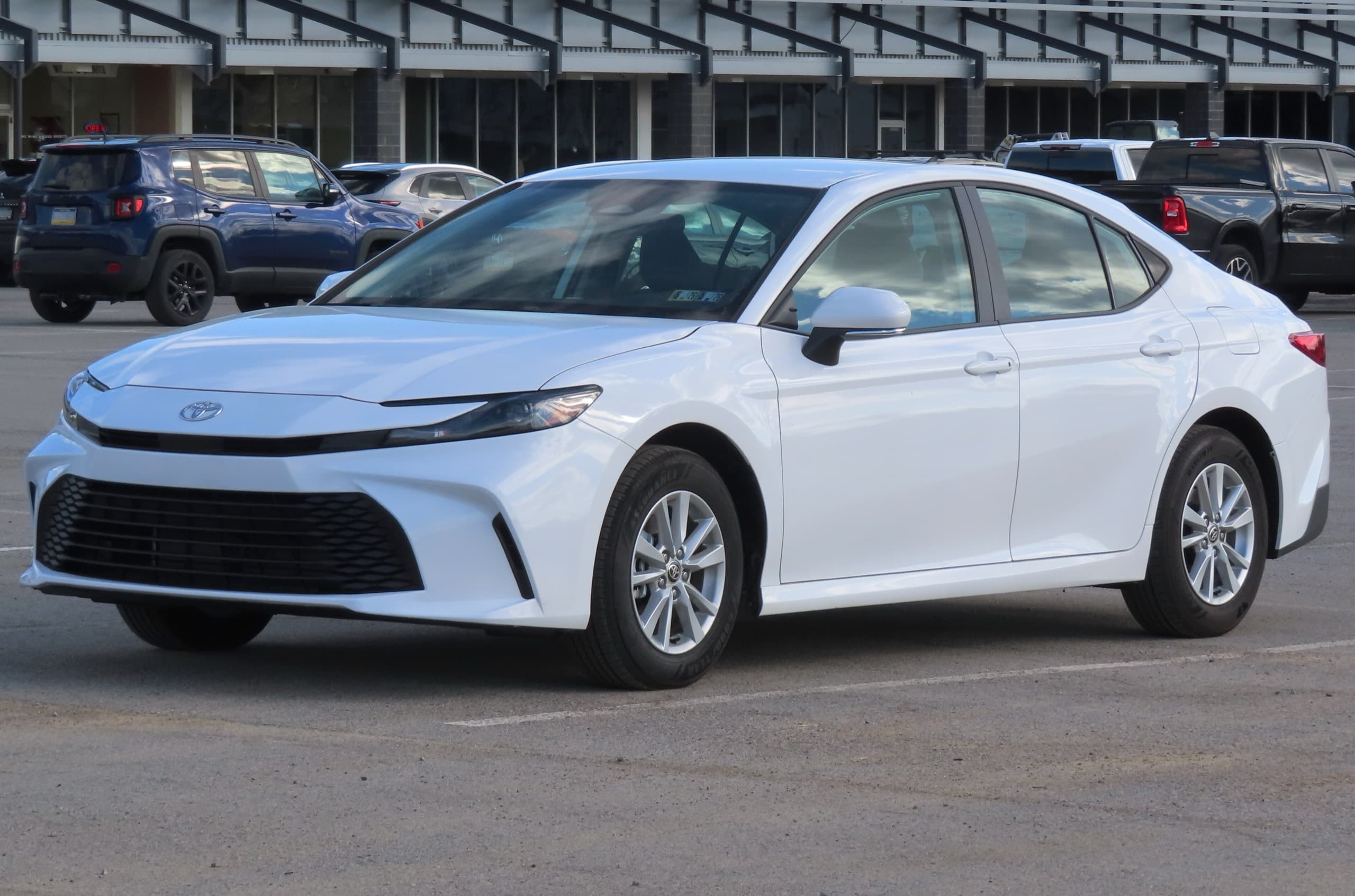
REVIEWS / Midsize Sedans
NEW2026 Toyota Camry Review
America's default sedan is now hybrid-only, and the 2026 buying decision is really three decisions: which of the five trims, front- or all-wheel drive, and whether the all-hybrid lineup should worry a longtime gas-Camry owner. We resolve all three on this page.
Published June 1, 2026 / Updated June 4, 2026
Expert verdict
The 2026 Toyota Camry is the most complete mainstream sedan you can buy: a 225-horsepower hybrid that returns up to an EPA-rated 51 mpg combined, seats a family in genuine comfort, and carries Toyota's strongest ownership case, including a 10-year/150,000-mile hybrid battery warranty. Toyota's official base prices run from $29,300 for the LE to $35,700 for the XSE, before the $1,285 Delivery, Processing and Handling fee, with all-wheel drive a $1,525 option on every trim. Our pick for most buyers is the one the flashier trims quietly undercut: the LE, front-wheel drive, which is both the cheapest Camry and by far the most efficient. The honest caveat is an open hybrid-inverter recall on early cars that we cover in plain language below.
HIGHS
- EPA-rated up to 51 mpg combined (LE FWD) on regular gas — verified across all five EPA configurations
- 10-year/150,000-mile hybrid battery warranty plus 8-year/100,000-mile hybrid-component coverage
- Standard Toyota Safety Sense 3.0 and wireless CarPlay/Android Auto on every trim
- AWD available on all five trims for $1,525, with only a 0-3 mpg penalty
- Rare press consensus: C/D 9/10, MotorTrend 9.5/10, Edmunds 8.3/10 (tied for segment best)
- Roomy cabin and 15.1 cu-ft trunk with no hybrid-battery intrusion
LOWS
- Open December 2025 recall: hybrid-inverter bolt on ~55,000 MY2025-2026 cars (free fix; check the VIN)
- Trim-MPG trap: SE/XLE/XSE drop to 46 combined, XSE AWD to 43, versus the LE's 51
- Vague steering and little athleticism (Car and Driver); firm front seats and full-throttle engine noise (Edmunds)
- Basic and powertrain warranties trail Hyundai and Kia terms
- No gas option and no V6 — entry price starts higher than the old four-cylinder car
AT A GLANCE
- Score
- 8.6
- Price
- $29.3K - $37.2K
- Horsepower
- 225 hp
- 0-60
- 6.9s
- Drivetrain
- FWD
- Body
- Sedan
Buyer Verdict
The fast answer before you compare specs.
Built for shoppers who want the recommendation first and the details right after.
Buy it if
- The 2026 Toyota Camry is the best all-around mainstream sedan on sale, and the smart buy is specific: the LE with front-wheel drive at $29,300 — the cheapest Camry and the only one EPA-rated at 51 mpg combined. Add the $1,525 AWD option only if your winters earn it. Step up to the XLE for comfort or the SE/Nightshade for the look, knowing those trims cost 5-8 mpg. Before any purchase, run the VIN through Toyota's recall lookup for the December 2025 hybrid-inverter campaign.
- Best for: Commuters and families who want the lowest-risk, lowest-running-cost sedan on sale — especially returning gas-Camry owners deciding whether the hybrid-only lineup, the trim ladder, and the $1,525 AWD option are worth it.
- Our trim pick: LE from $29,300.
Skip it if
- Open December 2025 recall: hybrid-inverter bolt on ~55,000 MY2025-2026 cars (free fix; check the VIN)
- Trim-MPG trap: SE/XLE/XSE drop to 46 combined, XSE AWD to 43, versus the LE's 51
- Vague steering and little athleticism (Car and Driver); firm front seats and full-throttle engine noise (Edmunds)
Closest rivals
- Honda Accord
The driver's-car rival
- Hyundai Sonata Hybrid
The value-and-warranty rival
- Kia K5
The style-first gas alternative
Quick take
If you are shopping the 2026 Toyota Camry, the reviews you have already opened agree the car is excellent and then quietly disagree about everything that matters to your wallet: Car and Driver rates it 9 out of 10 and recommends the SE, Edmunds scores it 8.3 and recommends the XSE, and MotorTrend rates it 9.5 and recommends the LE. Nobody walks you through the trim ladder and the front- versus all-wheel-drive choice as one decision, and almost nobody mentions that fuel economy swings from 51 mpg combined to 43 depending on how you spec it. This Research Desk review is built to close those gaps. The Camry is in the second year of its ninth-generation (XV80) redesign — hybrid-only, 225 horsepower with front-wheel drive or 232 with the electric on-demand AWD, in five trims listing from $29,300 to $35,700 before fees.
This is a buyer-research review built from Toyota's official 2026 Camry pricing, specifications, press materials, and warranty language, the EPA's published fuel-economy ratings for all five drivetrain configurations, and the instrumented tests and impressions of Car and Driver, Edmunds, MotorTrend, and Consumer Reports — each attributed to the outlet that produced it. It is not yet a MotorRank instrumented road test. We have not independently measured acceleration, braking, real-world fuel economy, or cabin noise, and we do not publish reliability scores, repair-cost figures, or resale percentages we cannot source. Where a number is Toyota-official we say so; where it is a third party's measured result we name them; where it is an expectation we have not verified, we label it preview basis.
Driving impressions
Why the Camry matters
The Camry matters because it is the default answer in a segment that keeps shrinking around it: the best-selling passenger car in America for most of the past two decades, and now the car that decides whether mainstream buyers accept an all-hybrid future. With the ninth generation, Toyota removed the choice that defined Camry shopping for 40 years — there is no four-cylinder gas version, no V6, only the 2.5-liter fifth-generation hybrid system. In exchange, every Camry now returns EPA ratings between 43 and 51 mpg combined, every trim offers all-wheel drive, and the price walk from the old gas car is smaller than buyers fear: Toyota said at launch that the hybrid-only base price actually came in more than $400 below the previous-generation Camry Hybrid. If the formula works here, it works everywhere — which is exactly why this car is worth a careful look rather than an automatic repurchase.
What to watch before you buy
Watch three things before you sign. First, the trim-MPG trap: the LE is rated at 51 mpg combined, but stepping to any other front-drive trim drops the rating to 46, and the XSE AWD falls to 43 — the sporty wheels and suspension cost you up to 8 mpg before you leave the lot. Second, the open recall: in December 2025 Toyota announced a safety recall covering roughly 55,000 model-year 2025-2026 Camrys for a hybrid-inverter bolt that can loosen and cause a loss of drive power or, in the worst case, a fire; the fix is free, and you should run any car's VIN through Toyota's recall lookup before delivery. Third, the fee math: Toyota's advertised prices exclude the $1,285 Delivery, Processing and Handling fee, and all-wheel drive adds $1,525 on every trim, so an advertised $29,300 LE is really a $30,585 car before tax and title.
SERP audit: who the 2026 Camry has to beat right now
Before writing a word of advice, we audited the live search results for the query buyers actually type — 2026 Toyota Camry review. The top organic result is Car and Driver's model hub (caranddriver.com/toyota/camry), carrying a 9-out-of-10 rating and real test data. Behind it sit Edmunds (8.3 out of 10, tested and rated), MotorTrend (9.5 out of 10), KBB and Consumer Reports rating pages, a Capital One buying guide, and — tellingly — a wall of owner content: a Reddit thread on six months of 2026 Camry SE ownership, and YouTube videos with titles like Here's Why I Hate My New 2026 Toyota Camry. Buyers are searching for the honest version, not another victory lap.
Here is the opening those pages leave. The three biggest outlets each recommend a different trim — Car and Driver says SE, Edmunds says XSE, MotorTrend says LE — and none of them explains the disagreement, which comes down to how much fuel economy and ride comfort you trade for wheels and styling. None of them resolves the front- versus all-wheel-drive question with the actual EPA spread. None mentions the December 2025 hybrid-inverter recall anywhere a shopper will see it. And none addresses the question under the question for a returning Camry owner: what does hybrid-only mean for cost, maintenance, and the battery, ten years out?
So this review is organized to beat exactly those gaps: one unified trim-plus-drivetrain verdict with the real MPG math, a plain-language section on the recall and the hybrid battery warranty, an ownership section that does not invent numbers, and cross-shop calls against the Accord, Sonata Hybrid, K5, and Toyota's own RAV4 that end in a decision. Every Toyota-official figure below was checked against toyota.com and Toyota's press materials, and every fuel-economy number against the EPA's published ratings.
The bottom line up front: is the 2026 Camry worth buying?
Yes — and more decisively than most cars we cover. The 2026 Camry does the family-sedan job about as well as it can currently be done: EPA ratings of up to 51 mpg combined on regular gas, a roomy and genuinely pleasant cabin, standard wireless Apple CarPlay and Android Auto, standard Toyota Safety Sense 3.0, available all-wheel drive on every trim, and the strongest hybrid-component warranty story in the class. The press consensus is unusually loud: Car and Driver scores it 9 out of 10, MotorTrend 9.5, and Edmunds 8.3 — tied with the Honda Accord hybrid for first in the segment, and Edmunds notes the Camry beat the Accord in its own head-to-head comparison test.
Our research-basis score is 8.6 out of 10. That reflects real strengths — efficiency, value, ownership confidence, standard safety equipment — balanced against honest weaknesses the outlets confirm: steering that Car and Driver calls vague, a firm ride on the 19-inch-wheel trims, front seats Edmunds found firm on long drives, engine coarseness at full throttle, and an open recall on early hybrid inverters that deserves a VIN check, not a shrug. For most buyers the smart spec is the $29,300 LE with front-wheel drive; the rest of this review explains why, and who should spend more.
Official pricing: all five trims, the $1,285 fee, and the $1,525 AWD option
Here is the full, Toyota-official base-MSRP ladder for the 2026 Camry, verified against toyota.com: LE $29,300; SE $31,800; SE Nightshade $32,800; XLE $34,500; XSE $35,700. Every trim is the same 2.5-liter hybrid — there are no engine upgrades anywhere on the ladder — and every trim offers Electronic On-Demand All-Wheel Drive for $1,525 more, a figure confirmed across Toyota dealer configurators and U.S. News' pricing breakdown. That puts the realistic top of the range, an XSE AWD, at $37,225 before fees.
None of those numbers is what you pay. Toyota's MSRPs exclude the Delivery, Processing and Handling fee, which Toyota's own offer fine print currently lists at $1,285 for its cars. So the real starting point for an LE is about $30,585 before tax, title, and registration, and a loaded XSE AWD crosses $38,500 before options. Third-party sites fold this in differently — Car and Driver lists the destination-inclusive range as $30,595 to $38,520 — so when you compare prices across sites, confirm whether destination is included before concluding one source is cheaper.
Two pricing observations that matter. First, the $2,500 walk from LE to SE buys appearance and sport seats, not equipment depth — and costs 5 mpg. Second, the $1,200 walk from XLE to XSE is the cheapest step on the ladder, which is why buyers who want the 12.3-inch screen and leather-trimmed comfort often land on one of those two; the choice between them is purely ride firmness versus styling. We resolve the whole ladder in the trim sections below.
What changed for 2026 — and whether to buy a leftover 2025 instead
The 2026 model year is the second year of the ninth-generation Camry, and the headline change is cosmetic: the new SE Nightshade Edition, which Toyota's press release describes as the SE grade dressed in Midnight Black Metallic elements — grille, air curtains, side canards, door handles, mirror caps, antenna, diffuser, and rear spoiler — plus 19-inch satin-black wheels and gloss-black badging. It lists at $32,800, exactly $1,000 over the SE. Mechanically, nothing changed: same 225- or 232-horsepower hybrid, same trims otherwise, same equipment structure.
That carryover status is useful intelligence. A leftover 2025 Camry is mechanically the same car, and Toyota launched the ninth generation at $28,400 — a price Toyota itself noted was more than $400 below the previous-generation Camry Hybrid's base sticker. The 2026 LE lists $900 higher than that launch price. If a dealer still holds a 2025 in the spec you want, it is a legitimate way to save; the trade-off is that early-build 2025s are squarely inside the recall population we describe below, so confirm the inverter fix is documented before you take delivery. Either way, do not pay 2026 money for a 2025 without the discount that justifies it.
The all-hybrid question: what a longtime gas-Camry owner needs to know
If your last Camry had the plain four-cylinder gas engine, the ninth generation asks you to accept three changes at once, and it is worth being precise about each. Price: there is no cheap gas version anymore, so entry now starts at $29,300 — but that buys the hybrid that used to be the upgrade, and at launch Toyota priced the hybrid-only car below the old hybrid, not above it. Fuel: the EPA rates the LE at 51 mpg combined against the high-20s-to-30s territory of the old gas car — at 12,000 miles a year, that difference pays real money back every year you own it, on regular-grade fuel. Complexity: the fifth-generation Toyota Hybrid System adds a battery and motor-generators, and that is the part that worries returning buyers most.
The worry deserves a direct answer rather than reassurance-by-vibes. Toyota's stated coverage on this car is a 36-month/36,000-mile basic warranty, 60-month/60,000-mile powertrain coverage, 8 years/100,000 miles on hybrid components, and 10 years/150,000 miles on the hybrid battery itself. That battery warranty is the longest commitment on the window sticker, it transfers with the car, and it covers the single component buyers fear most. Toyota has also been building this powertrain lineage at scale since the late 1990s; the system in the Camry is the fifth generation of it. We will not pretend to know the 2026 car's 15-year durability — nobody can — but the warranty math means the battery question is largely Toyota's risk for the first decade, not yours.
Day to day, the differences are smaller than expected. The hybrid never plugs in — it charges itself as you drive and brake. It runs on regular gas from a 13-gallon tank. Routine maintenance follows the normal Toyota schedule, and the first two years or 25,000 miles of factory-scheduled maintenance are covered by ToyotaCare at no cost. The driving experience is quieter at low speed (the car starts and creeps on electric power) and the transmission behaves like a smooth automatic. The one habit change worth knowing: under full throttle the engine drones louder than the old six — Edmunds calls the noise at wide-open throttle its main demerit — but in normal commuting the hybrid is the more refined car.
Fuel economy: the official numbers, and the trap hiding in the trim walk
Here are the EPA's published ratings for every 2026 Camry configuration, all on regular fuel. Front-wheel drive: the LE returns 52 city / 49 highway / 51 combined, while the SE, Nightshade, XLE, and XSE all return 47 / 45 / 46. All-wheel drive: the LE AWD returns 50 / 49 / 50, the SE and XLE AWD return 46 / 46 / 46, and the XSE AWD falls to 43 / 43 / 43. Those are official EPA figures, verified against fueleconomy.gov.
Read that spread again, because no top-ranking review presents it plainly: the same car, same engine, same tank, is rated anywhere from 51 mpg combined down to 43 depending on trim and drivetrain. The penalty is mostly wheels, tires, and weight — the LE's 16-inch wheels and lighter spec are the entire reason it embarrasses the rest of the lineup. If you buy a Camry primarily for fuel economy, the LE is not just the cheapest trim, it is the most efficient by a margin that compounds for a decade. An XSE AWD owner gives up roughly one-sixth of the LE's efficiency for styling and grip.
Real-world checks support the stickers. Consumer Reports' published overview says it measured 38 mpg in mixed driving — 4 mpg better than the previous-generation car it tested. Car and Driver observed 34 mpg overall in its hardest-use testing of an SE Nightshade. Both are below the EPA combined figures, as measured results usually are for hybrids driven hard, and both are still extraordinary for a 193-inch family sedan. We label our own real-world expectation preview basis until MotorRank runs its own fuel loop.
FWD or AWD: the $1,525 decision, resolved
Every 2026 Camry offers Electronic On-Demand All-Wheel Drive for $1,525, and it works differently from a mechanical AWD system: a dedicated electric motor-generator drives the rear wheels when needed, with no driveshaft running the length of the car. It also raises output from 225 to 232 net combined horsepower — Toyota-official figures — and MotorTrend's instrumented testing actually found the AWD car a tenth quicker to 60 (6.8 seconds versus 6.9) despite the added weight.
The efficiency cost is the real decision input: 1 mpg combined on the LE (51 to 50), zero on the SE and XLE (46 to 46), and 3 on the XSE (46 to 43). So here is the plain-language verdict the leading reviews never quite give. If you live where winters are real — snow-belt states, lake-effect country, a steep unplowed driveway — the $1,525 is cheap insurance and costs you almost nothing at the pump on the LE, SE, or XLE. If you live in a mild climate, skip it: a front-drive Camry on good tires handles rain fine, and dedicated winter tires on a FWD car will outperform an AWD car on all-seasons in genuine snow anyway. The one spec we would avoid is the XSE AWD-for-image build — that is where the efficiency penalty is largest and the justification weakest.
Performance and driving manners: quick enough, tuned for calm (preview basis)
We have not yet instrument-tested the Camry, so the numbers here are attributed. MotorTrend measured 0-60 mph in 6.9 seconds with front-wheel drive and 6.8 with AWD; Car and Driver clocked its SE Nightshade test car at 7.0 seconds, recorded a 171-foot stop from 70 mph, and observed 34 mpg. Edmunds tested an XSE at 7.8 seconds and noted it still out-accelerated the Accord and Sonata hybrids it competes with. Translation for the street: the hybrid Camry is meaningfully quicker than the old four-cylinder gas car, merges and passes without drama, and its electric torque makes city driving feel more responsive than the figures suggest.
The character is deliberately unsporty, and the outlets agree on the seams. Car and Driver's listed lows are vague steering and a general lack of athleticism; Edmunds praises the taut suspension tuning and connected feel but flags firm front seats and engine noise at full throttle; MotorTrend cautions that the SE and XSE ride stiffer on their bigger wheels and notes the styling barely moved from 2025. None of that undermines the mission — this is a comfort-and-efficiency machine that happens to corner respectably — but if you want a sedan that entertains, the segment's honest answer is the Accord for steering feel, and the Camry's case is everything else. We will publish our own measured results when MotorRank completes a full road test.
Choosing a trim, part 1: LE, SE, and the new Nightshade
The LE at $29,300 is our recommendation for most buyers, and the case is arithmetic, not asceticism. It is the only Camry rated at 51 mpg combined, and it is not a stripped car: an 8-inch touchscreen with standard wireless Apple CarPlay and Android Auto, a 7-inch digital gauge cluster, dual-zone automatic climate control with rear vents, LED lighting, 16-inch alloys, and the complete Toyota Safety Sense 3.0 suite are all standard. The seats are fabric and the screen is the smaller one — that is genuinely the bulk of what you give up. MotorTrend lands on the LE as its pick too.
The SE at $31,800 is Car and Driver's recommended trim, and it is the right call for a specific buyer: you want the sport-sedan look — 18-inch black-finished wheels, mesh grille, rear spoiler, SofTex-trimmed sport seats with power driver adjustment — and you accept that it costs $2,500 and 5 mpg combined over the LE while adding no power. That is an honest trade stated honestly; the outlets that recommend the SE simply weight appearance more than we do.
The SE Nightshade at $32,800 is the 2026 news: Midnight Black Metallic trim everywhere, 19-inch satin-black wheels, gloss-black badging. It is an appearance package on the SE, full stop — Toyota's own release describes no mechanical changes. Car and Driver's test of a Nightshade returned the same 46-mpg-class EPA ratings and a well-sorted ride. If the blacked-out look is the reason you walked into the store, the $1,000 over SE is fairly priced; if not, nothing else changes.
Choosing a trim, part 2: XLE, XSE, and the verdict by buyer type
The XLE at $34,500 is the comfort flagship and the sleeper pick of the upper ladder. It brings the 12.3-inch touchscreen, leather- and microfiber-trimmed multi-stage heated front seats, available ventilation, and the 12.3-inch digital cluster — the full premium-feeling cabin — while keeping the SE-size 18-inch wheels' softer-riding character relative to the XSE. If long commutes and passenger comfort define your use, this is where the money goes furthest. The XSE at $35,700 takes the same equipment in the sporty direction: 19-inch smoked-gray wheels, sport-tuned suspension, dual chrome exhaust tips. Edmunds recommends the XSE and rated the car 8.3 overall after testing one; the cost is the firmest ride in the lineup and, with AWD, the worst fuel economy at 43 combined.
The verdict matrix the top-ranking pages never print: Best for most buyers and best value — LE FWD, $29,300, the efficiency champion. Best in snow country — LE AWD or XLE AWD, where the all-wheel-drive penalty is negligible. Best look for the money — SE, or Nightshade if the black-out treatment is the point. Best comfort — XLE. Best sport pretension with real equipment — XSE FWD. Skip — the XSE AWD bought for image, and any trim bought without checking the recall status first.
One structural note that simplifies everything: because every Camry shares one powertrain, you are never paying for performance you cannot get elsewhere on the ladder — only for wheels, seats, screens, and styling. That makes the Camry one of the rare cars where buying the base trim is not a compromise strategy; it is the spec the engineers' fuel-economy work shows off best.
Interior, technology, trunk, and the safety equipment that comes standard
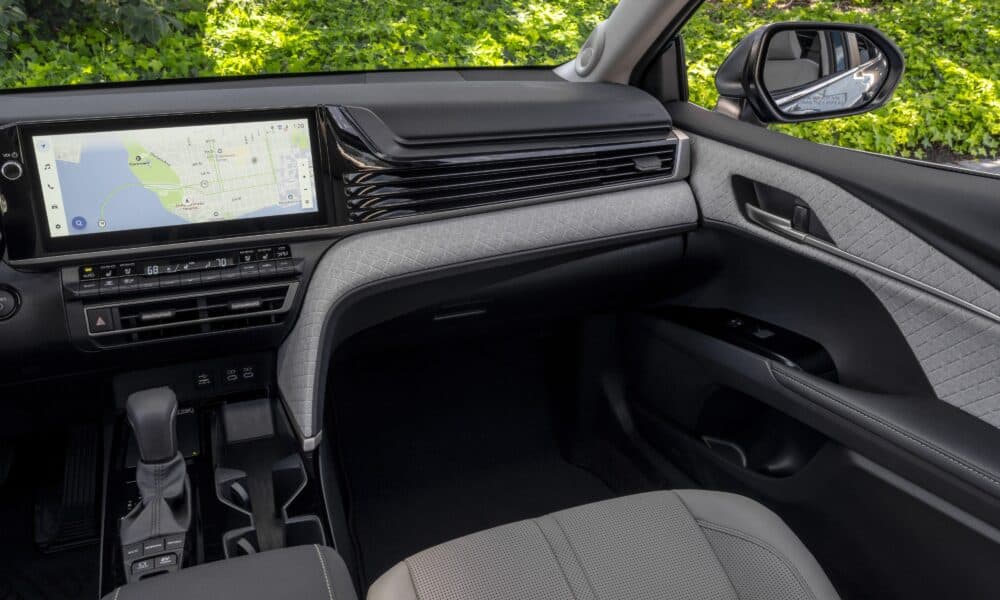
The ninth-generation cabin is a real strength. Every Camry gets standard wireless Apple CarPlay and Android Auto; the LE and SE carry an 8-inch touchscreen and 7-inch digital cluster, while the XLE and XSE upgrade to 12.3 inches for both. Edmunds scores the in-cabin tech 9.1 out of 10 — its highest sub-score for the car — and the layout keeps physical climate controls, a detail commuters appreciate daily. Materials in the upper trims read genuinely premium; the XLE's leather-and-microfiber treatment and the XSE's red-accented cockpit are the showpieces, and our licensed press photos below show both.
Packaging numbers, per Toyota's published specifications: 38.0 inches of rear legroom, 42.1 up front, 99.9 cubic feet of passenger volume, and a 15.1-cubic-foot trunk with standard split-folding rear seats. That trunk matches or beats most of the class, and the hybrid battery does not intrude on it — the packaging penalty that haunted early hybrids is gone. At 193.5 inches long on a 111.2-inch wheelbase, the Camry is a full-size-feeling sedan in the back seat; the Reddit ownership threads in our SERP audit consistently praise exactly this.
Safety equipment is standard, not extra: Toyota Safety Sense 3.0 on every trim includes a Pre-Collision System with pedestrian detection, Full-Speed Dynamic Radar Cruise Control, Lane Departure Alert with Steering Assist, Lane Tracing Assist, Road Sign Assist, and Automatic High Beams, with Blind Spot Monitoring available across the lineup. We do not quote crash-test star ratings here because we have not verified final 2026-model results from NHTSA and IIHS as of this writing; we will update this section when we have, and we say that rather than guessing.
The recall, the warranty, and the battery question — the honest section
Here is the item the top-ranking reviews do not surface. On December 16, 2025, Toyota announced a safety recall covering approximately 55,000 vehicles in the U.S. — certain model-year 2025-2026 Toyota Camrys and 2026 Corolla Cross Hybrids. Toyota's own notice states that a bolt inside the hybrid powertrain's inverter can loosen, which could cause a loss of motive power while driving or, in the worst case, a fire when the vehicle is on. Toyota said owners would be notified by mid-February 2026 and the remedy would be free of charge. This is a real, current, Toyota-confirmed safety issue on early ninth-generation cars, and any honest review of this model has to lead the ownership section with it.
What it means for you as a buyer in June 2026 is procedural, not disqualifying. Before taking delivery of any 2025 or 2026 Camry — new, leftover, or used — run the VIN through Toyota.com/recall or NHTSA's recall lookup and require the selling dealer to document that any open recall work is complete. Production-line fixes typically follow recall announcements quickly, so most cars built after early 2026 should be unaffected, but the VIN check costs nothing and removes the question. A recall handled is not a reliability verdict; how Toyota executes the remedy is the thing to watch, and we will update this review as the campaign completes.
The warranty picture is the counterweight, and it is strong where it counts. Toyota's stated coverage: 36 months/36,000 miles basic, 60 months/60,000 miles powertrain, 8 years/100,000 miles on hybrid components, and 10 years/150,000 miles on the hybrid battery, plus ToyotaCare's two years/25,000 miles of no-cost scheduled maintenance. The basic and powertrain terms trail Hyundai's and Kia's published coverage — a real gap if a long bumper-to-bumper warranty is your priority — but the decade-long battery warranty addresses the single most expensive component in the car, and it is the specific reassurance a first-time hybrid buyer should anchor on.
Ownership, reliability, and resale: what we can source, and what we cannot
We do not publish reliability scores, repair-cost dollar figures, or resale percentages we cannot source, so here is the attributed picture. The Camry nameplate carries one of the strongest reliability reputations in the industry, built over four decades; Consumer Reports' published 2026 overview is positive, highlighting its measured 38-mpg result and composed ride, and the Camry's hybrid system belongs to the Toyota Hybrid System lineage that has powered millions of vehicles since 1997 — the strongest real-world durability evidence any hybrid powertrain has. None of that is a number we invented; all of it is on the public record.
The honest counterweights. First, the ninth generation is still young — the long-term owner data that made the previous Camry a known quantity does not exist yet for this one, and the December 2025 inverter recall is a reminder that even Toyota's early-production cars can carry teething issues. Second, MotorTrend lists build quality concerns among its cons for this generation — their judgment, not ours, but worth a careful walkaround at delivery. Third, owner content in the search results (the six-month SE ownership thread, the YouTube complaint videos) skews positive on economy and comfort and negative on small irritations: infotainment quirks and road noise come up. We flag these as themes to test-drive against, not verified defect patterns.
On cost of ownership, the structure without invented numbers: fuel is the headline saving — a 46-to-51-mpg sedan on regular gas is about as cheap to run as a family car gets; scheduled maintenance is ToyotaCare-covered for two years and conventional after; insurance is typically mainstream-sedan territory, and you should quote your own. Resale has historically been a Camry strength and there is no structural reason the hybrid-only car changes that — demand for used Toyotas with strong fuel economy is its own argument — but we will not attach a residual percentage we have not sourced. If you keep cars ten years, the warranty timeline above is your actual risk map, and it is a good one.
Cross-shop: Accord, Sonata Hybrid, K5 — and Toyota's own RAV4
Choose the Camry over the Honda Accord if fuel economy, standard safety equipment, and hybrid-warranty depth lead your list — the Accord hybrid maxes out around the mid-40s combined where the Camry LE reaches 51, the Accord's base trims are gas-only, and Edmunds, which scores them in a dead heat at 8.3, gave the Camry the win in its head-to-head comparison. Choose the Accord if steering feel and back-road composure matter to you; it remains the driver's car of the pair, and Car and Driver still ranks its dynamics ahead of the Camry's.
The Hyundai Sonata Hybrid is the value counterpunch: typically less expensive trim-for-trim, with a longer basic warranty (Hyundai's published 5-year/60,000-mile basic and 10-year/100,000-mile powertrain coverage beats Toyota's 3/36 and 5/60), and a striking cabin. The Camry answers with better fuel economy, available AWD — the Sonata Hybrid does not offer it — and the stronger long-term hybrid track record. The Kia K5 undercuts on price and looks sharp, but it has no hybrid at all; if you are cross-shopping a K5 you are really deciding whether you want a hybrid in the first place, and the fuel math in this review is the answer.
The most useful cross-shop may be inside the showroom. The Toyota RAV4 — fully redesigned for 2026 and reviewed separately on MotorRank — is where Camry intenders actually defect: similar money, the same hybrid logic, a higher seating position, and cargo flexibility a trunk cannot match. The sedan still wins on efficiency (no RAV4 touches 51 mpg combined), on ride quietness, and on driving feel. Our straight call: if your life regularly involves bikes, dogs, strollers, or flat-pack furniture, read our 2026 RAV4 review before you sign; if your miles are commuting and road trips with people in the seats, the Camry is the better car and the cheaper one to feed.
How to buy: out-the-door math, incentives, and timing
Build the number from Toyota's side first: base MSRP, plus $1,525 if you choose AWD, plus the $1,285 Delivery, Processing and Handling fee, plus your state's tax, title, and registration. That is the structural price — an LE FWD lands near $30,585 plus tax, an XLE AWD near $37,310 plus tax — and anything above it is dealer-added. Ask for a complete itemized out-the-door figure in writing and compare that number across at least two stores; a monthly-payment quote hides term length and add-ons. Watch the usual pre-loaded extras — protection packages, nitrogen, etched glass — which are negotiable or declinable.
On market conditions: the Camry sells at enormous volume, which is your leverage — this is not a markup car in most regions, and inventory competition between Toyota stores is real. Edmunds' pricing tool has shown suggested transaction prices below MSRP in some markets, which tells you discounting exists even on a hot seller; treat that as a signal to shop multiple quotes rather than a promised number, since regional incentives change monthly. Time pressure is low: the 2026 is a carryover year, so there is no spec reason to rush — but if you find a discounted leftover 2025, verify the inverter-recall remedy is documented and bank the savings.
The verdict: which Camry to buy, and who should pass
The 2026 Toyota Camry is the best all-around mainstream sedan on sale — the rare car where the enthusiast press (9 and 9.5 out of 10 at Car and Driver and MotorTrend) and the consumer press (Edmunds' segment-leading 8.3, Consumer Reports' 38-mpg test result) converge on the same conclusion. It is not a sport sedan and does not steer like one, its firmest trims trade away real efficiency for looks, and early-build cars carry an open inverter recall you must check by VIN. Buy it for what it is: the most efficient, most complete, lowest-risk way to move a family on regular gasoline.
Our buying advice in one breath: most shoppers should buy the LE front-wheel drive at $29,300 — cheapest, most efficient at 51 mpg combined, and fully equipped where it counts. Add AWD for $1,525 only if your winters earn it. Buy the XLE if comfort is the mission, the SE or Nightshade if the look is worth 5 mpg to you, and the XSE only knowing it is the firmest and thirstiest of the family. Pass entirely if you need cargo flexibility (read our RAV4 review), crave steering feel (drive an Accord first), or cannot get a documented recall fix on the specific car in front of you. This is a research-basis review built from official Toyota and EPA data and attributed third-party testing; we will update it with instrumented results once the Camry completes a full MotorRank evaluation.
Specs Snapshot
The numbers shoppers compare first.
Key numbers to compare against alternatives before you commit.
| Base price | $29.3K - $37.2K |
|---|---|
| Horsepower | 225 hp |
| 0-60 mph | 6.9 sec |
| Drivetrain | FWD |
| Transmission | CVT |
| Fuel type | Hybrid |
| Combined MPG/MPGe | 51 |
Media Proof
Exterior and interior visuals with source receipts.
Every asset shown here links back to its source and license so the page can gain trust without borrowing competitor media.
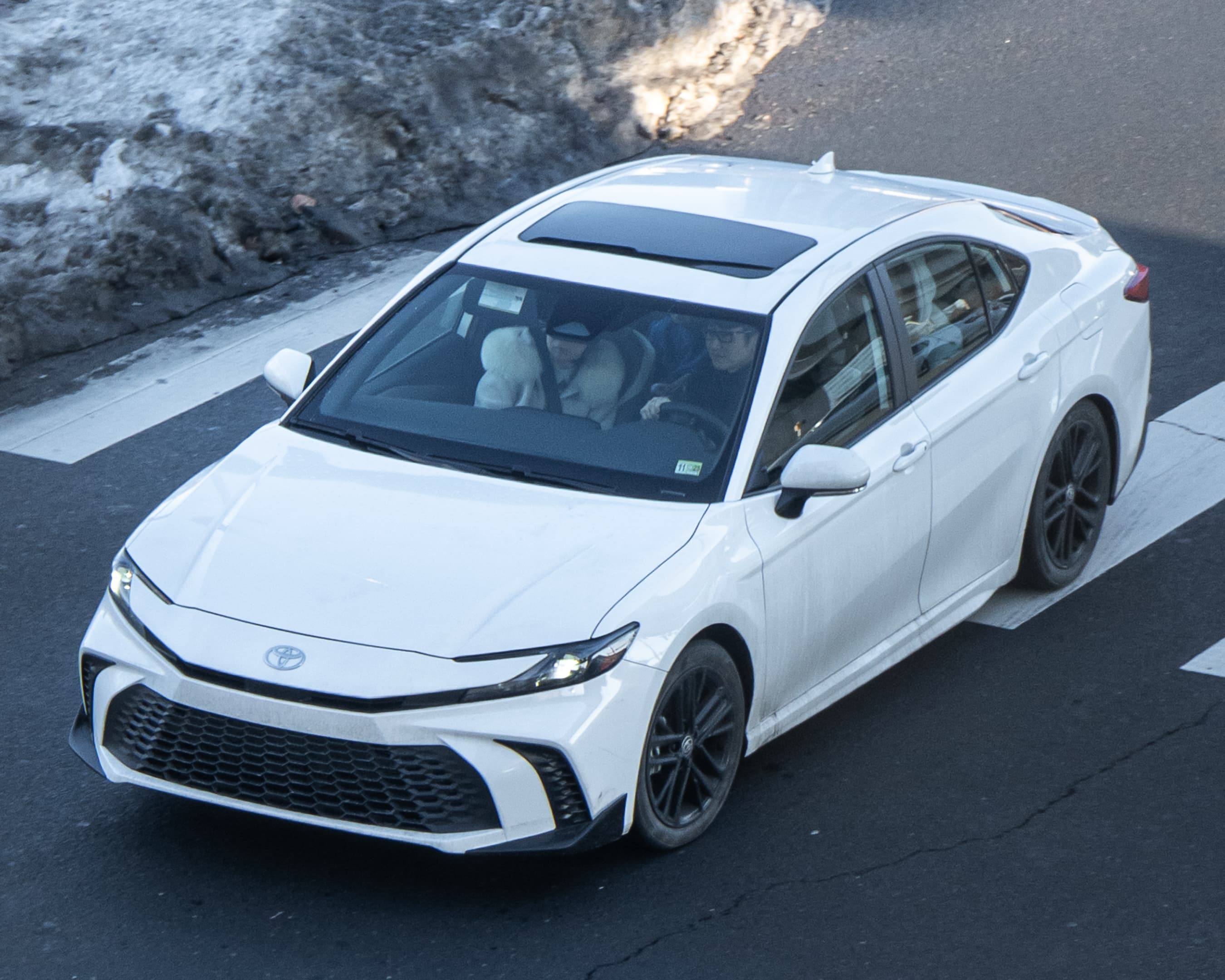
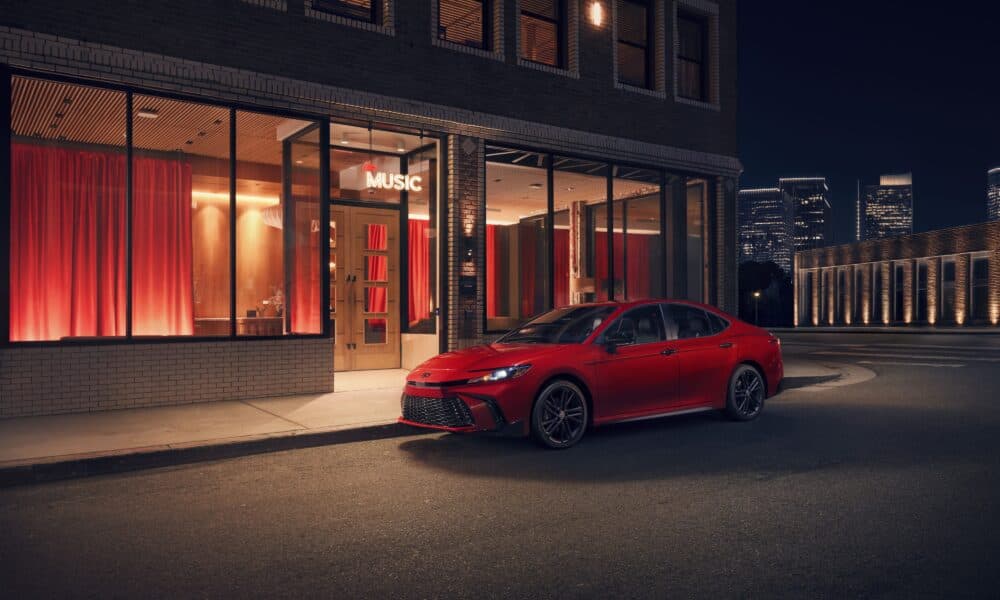
Source Receipts
Source pages, creator credits, and reuse licenses are visible for editorial trust and legal hygiene.
Related Video
2026 Toyota Camry Overview | Toyota
Toyota USA
Embedded from Toyota's official Toyota USA YouTube channel as manufacturer reference media for the 2026 Camry, not an independent MotorRank road test.
Interior
Cabin views before you choose a trim.
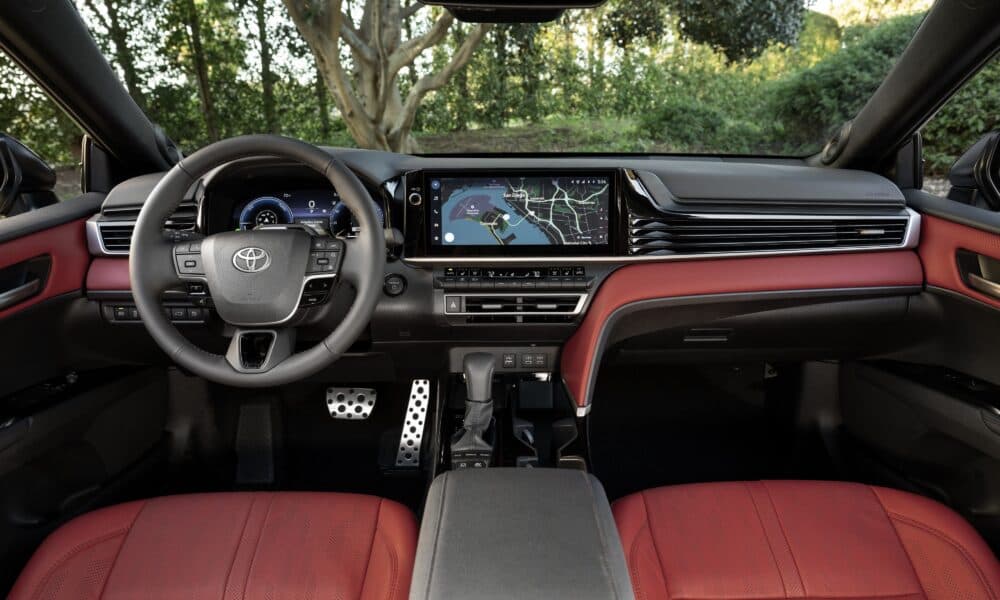
Every Camry gets standard wireless Apple CarPlay and Android Auto; the LE and SE use an 8-inch touchscreen and 7-inch digital cluster, while the XLE and XSE move to 12.3 inches for both. Edmunds scores the in-cabin tech 9.1 out of 10. The honest catches: Edmunds found the front seats firm on long drives, and the premium look in these press photos belongs to the upper trims.
Interior Source Receipts
Research basis
Updated June 10, 2026
Built from Toyota's official 2026 Camry trim pricing and specifications on toyota.com, Toyota's 2026 Camry press materials and December 16, 2025 recall notice on pressroom.toyota.com, the EPA's published fuel-economy ratings for all five 2026 configurations on fueleconomy.gov, and the instrumented tests and impressions of Car and Driver, Edmunds, MotorTrend, and Consumer Reports. All five base MSRPs were verified against toyota.com.
MSRP figures are Toyota's published base prices and exclude the $1,285 Delivery, Processing and Handling fee unless stated otherwise; the $1,525 AWD option price is confirmed via Toyota dealer configurators, U.S. News, and Autoweb's test-car invoice. Acceleration, braking, and observed-MPG figures are attributed to the outlet that measured them. MotorRank has not yet run its own instrumented road test of the 2026 Camry; ride, comfort, and real-world fuel-economy impressions are preview basis.
Update after MotorRank runs an instrumented road test and real-world fuel sampling, once final NHTSA and IIHS crash ratings for the 2026 model year are verified, and once Toyota's hybrid-inverter recall campaign (announced December 16, 2025) reports completion.
Which 2026 TOYOTA CAMRY to Buy
Which trim is right for you?
LE
$29,300
The value and efficiency champion: 51 mpg combined, the full Toyota Safety Sense 3.0 suite, and wireless CarPlay at the lowest price in the lineup.
Our pick
SE
$31,800
The sporty-look pick and Car and Driver's favorite: 18-inch wheels, sport seats, and a black mesh grille — at a 5-mpg combined penalty against the LE.
SE Nightshade
$32,800
New for 2026: the SE dressed in Midnight Black Metallic trim with 19-inch satin-black wheels and gloss-black badging. Appearance only — no mechanical changes.
XLE
$34,500
The comfort flagship: leather- and microfiber-trimmed multi-stage heated front seats, the 12.3-inch touchscreen, and available ventilated seats.
XSE
$35,700
The sport flagship: 19-inch wheels, sport-tuned suspension, and the XLE's tech — the trim Edmunds recommends, and the firmest-riding Camry.
Performance
- Horsepower
- 225hp
- 0–60 mph
- 6.9s
Scorecard
- Performance7.8
- Comfort8.3
- Value8.7
- Ownership8.9
- Technology8.4
- Safety8.7
- Reliability8.8
- Interior8.3
Shopping Tools
Next steps for 2026 Toyota Camry shoppers.
Research tools to help you move from browsing to buying.
Compare rivals
Line up the closest alternatives before you commit.
Check deal signals
Review pricing pressure, incentives, and value angles.
Read owner signal
Balance the expert take with ownership patterns.
Sedan or SUV cross-shop
The other car in every Camry buyer's head. The redesigned RAV4 offers the same hybrid logic with a higher seat and real cargo flexibility — but no RAV4 touches the Camry LE's 51 mpg combined. Read both before you decide which body style your life actually needs.
Open vehicle hub
Keep specs, reliability, rankings, and review links together.
Compare Against
Cross-shop before you commit.
The closest alternatives in this price range, with our read on each.
The driver's-car rival
Honda Accord
The Accord steers and handles better and ties the Camry in Edmunds' scoring — but its base trims are gas-only, it offers no AWD, and Edmunds' head-to-head comparison went to the Camry on economy and value.
The value-and-warranty rival
Hyundai Sonata Hybrid
Cheaper trim-for-trim with Hyundai's longer basic and powertrain warranties. The Camry answers with stronger EPA numbers, available AWD the Sonata lacks, and the longest-proven hybrid system in the class.
The style-first gas alternative
Kia K5
Sharp looks and a lower sticker, but no hybrid option at all — the K5 cross-shop is really the question of whether you want a hybrid, and the Camry's 46-to-51-mpg fuel math is the answer for most commuters.
The sedan-or-SUV question
Toyota RAV4
Same showroom, same hybrid logic, higher seat, and real cargo flexibility — but no RAV4 approaches the Camry LE's 51 mpg combined, and the sedan rides quieter for less money. Choose by how you actually haul.
Buyer FAQ
2026 Toyota Camry buyer questions, answered.
29
buyer answers
Question Map
Decision
Should you buy the 2026 Toyota Camry?
The press consensus is unusually strong — the real questions are which spec, and whether a sedan still fits your life.
Is the 2026 Toyota Camry any good?
Yes — Car and Driver rates it 9/10, MotorTrend 9.5/10, and Edmunds 8.3/10, tied for best in the segment.+
The 2026 Camry earns rare across-the-board acclaim: Car and Driver scores it 9 out of 10, MotorTrend 9.5, and Edmunds 8.3 — tied with the Honda Accord hybrid for first in the class, with Edmunds noting the Camry won its head-to-head comparison. Strengths are efficiency (up to an EPA-rated 51 mpg combined), a roomy cabin, standard safety tech, and Toyota's hybrid warranty depth. The honest knocks: vague steering, firm front seats, engine noise at full throttle, and an open inverter recall on early cars. Our research-basis score is 8.6.
Who should skip the 2026 Camry?
Cargo-haulers, steering-feel enthusiasts, and anyone who cannot verify the recall fix on a specific car.+
Skip the Camry if your life regularly involves bulky cargo — a trunk opening cannot match a hatch, and our 2026 RAV4 review covers the obvious alternative for similar money. Skip it if driving feel is the priority; Car and Driver calls the steering vague, and the Honda Accord remains the driver's choice in this class. And walk away from any specific 2025-2026 car whose dealer cannot document that the December 2025 hybrid-inverter recall work is complete — there are too many clean examples to accept an unverified one.
Is the 2026 Camry different from the 2025?
Only the new SE Nightshade appearance package — otherwise it is a carryover, so a discounted 2025 can be a smart buy.+
The 2025 model year launched the ninth-generation redesign; 2026 adds the SE Nightshade Edition — Midnight Black Metallic trim, 19-inch satin-black wheels, gloss-black badging on the SE grade — and changes nothing mechanical, per Toyota's own release. That means a leftover 2025 is the same car and can be a genuine value, with one caveat: early-build 2025s fall inside the December 2025 inverter-recall population, so confirm the free fix is documented before delivery. The 2026 LE also lists $900 above the 2025's $28,400 launch price.
Why does the 2026 Camry matter right now?
It is America's default sedan gone hybrid-only — the car testing whether mainstream buyers accept an all-hybrid future.+
The Camry has been America's best-selling passenger car for most of two decades, and the ninth generation removed the gas-only option entirely: every 2026 Camry is a 2.5-liter hybrid making 225 horsepower with front-wheel drive or 232 with AWD. That makes it the highest-stakes test of mainstream hybrid acceptance on the market — and for shoppers, it means the old buy-the-cheap-gas-engine playbook is gone. The new playbook, which this review lays out, is trim and drivetrain selection, because that is where a 51-versus-43-mpg gap hides.
Hybrid
Hybrid-only: what a longtime gas-Camry owner needs to know
No more four-cylinder gas option — here is what that actually changes about cost, maintenance, and risk.
Is the hybrid-only Camry a problem for a former gas-Camry owner?
No — entry costs more than the old gas car but less than the old hybrid, and fuel savings repay the difference.+
The hybrid-only lineup means entry now starts at $29,300 instead of the old gas car's lower sticker — but Toyota priced the ninth generation's launch at $28,400, which it said was over $400 below the previous-generation Camry Hybrid. In other words, you are getting the powertrain that used to be the upgrade, at less than the old upgrade price. With EPA ratings of 46 to 51 mpg combined against the old gas car's high-20s-to-30s, the fuel savings compound every year on regular-grade gasoline. There is no plug, no charging, and no change to your routine.
How worried should I be about the hybrid battery?
Toyota covers the battery for 10 years/150,000 miles, transferable — the first decade of risk is mostly Toyota's.+
This is the question returning buyers ask most, and the answer is on the warranty page: Toyota covers the 2026 Camry's hybrid battery for 10 years or 150,000 miles, transferable between owners, plus hybrid components for 8 years/100,000 miles. The battery is the most expensive single part to replace outside coverage, so a decade of protection is concrete financial security, not marketing. The system itself is the fifth generation of the Toyota Hybrid System lineage that has powered millions of vehicles since 1997. We will not claim to know this specific car's 15-year durability — no one can yet — but the warranty timeline is your actual risk map.
Does the hybrid Camry need a plug or special maintenance?
No plug, regular gas, normal Toyota service schedule — plus two years of free ToyotaCare maintenance.+
The Camry is a conventional hybrid, not a plug-in: it charges its own battery while driving and braking, runs on regular-grade gasoline from a 13-gallon tank, and follows the normal Toyota maintenance schedule. ToyotaCare covers factory-scheduled maintenance for the first two years or 25,000 miles at no cost, plus roadside assistance. Day to day the differences are positive — silent electric starts, less brake wear thanks to regenerative braking — and the one quirk to know is the engine's drone under full throttle, which Edmunds flags as its main refinement complaint.
What is the 2026 Camry inverter recall about?
A bolt inside the hybrid inverter can loosen on ~55,000 MY2025-2026 cars — free fix; check any VIN before buying.+
On December 16, 2025, Toyota announced a safety recall covering approximately 55,000 model-year 2025-2026 Camrys and 2026 Corolla Cross Hybrids: a bolt inside the hybrid powertrain's inverter can loosen, which could cause a loss of motive power while driving or, in the worst case, a fire. Toyota's notice says the remedy is free and owners were to be notified by mid-February 2026. Practical takeaway: run any 2025 or 2026 Camry's VIN through Toyota.com/recall or NHTSA's lookup before delivery and require documentation that open recall work is done. Handled properly, it is a procedural step, not a disqualifier.
Real Cost
Price, fees, and what you will actually pay
Five trims from $29,300 to $35,700 before the $1,285 destination fee — and the $1,525 AWD line item.
How much does the 2026 Toyota Camry cost?
Toyota's base MSRPs: LE $29,300, SE $31,800, Nightshade $32,800, XLE $34,500, XSE $35,700 — before the $1,285 fee.+
Toyota's official base prices are $29,300 (LE), $31,800 (SE), $32,800 (SE Nightshade), $34,500 (XLE), and $35,700 (XSE). All-wheel drive adds $1,525 to any trim, and every price excludes Toyota's $1,285 Delivery, Processing and Handling fee, so a real LE starts near $30,585 before tax, title, and registration, and an XSE AWD reaches about $38,535. Car and Driver's destination-inclusive range of $30,595 to $38,520 matches that math. When comparing prices across websites, always confirm whether destination is already folded in.
How much should I actually pay for a 2026 Camry?
Build the math yourself — MSRP plus $1,285 destination plus tax — and shop two dealers; discounts exist on this car.+
Anchor on the structural number: base MSRP, plus $1,525 if AWD, plus the $1,285 fee, plus your state's tax and registration. Anything above that is dealer-added and negotiable — protection packages, nitrogen, doc-fee padding. The Camry sells in enormous volume, which means inventory competition between Toyota stores is your leverage; Edmunds' pricing tool has shown suggested transaction prices below MSRP in some markets. Get complete itemized out-the-door quotes in writing from at least two stores and let them compete. Incentives change monthly and vary by region, so check Toyota's current offers the same day you negotiate.
What is the cheapest 2026 Camry, and is it enough car?
The $29,300 LE — and it is not a penalty box: full safety suite, wireless CarPlay, dual-zone climate, 51 mpg.+
The LE is the cheapest Camry and our recommended trim, and the equipment list explains why that is not a compromise: standard Toyota Safety Sense 3.0, wireless Apple CarPlay and Android Auto on an 8-inch touchscreen, a 7-inch digital cluster, dual-zone automatic climate control with rear vents, LED lighting, and 16-inch alloys. What you give up versus the upper trims is mostly fabric-versus-leather seating and screen size. What you gain is unique: the LE is the only Camry EPA-rated at 51 mpg combined — every other trim drops to 46 or lower.
Is the 2026 Camry expensive compared with its rivals?
Slightly, trim-for-trim — Car and Driver lists price as a con — but the efficiency and warranty close the gap.+
Car and Driver lists being more expensive than rivals among the Camry's lows, and trim-for-trim a Hyundai Sonata Hybrid or Kia K5 typically stickers lower. The counterweights are concrete: no Sonata Hybrid offers AWD, no K5 offers a hybrid at all, the Camry's 51-mpg LE out-economies both, and Toyota's 10-year/150,000-mile battery warranty is the segment's strongest single coverage line. Factor fuel savings over a typical ownership period and the Camry's total cost case usually wins even when its sticker does not — that is the math, not brand loyalty.
Trim
Which 2026 Camry trim should you buy?
The outlets disagree — C/D says SE, Edmunds says XSE, MotorTrend says LE. Here is how to decide for yourself.
Which 2026 Camry trim is the best value?
The LE at $29,300 — cheapest, only 51-mpg trim, and fully equipped where it matters. MotorTrend agrees.+
The LE wins on arithmetic. It is the least expensive Camry, the only one EPA-rated at 51 mpg combined (every other trim is 46 or below), and it carries the full safety suite, wireless CarPlay, and dual-zone climate as standard. MotorTrend independently names the LE its pick. The trims above it sell appearance, bigger screens, and seat upgrades — legitimate wants, but none adds power, and the SE/XSE wheels actively cost efficiency. If you want one sentence: buy the LE unless a specific feature on a specific trim is worth real money to you.
Which 2026 Camry should you stay away from?
No bad trims — but the XSE AWD bought for looks is the weakest value, and unverified-recall cars are the real avoid.+
Nothing in the lineup is a bad car, so the stay-away answer is about value and process. The weakest value is an XSE AWD bought for image: at roughly $38,500 with destination it is the thirstiest Camry at 43 mpg combined — an 8-mpg penalty against the LE — and the firmest-riding, per MotorTrend's note on the SE/XSE suspensions. The genuine avoid is procedural: any model-year 2025-2026 car whose seller cannot document the December 2025 inverter-recall fix. Check the VIN first; clean examples are plentiful.
Is the new Nightshade Edition worth $1,000 over the SE?
Only if the blacked-out look is the point — it is appearance-only, with zero mechanical changes.+
The SE Nightshade adds Midnight Black Metallic treatment across the grille, air curtains, canards, door handles, mirror caps, antenna, diffuser, and spoiler, plus 19-inch satin-black wheels and gloss-black badging — Toyota's release describes no mechanical changes. Car and Driver's instrumented test of a Nightshade returned the same performance class as the SE (7.0 seconds to 60) and praised the well-sorted ride. As a styling package, $1,000 is fairly priced against what dealers charge for less; as a value proposition, it is the SE question again — you are paying for the look, not the hardware.
XLE or XSE — which upper trim makes more sense?
XLE for comfort and the softer ride; XSE only if you want the sport look and accept the firmest, thirstiest spec.+
Both carry the 12.3-inch touchscreen and cluster, heated leather-and-microfiber-trimmed seats, and the premium cabin. The XLE rides on smaller wheels with comfort tuning; the XSE adds 19-inch wheels and sport-tuned suspension — the firmest Camry, per MotorTrend — and drops to 43 mpg combined with AWD. Edmunds recommends the XSE and scored its test car 8.3; we lean XLE because the Camry's character rewards comfort, and the XSE's $1,200 premium buys stiffness this chassis never converts into real sport. Drive both back to back over broken pavement before deciding.
FWD vs AWD
Front-wheel drive or AWD — and what each really returns
Every trim offers AWD for $1,525. The EPA penalty runs from nearly nothing to 3 mpg, depending on trim.
Should you buy the 2026 Camry with AWD?
Yes in snow country — it is $1,525 with almost no MPG penalty on LE/SE/XLE. Skip it in mild climates.+
Toyota's Electronic On-Demand AWD uses a dedicated rear electric motor — no driveshaft — and raises output from 225 to 232 horsepower. The EPA penalty is small on most trims: the LE drops from 51 to 50 combined, and the SE and XLE hold at 46. If you face real winters or a steep driveway, $1,525 is cheap insurance. In mild climates, front-wheel drive plus good tires does the job, and dedicated winter tires on a FWD car beat all-season-shod AWD in genuine snow. The spec to avoid is XSE AWD for image — that is where the penalty hits 43 combined.
What gas mileage does the 2026 Camry actually get?
EPA: 51 combined (LE FWD) down to 43 (XSE AWD). Real-world tests: 38 mpg (Consumer Reports), 34 (Car and Driver).+
The official EPA ratings, verified on fueleconomy.gov: LE FWD 52/49/51 city/highway/combined; SE, Nightshade, XLE, and XSE FWD 47/45/46; LE AWD 50/49/50; SE and XLE AWD 46/46/46; XSE AWD 43/43/43. Real-world results land below the stickers, as hybrids driven hard usually do: Consumer Reports says it measured 38 mpg in mixed driving — 4 mpg better than the previous generation — and Car and Driver observed 34 mpg overall in its testing of an SE Nightshade. Either number is exceptional for a sedan this size on regular gas.
Why does the XSE AWD only get 43 mpg when the LE gets 51?
Wheels, tires, and weight — the 19-inch sport setup and rear motor cost up to 8 mpg combined. Same engine.+
Every Camry uses the identical 2.5-liter hybrid system, so the 8-mpg spread between a 51-mpg LE and a 43-mpg XSE AWD comes entirely from specification: the LE's 16-inch wheels and lighter equipment versus the XSE's 19-inch wheels, wider rubber, sport suspension, added content, and the AWD system's rear motor and weight. That is the trap in the trim walk — the showroom upsell costs you roughly one-sixth of the base car's efficiency before you leave the lot. If maximum economy is why you are buying a hybrid, the LE is the only rational endpoint.
Is the FWD Camry okay in winter without AWD?
Yes with proper tires — front-drive plus winters outperforms AWD on all-seasons in snow.+
Front-wheel drive with a real set of winter tires handles snow-belt commuting well — tires determine braking and cornering grip in snow, which AWD does not improve. AWD's genuine advantage is acceleration traction: pulling away uphill, on ice, or from an unplowed stop. So the honest decision rule: if your winters involve regular snowfall and you would never buy a second tire set, take the $1,525 AWD (on the LE it costs just 1 mpg). If you will run winter tires anyway, FWD is the better-value spec, and the savings buy most of the tire set.
Daily Use
Living with it: comfort, space, and tech
Where the Camry quietly wins — and the firm seats and full-throttle drone the spec sheet hides.
Is the 2026 Camry comfortable for daily driving?
Yes — composed ride and quiet cabin on LE/XLE; firmer on 19-inch trims, with firm front seats per Edmunds (preview basis).+
On preview basis, attributed to the outlets that have driven it: the Camry rides with calm, well-damped composure — Car and Driver called its Nightshade test car's ride well-sorted, and Consumer Reports notes it rides well — and the hybrid's silent low-speed running makes city driving notably relaxed. The caveats are consistent too: the SE and XSE's 19-inch wheels firm things up (MotorTrend's con), Edmunds found the front seats firm after long stints, and the engine drones at full throttle. Test-drive over your actual roads, ideally an LE or XLE against an XSE, and judge the seats on a long loop.
How big are the 2026 Camry's back seat and trunk?
38.0 inches of rear legroom and a 15.1-cubic-foot trunk — full family-size, with no hybrid-battery intrusion.+
Per Toyota's published specifications, the Camry offers 38.0 inches of rear legroom, 42.1 up front, 99.9 cubic feet of passenger volume, and a 15.1-cubic-foot trunk with split-folding rear seats — all on a 111.2-inch wheelbase and 193.5 inches of length. The hybrid battery no longer steals trunk space, a real change from older hybrid sedans. Two adults ride comfortably in back, three fit for around-town trips, and rear-facing child seats install without crushing the front passenger. If you routinely haul bulky cargo, that trunk opening — not the volume — is the constraint; see our RAV4 cross-shop.
How good is the 2026 Camry's infotainment and tech?
Excellent — Edmunds scores the cabin tech 9.1/10; wireless CarPlay/Android Auto standard on every trim.+
Every 2026 Camry includes wireless Apple CarPlay and Android Auto as standard — no trim ladder games with smartphone mirroring. The LE and SE use an 8-inch touchscreen with a 7-inch digital cluster; the XLE and XSE move to 12.3 inches for both, and physical climate controls remain on all trims. Edmunds rates the in-cabin tech 9.1 out of 10, its highest sub-score for the car. The practical notes: native connected navigation runs on a trial-then-subscription basis, so plan to live in CarPlay/Android Auto, and the bigger screen alone is not worth a $5,200 walk from LE to XLE unless the comfort gear matters too.
Ownership
Reliability, warranty, resale, and the recall
The strongest part of the Camry case — handled honestly, including the open recall and what we cannot yet know.
Is the 2026 Toyota Camry reliable?
The nameplate's track record and CR's positive coverage say yes — but the ninth generation is young, and one recall is open.+
We do not publish reliability scores we cannot source, so on attribution: the Camry carries one of the strongest reliability reputations in the industry, Consumer Reports' published 2026 coverage is positive, and the hybrid system is the fifth generation of a lineage proven at massive scale since 1997. The honest caveats: this generation is two model years old, the long-term owner data that made the old Camry a known quantity does not yet exist for this one, the December 2025 inverter recall shows early-production teething is real, and MotorTrend lists build-quality concerns among its cons. Our reliability score reflects reputation and warranty depth, clearly labeled as editorial judgment.
What are the common problems with the 2026 Camry?
One documented safety recall (hybrid inverter bolt); beyond that, owner gripes center on infotainment quirks and road noise.+
The documented item is the December 16, 2025 safety recall: a hybrid-inverter bolt that can loosen on roughly 55,000 MY2025-2026 Camrys and Corolla Cross Hybrids, risking loss of drive power or fire — fixed free, verifiable by VIN. Beyond that, no widespread defect pattern is documented for the 2026 model as of June 10, 2026. Owner content in the search results — six-month ownership threads, complaint videos — skews positive overall and surfaces small irritations: infotainment quirks and road noise on coarse pavement come up most. We treat those as test-drive checkpoints, not verified patterns.
What warranty does the 2026 Camry have, and does it hold its value?
3yr/36k basic, 5yr/60k powertrain, 8yr/100k hybrid parts, 10yr/150k battery — and Camry resale is historically strong.+
Toyota's stated coverage: 36 months/36,000 miles basic, 60 months/60,000 miles powertrain, 8 years/100,000 miles on hybrid components, and 10 years/150,000 miles on the transferable hybrid battery warranty, plus two years/25,000 miles of ToyotaCare scheduled maintenance. The basic and powertrain terms trail Hyundai and Kia's published 5/60 and 10/100 coverage — a fair criticism — but the battery line is the one that matters most on a hybrid, and it is the longest in the mainstream class. On resale: the Camry's record is historically excellent, and we will not attach a specific residual percentage we have not sourced for this generation.
Compare
What should you cross-shop before signing?
Straight choose-this-if verdicts against the Accord, Sonata Hybrid, K5 — and Toyota's own RAV4.
2026 Camry or Honda Accord?
Camry for economy, AWD, and warranty depth; Accord for steering feel — Edmunds' comparison went to the Camry.+
These two effectively tie at the top — Edmunds scores both 8.3, and its head-to-head comparison test went to the Camry. Choose the Camry for fuel economy (the 51-mpg LE beats any Accord), available AWD (the Accord has none), standard hybrid power at the base price (the entry Accords are gas-only), and the 10-year battery warranty. Choose the Accord if steering feel and chassis polish matter most — Car and Driver still rates the Honda the better driver's car — and if its larger cabin and trunk-opening practicality fit your family better. Neither is a mistake; the Camry is the better appliance, in the best sense.
2026 Camry vs Hyundai Sonata Hybrid or Kia K5?
Sonata Hybrid undercuts on price with a longer basic warranty; the K5 has no hybrid at all. The Camry out-economies both.+
The Sonata Hybrid is the serious alternative: typically cheaper trim-for-trim, striking design, and Hyundai's longer 5-year/60,000-mile basic and 10-year/100,000-mile powertrain warranties. The Camry counters with better EPA numbers, AWD availability the Sonata Hybrid lacks entirely, and the longer-proven hybrid system. The Kia K5 is a styling-and-price play with no hybrid option — cross-shopping it really means deciding whether you want a hybrid at all, and at 12,000 miles a year the Camry's fuel math answers that. If sticker price is everything, drive the Hyundai; if total cost and flexibility are, the Camry wins.
Should you buy a Camry or step up to a Toyota RAV4?
Camry for efficiency, ride, and driving feel; RAV4 for cargo flexibility and the high seat. Be honest about which you use.+
This is the real decision happening in Toyota showrooms. The redesigned 2026 RAV4 offers the same hybrid logic with a higher seating position and genuine cargo flexibility — dogs, bikes, flat-pack furniture — that a 15.1-cubic-foot trunk cannot match. The Camry answers with efficiency no RAV4 touches (51 versus the RAV4's lower combined ratings), a quieter, lower, more composed ride, and less money for comparable equipment. Our straight call: if you regularly use cargo volume, read our 2026 RAV4 review and buy the SUV; if your miles are people-in-seats commuting and road trips, the sedan is the better drive and the cheaper one to feed.
Ready to buy?
Configure your 2026 Toyota Camry.
Get matched with a Toyota dealer or build your spec sheet from scratch.