
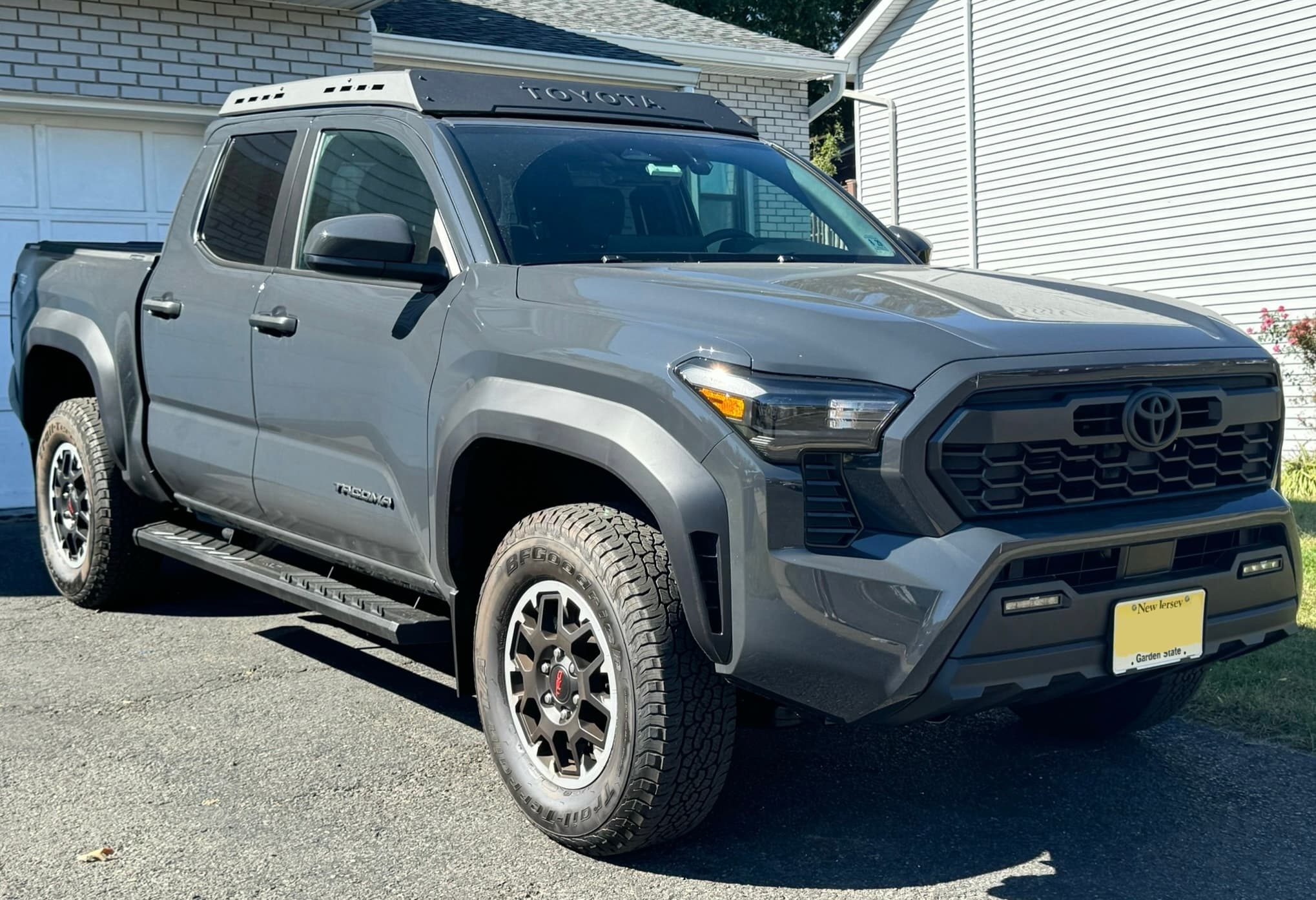
REVIEWS / Midsize Trucks
NEW2026 Toyota Tacoma Review
America's best-selling midsize pickup spans eleven configurations, two cabs, three drivetrains, a hybrid, and the segment's last manual gearbox — which is exactly why the 2026 buying decision needs more than a one-sentence trim tip.
Published June 1, 2026 / Updated June 4, 2026
Expert verdict
The 2026 Toyota Tacoma is the most complete midsize-truck lineup on sale: a $32,445 SR work truck, a rear-drive TRD PreRunner desert special, genuine trail hardware from the TRD Off-Road up, a 326-horsepower i-FORCE MAX hybrid, and the only manual transmission left in the class, all before the $1,745 Delivery, Processing and Handling fee. It is not the segment's best tow rig — 6,500 pounds maximum, and the hybrid caps at 6,000 — and the lower trims ride stiffer than the brochure suggests. For most buyers the smart money is the gas 4WD TRD Off-Road at $42,715, or the SR5 at $36,535 if the truck is mostly a daily driver, and we resolve the gas-versus-hybrid call below instead of splitting it across two pages.
HIGHS
- Unmatched lineup breadth: 11 configurations, two cabs, two beds, gas, hybrid, and the segment's last manual
- Real trail hardware from $42,715: Bilstein reservoirs, locking rear diff, available sway-bar disconnect
- 326-hp i-FORCE MAX hybrid with 465 lb-ft and a 2,400-watt onboard power supply
- Toyota Safety Sense 3.0 standard on every truck, including the $32,445 SR
- Segment-benchmark resale and durability reputation; zero NHTSA recalls on the 2026 as of June 10, 2026
- Coil-spring rear suspension on most trims makes it far more livable than the old truck
LOWS
- Max towing of 6,500 lbs trails the Colorado (7,700) and Ranger (7,500) — and hybrids cap at 6,000
- Stiff ride on lower trims and a gritty-sounding four-cylinder (attributed: Edmunds, Consumer Reports)
- Hybrid is gated to TRD Sport and above, and its payoff is torque and power export, not MPG
- Double Cab back seat is tight for adults; XtraCab seats only two
- Trailhunter and TRD Pro reach $63,650-$64,650 before the $1,745 fee — full-size-truck money
AT A GLANCE
- Score
- 7.9
- Price
- $32.4K - $64.7K
- Horsepower
- 278 hp
- Drivetrain
- 4WD
- Body
- Truck
- Fuel
- Gas
Buyer Verdict
The fast answer before you compare specs.
Built for shoppers who want the recommendation first and the details right after.
Buy it if
- The 2026 Toyota Tacoma is the midsize pickup to buy for lineup breadth and long-term ownership value, and the smart buy is specific: the gas 4WD TRD Off-Road at $42,715, or the SR5 at $36,535 if the truck is mostly a daily driver. Pay for the i-FORCE MAX hybrid for its 465 lb-ft of torque and 2,400-watt power supply — not for fuel economy, and know it tows less (6,000 vs 6,500 pounds). If heavy towing or rear-seat space lead your list, cross-shop the Colorado and Ranger first.
- Best for: Buyers who want the midsize segment's widest choice of genuinely different trucks — work, street, trail, overland, hybrid, even a manual — backed by the class-benchmark durability and resale reputation, and who tow 6,000 pounds or less.
- Our trim pick: TRD Off-Road from $42,715.
Skip it if
- Max towing of 6,500 lbs trails the Colorado (7,700) and Ranger (7,500) — and hybrids cap at 6,000
- Stiff ride on lower trims and a gritty-sounding four-cylinder (attributed: Edmunds, Consumer Reports)
- Hybrid is gated to TRD Sport and above, and its payoff is torque and power export, not MPG
Closest rivals
- Ford Ranger
The all-around scorecard rival
- Chevrolet Colorado
The towing and turbo-grunt rival
- Nissan Frontier
The simple-value alternative
Quick take
If you are shopping the 2026 Toyota Tacoma, you have probably opened the Car and Driver review, skimmed an Edmunds scorecard, fallen into a Reddit reliability thread, and still not gotten an answer to the question that actually matters: which of the eleven configurations should you buy, and is the hybrid worth it? This Research Desk review is built to answer that. The Tacoma — by Toyota's own accounting, America's best-selling midsize pickup for more than two decades — is in the third year of its fourth-generation redesign on the TNGA-F platform shared with the Tundra, Land Cruiser, and our 2026 Toyota 4Runner. The 2026 lineup runs from a $32,445 SR to a $64,650 TRD Pro before the $1,745 destination fee, with two turbocharged 2.4-liter powertrains, two cab styles, two bed lengths, three drivetrain layouts, and the last manual gearbox in the segment.
This is a buyer-research review built from Toyota's official 2026 Tacoma pricing and specifications on toyota.com and Toyota's press materials, the EPA's published fuel-economy ratings, NHTSA's recall database, and the instrumented test data and impressions of Car and Driver, Edmunds, Consumer Reports, The Car Connection, and Motor Authority — each attributed to the outlet that produced it. It is not a MotorRank instrumented road test. We have not independently measured acceleration, braking, fuel economy, or cabin noise, and we do not publish reliability scores, repair-cost figures, or resale percentages we cannot source. Where a number is Toyota-official we say so; where it is a third party's measured result we name them; where it is an expectation we have not verified, we label it preview basis.
Driving impressions
Why the Tacoma matters
The Tacoma matters because it is the default answer in its segment — the truck everything else is cross-shopped against — and because the fourth generation fixed most of what made the old one feel ancient while keeping the ownership story that made it the default. The coil-spring multi-link rear suspension on most trims transformed the ride, the cabin finally got modern screens and Toyota Safety Sense 3.0 standard, and the i-FORCE MAX hybrid brought 326 horsepower and 465 pound-feet to a class that had neither. What did not change is the reason people pay Tacoma money in the first place: a durability and resale reputation that is the benchmark of the midsize-truck segment. The catch is that the lineup is now genuinely complicated — eleven price points across eight grades — and the pages ranking above this one mostly hand you a single-sentence trim tip and move on.
What to watch before you buy
Watch three things before you sign. First, towing: the Tacoma's 6,500-pound maximum trails the Chevrolet Colorado's 7,700 and Ford Ranger's 7,500, and the i-FORCE MAX hybrid is capped lower still at 6,000 pounds — if heavy, regular towing is the mission, this is the wrong default. Second, ride and refinement: Edmunds is blunt that lower trims ride stiffly, Consumer Reports says the turbo four sounds gritty and unrefined under load, and the Double Cab back seat is tight for adults. Third, the fee stack and the hybrid gate: every MSRP here excludes the $1,745 Delivery, Processing and Handling fee, the hybrid is not offered below the TRD Sport, and the Trailhunter and TRD Pro are the trims most likely to wear dealer markups.
SERP audit: who the 2026 Tacoma has to beat right now
Before writing a word of buyer advice, we audited the live results for the query buyers actually type — 2026 Toyota Tacoma review. The number-one editorial result is Car and Driver's model hub (caranddriver.com/toyota/tacoma), a 9/10 review updated in February 2026. Behind it sit a Reddit r/ToyotaTacoma reliability thread, an independent blog drive review, YouTube walkarounds, Consumer Reports' paywalled road-test report, Edmunds' driven-tested-rated review (6.8/10, published April 2026), The Car Connection, J.D. Power, Capital One's shopping page, dealer marketing pages, and Toyota's own configurator. It is a commercially crowded page with surprisingly little decision help on it.
Here is the opening those pages leave. Car and Driver scores the truck 9/10 but names its recommended SR5 in roughly a sentence, and the pricing module it displays runs $34,190 to $46,060 with destination — it never prices the Limited, Trailhunter, or TRD Pro at all. Edmunds is the most honest about the stiff ride and the Ford Ranger ranking above the Tacoma on its scorecard, but it scatters the answer across separate articles: the rating review names no trim, while a separate price guide names the TRD Sport its editors' pick. Consumer Reports is paywalled. And none of the top results leads with the two facts a cross-shopper most needs: the hybrid tows less than the gas truck, and the trim ladder spans $32,000 of price with three different right answers depending on use case.
So this review is organized to beat exactly those gaps: every one of the eleven configurations priced from toyota.com, a budget-by-use-case trim verdict, the gas-versus-hybrid call resolved on one page including the towing twist, honest ownership and recall context from NHTSA, and cross-shop verdicts against the Ranger, Colorado, Frontier, and our own 2026 Toyota 4Runner review. Every Toyota figure below was checked against toyota.com or Toyota's press materials on June 10, 2026, every fuel-economy number against the EPA, and the recall record against NHTSA's database the same day.
The bottom line up front: is the 2026 Tacoma worth buying?
Yes, for most midsize-truck shoppers — with two honest exceptions. Buy the Tacoma if you want the segment's widest range of genuinely different trucks and its strongest long-term ownership reputation, and you tow 6,000 pounds or less. Skip it if you tow heavy and often — the Colorado and Ranger carry higher ratings — or if your real priority is the softest ride and roomiest back seat in the class, where the unibody Honda Ridgeline and the Ranger both counter and Edmunds' scorecard, which slots the Tacoma below the Ranger, is worth taking seriously.
Our research-basis score is 7.9 out of 10. That reflects real strengths — the breadth of the lineup, true trail hardware from $42,715, the 326-horsepower hybrid option, standard Toyota Safety Sense 3.0 on every truck, and the resale-and-durability story that defines the nameplate — balanced against weaknesses every outlet confirms: a stiff ride on lower trims, a coarse-sounding four-cylinder, a tight Double Cab back seat, towing that trails the class leaders, and flagships that now cost full-size-truck money. For most buyers the answer is the gas 4WD TRD Off-Road at $42,715; the SR5 at $36,535 is the value play if the truck is mostly a commuter that occasionally works.
Official pricing: all eleven 2026 Tacoma configurations, plus the $1,745 fee
Here is the full, Toyota-official base-MSRP ladder for the 2026 Tacoma, verified against toyota.com on June 10, 2026. SR $32,445; SR5 $36,535; TRD PreRunner $39,035; TRD Sport $40,315; TRD Off-Road $42,715; TRD Sport i-FORCE MAX $47,235; TRD Off-Road i-FORCE MAX $47,535; Limited $53,470; Limited i-FORCE MAX $56,795; Trailhunter $63,650; and TRD Pro $64,650. Toyota markets the lineup as eight grades; the eleven price points exist because the i-FORCE MAX hybrid versions of the TRD Sport, TRD Off-Road, and Limited are priced as their own configurations, just as Toyota does with the 4Runner.
Every number above excludes Toyota's Delivery, Processing and Handling fee, which for the Tacoma and Tacoma Hybrid is $1,745 — the midsize-pickup rate, higher than the $1,450 Toyota charges on the 4Runner. It is not optional and not set by the dealer. That means the real starting point for an SR is $34,190 before tax, title, and registration, and a TRD Pro lands at $66,395 before a dollar of dealer markup. As a sanity check, those destination-inclusive figures match what Car and Driver and Edmunds display to the dollar, so when a third-party site shows higher numbers than toyota.com, it is usually just folding the fee in — compare like with like.
One timing note worth knowing: when Toyota announced the 2026 Tacoma in November 2025, the press release quoted a starting price of $32,145. By June 2026, toyota.com lists the SR at $32,445 — a roughly $300 mid-year nudge. Pricing on this page reflects toyota.com as of June 10, 2026; if you are reading this later, expect small drifts rather than big swings, and always anchor on the configurator's current number for the exact cab, bed, and drivetrain you want, since 4WD, the longer bed, and packages all move the figure from these bases.
i-FORCE vs i-FORCE MAX: the hybrid call, with the towing twist nobody leads with
The engine room, in Toyota-official numbers. The standard i-FORCE is a 2.4-liter turbocharged four making 278 horsepower and 317 pound-feet with the 8-speed automatic, or 270 horsepower and 310 pound-feet with the 6-speed manual; the base SR runs a detuned version at 228 horsepower and 243 pound-feet. The i-FORCE MAX hybrid adds an electric motor-generator to the same engine for 326 horsepower and 465 pound-feet, automatic only, and includes a 2,400-watt AC power supply in both the cabin and the bed. The hybrid is available on the TRD Sport, TRD Off-Road, and Limited, and standard on the Trailhunter and TRD Pro — it does not exist below the TRD Sport.
Now the two facts that should anchor the decision. Fuel economy first: the EPA rates the hybrid 4WD at 22 city, 24 highway, 23 combined, against roughly 20/23/21 for the gas 4WD trucks — a one-to-two mpg combined gain — and the gas 2WD models match the hybrid's 23 combined outright. Towing second, and this is the twist the top-ranking reviews bury: the hybrid tows less. Toyota rates the gas Tacoma to a 6,500-pound maximum; hybrid models cap at 6,000 pounds, a limit Car and Driver flags in its review. If you came to the hybrid for capability, the capability case is torque and effort, not rated capacity.
Our verdict, in one place. Buy the gas i-FORCE if you are a value buyer, you tow near the limit, you want the manual, or your truck lives on the highway — it is cheaper, tows more, and gives up nothing meaningful at the pump. Pay for the i-FORCE MAX if you want the 465 pound-feet for effortless around-town and grade pulling, you will actually use the 2,400-watt power export for tools or camp, or you are buying a Trailhunter or TRD Pro where it is the only choice. Car and Driver's blunt assessment is that the hybrid's benefits do not justify its higher price, and on toyota.com's base prices the gap runs from $3,325 on the Limited to $6,920 on the TRD Sport — though part of that spread reflects the hybrid bundling 4WD that the cheapest gas configurations skip, so build both versions of your exact truck before you decide.
Fuel economy: what the EPA numbers actually say
The official EPA ratings for 2026, all on regular gasoline. Gas 2WD trucks rate up to 21 city, 26 highway, 23 combined (the SR's detuned engine posts 20/26/23). Gas 4WD models land at 20/23/21, with some configurations at 19/24/21 or 19/23/21 depending on trim and tires. The 6-speed manual, offered only with 4WD, is the thirstiest at 18/23/20. The i-FORCE MAX hybrid 4WD rates 22/24/23. Net: every 2026 Tacoma is a low-20s truck in combined EPA terms, and the spread between the best gas configuration and the hybrid is effectively zero on paper.
Three practical takeaways. The hybrid's edge is city torque and the power supply, not economy — against the 4WD gas trucks it gains about two combined mpg, and against 2WD gas trucks it gains nothing. The manual costs you roughly one combined mpg and about a second to 60 mph (Car and Driver measured 7.9 seconds for the manual against 7.0 for the 278-hp automatic), so you are buying it for engagement, not numbers. And real-world results land close to the sticker: Edmunds reports averaging 22.6 mpg in its evaluation against a 21-mpg EPA estimate for its test truck. If 30 mpg is the goal, no Tacoma gets there — that is Ford Maverick hybrid territory, a size class down.
The last stick-shift pickup: should you buy the manual?
The Tacoma is the only pickup sold in America with a manual transmission, and Toyota's 6-speed intelligent manual — offered on select i-FORCE configurations of the SR, TRD Sport, and TRD Off-Road with 4WD — includes rev-matching and stall-avoidance logic, so it is friendlier in traffic and on trails than old-school sticks. The cost is measurable: output drops to 270 horsepower and 310 pound-feet, EPA economy falls to 18/23/20, and Car and Driver's testing puts the manual at 7.9 seconds to 60 against 7.0 for the automatic.
Our advice is honest and simple: buy the manual because you want a manual. It is slower, thirstier, and it cannot pair with the hybrid — but it is also the last of its kind in the class, it makes a TRD Off-Road feel more like an instrument and less like an appliance, and the rev-matching makes it easy to live with. If that paragraph made you smile, order it without guilt. If it did not, the 8-speed automatic is objectively the better truck.
Choosing a trim, part 1: SR, SR5, and TRD PreRunner
The SR at $32,445 is the honest work truck. It runs the 228-horsepower version of the i-FORCE turbo, comes as a Double Cab with the 5-foot bed or a two-seat XtraCab with the 6-foot bed, and for 2026 adds a standard tow hitch on XtraCab models. It still gets the 8-inch touchscreen with wireless Apple CarPlay and Android Auto and the full Toyota Safety Sense 3.0 suite. Buy it as a fleet or jobsite tool; for personal use, the engine and equipment gap to the SR5 is worth closing.
The SR5 at $36,535 is the value pick for daily drivers, and it is the trim both Car and Driver and The Car Connection point shoppers toward — The Car Connection specifically likes the Double Cab with the SR5 Upgrade and Cold Weather packages. You get the full 278-horsepower engine, the coil-spring multi-link rear suspension on Double Cab models (XtraCabs keep leaf springs), and the only trim with a choice of 5- or 6-foot bed on the Double Cab. If your truck is a commuter that hauls bikes, mulch, and the occasional rental trailer, this is the rational answer.
The TRD PreRunner at $39,035 is the lineup's oddball and its most distinctive idea: a two-seat, rear-drive-only XtraCab with the 6-foot bed, a front suspension lift, 32-inch all-terrain tires, and an electronically controlled locking rear differential, per Toyota's configurator and Edmunds' price guide. It is a Baja-style desert runner for people who do not need four seats or 4WD — a niche tool, but nothing else in the segment offers the formula. Edmunds clocked one at 7.1 seconds to 60, the quickest gas Tacoma it tested, which tracks with the lighter two-seat body.
Choosing a trim, part 2: TRD Sport and TRD Off-Road
The TRD Sport at $40,315 ($47,235 as a hybrid) is the street truck: sport-tuned suspension, the aggressive look including the 2026 black front logo, the available manual, and the available JBL audio. Edmunds' price guide names it the editors' pick for balancing cost and features, and if your Tacoma will live on pavement, that logic holds. But it carries no locking differential and no trail-specific hardware, so do not pay TRD Sport money expecting TRD Off-Road ability — the badge is the giveaway, not the guarantee.
The TRD Off-Road at $42,715 ($47,535 as a hybrid) is our default recommendation for the buyer who wants what the Tacoma nameplate actually promises. It adds Bilstein monotube shocks with piggyback reservoirs and an end-stop control valve, the electronic locking rear differential, Multi-Terrain Select in both 4WD-High and 4WD-Low, next-generation CRAWL Control, and the available Stabilizer Disconnect Mechanism that frees the front sway bar at the push of a button. The hybrid version rides on 33-inch Falken WildPeak all-terrain tires, and a new-for-2026 i-FORCE Premium Package brings 18-inch TRD wheels with 32-inch Goodyear all-terrains to the gas truck. For $2,400 over a TRD Sport, you buy the difference between looking the part and doing the job.
Choosing a trim, part 3: Limited, Trailhunter, and TRD Pro
The Limited at $53,470 ($56,795 as a hybrid) is the comfort Tacoma: full-time 4WD with an electronic locking center differential, Adaptive Variable Suspension that is standard on all Limiteds for 2026, heated and ventilated SofTex front seats, walnut burl-wood trim, power running boards, a head-up display, the 14-inch touchscreen, JBL audio with the removable FLEX portable speaker, a digital rearview mirror, and a power moonroof. It is the right truck for the buyer who wants Tacoma durability with crossover civility — just notice that a loaded Limited hybrid costs more than some well-equipped half-ton trucks, which is the honest cross-shop at that money.
The Trailhunter at $63,650 is the factory overlander, hybrid-only, and the only flagship offered with either the 5- or 6-foot bed. The hardware is genuinely specialized: Old Man Emu 2.5-inch forged monotube shocks with rear piggyback reservoirs, a low-profile high-mount air intake, 33-inch Goodyear Rugged-Terrain tires on bronze 18-inch wheels, a high-clearance front bumper, rock rails, an ARB steel rear bumper with recovery points, an ARB modular sport bar with MOLLE panels, and RIGID color-selectable fog lamps. Buy it if you are building a loaded expedition rig and want the warranty-backed factory version of the build you were pricing anyway.
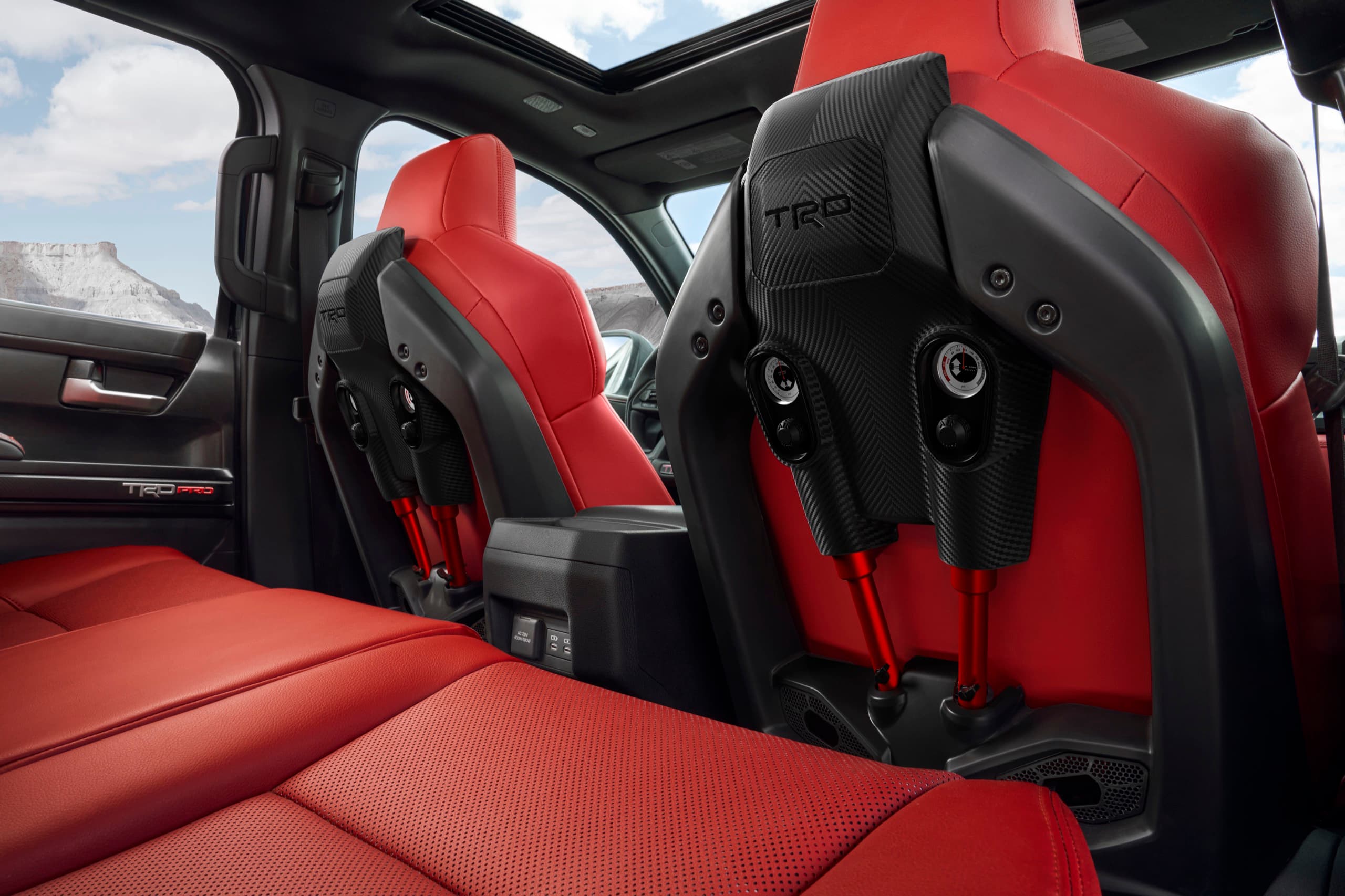
The TRD Pro at $64,650 is the Baja flagship, also hybrid-only: TRD-tuned FOX QS3 three-way adjustable shocks with rear piggyback reservoirs and external FOX IFP bump stops, the segment-first IsoDynamic Performance front seats with their own air-over-oil dampers to stabilize your head on rough terrain, a TRD performance air intake and dual-tip exhaust, 33-inch Goodyears on black 18-inch wheels, and the exclusive Wave Maker color that began reaching dealers in March 2026. It is the high-speed tool of the pair — and both flagships are the configurations most likely to wear dealer markups, so shop them across multiple stores.
The trim verdict, by buyer type
Because the top-ranking reviews hand you one trim name in one sentence, here is the matrix none of them publishes. Best value daily driver: the SR5 Double Cab at $36,535, with the coil rear suspension and the 278-horsepower engine. Best all-around buy for most shoppers: the gas 4WD TRD Off-Road at $42,715 — the cheapest Tacoma with the full capability hardware. Best hybrid: the TRD Off-Road i-FORCE MAX at $47,535, which costs just $300 more than the hybrid TRD Sport and adds the trail kit. Best work truck: the SR XtraCab with its now-standard tow hitch. Best two-seat toy: the TRD PreRunner, if its rear-drive desert-runner formula matches how you actually play.
Best comfort-and-towing daily: the gas Limited, whose full-time 4WD and adaptive dampers make it the easiest Tacoma to live with while keeping the 6,500-pound rating the hybrid gives up. Best overland base: the Trailhunter. Best high-speed off-roader: the TRD Pro. Easiest to skip: the TRD Sport for buyers who will ever leave pavement (the Off-Road is $2,400 away), and the Limited i-FORCE MAX for value buyers, because at $56,795 plus fees you have left the midsize value argument entirely. And if you read this list and realized you mostly need a comfortable family hauler that rarely hauls — read our cross-shop section before you spend Tacoma money.
Off-road capability: geometry, lockers, and the sway-bar disconnect
The hardware, per Toyota: an electronically controlled locking rear differential comes on the TRD PreRunner, TRD Off-Road, Trailhunter, and TRD Pro; part-time 4WD trucks use a two-speed transfer case; the Limited runs full-time 4WD with a locking center differential. Multi-Terrain Select offers terrain-specific traction modes in both high and low range, next-generation CRAWL Control works as low-speed off-road cruise, Downhill Assist Control manages descents, and the Multi-Terrain Monitor on the 14-inch screen shows trail obstacles. The headline piece is the Stabilizer Disconnect Mechanism — standard on Trailhunter and TRD Pro, available on TRD Off-Road — which electronically frees the front sway bar for more articulation and even works with Toyota-approved lift kits. Underbody protection and front recovery hooks are standard on every Tacoma, with rear recovery points on the flagships.
The geometry, attributed to Motor Authority's test of the two flagships: the TRD Pro carries 11.5 inches of ground clearance with a 35.7-degree approach angle, 27.4-degree breakover, and 25.3-degree departure; the Trailhunter runs 11.0 inches, 35.2 degrees approach, 24.0 breakover, and 22.3 departure. Toyota does not publish a full geometry table per trim on its consumer site, so we will not invent figures for the lower grades. The plain-English ladder mirrors the 4Runner's: TRD Off-Road for 90 percent of real trail use at $21,000 less than the flagships, Trailhunter for loaded overlanding, TRD Pro for speed, and the TRD Sport and PreRunner as styling-and-desert specialists rather than rock crawlers.
Towing and payload: the honest 6,500-pound conversation
Toyota rates the 2026 Tacoma to tow a maximum of 6,500 pounds with payload up to 1,705 pounds — official figures, achieved on specific gas configurations, so check the rating for your exact cab, bed, and drivetrain rather than assuming the headline number. The i-FORCE MAX hybrid caps at 6,000 pounds, as Car and Driver also notes. The tow-tech menu is genuinely modern: an available integrated trailer brake controller, Trailer Back Up Guide with Straight Path Assist and a simulated 360-degree top-down view, an available Wireless Trailer Camera feeding the digital rearview mirror, a new manual headlight-leveling switch for loaded driving, and Tow/Haul mode standard on every hybrid.
The honest context: the Tacoma is mid-pack on rated capacity. The Chevrolet Colorado tows up to 7,700 pounds, the Ford Ranger 7,500, and the Nissan Frontier 7,150 — all above the Tacoma's best number, a gap Car and Driver calls out directly. If your trailer weighs under 5,500 pounds — most boats, campers, and equipment trailers people actually pull — any properly equipped Tacoma handles it, and the hybrid's 465 pound-feet makes the pulling feel easy even though its rating is lower. If you regularly tow above 6,000 pounds, buy the gas truck for the rating, or be honest with yourself and cross-shop the Colorado or a discounted half-ton, then run the payload math: passengers plus tongue weight come out of that roughly 1,700-pound budget fast.
Cab, bed, and the back seat: the packaging decision
Every Tacoma is one of two bodies. The Double Cab has four full doors and seats five, with the 5-foot bed standard and the 6-foot bed available on SR5 and Trailhunter. The XtraCab — offered on SR, SR5, and TRD PreRunner — seats two, pairs only with the 6-foot bed, and replaces the back seat with a utility-focused storage area including lockable compartments and a fold-flat passenger seat that doubles as a workspace. Hybrid trucks add the 2,400-watt AC power supply with outlets in both the cabin and the bed, which is a genuine jobsite and campsite feature, not a gimmick.
The packaging honesty: the Double Cab's rear seat is tight for adults — Edmunds lists the limited rear-seat space among its main criticisms, and it is the most common complaint in owner threads. If rear passengers are occasional kids, it is fine; if you carry adults regularly, sit in the back before you buy, and consider that the Ford Ranger and Honda Ridgeline both package rear passengers better. The flip side is that the XtraCab is a quietly excellent work configuration that rivals have abandoned — if the back seat in your current truck is really a parts shelf, the XtraCab with its 6-foot bed and standard hitch is the more honest tool.
Technology and safety
The tech baseline is strong for the class. Every Tacoma gets Toyota's latest Audio Multimedia system with wireless Apple CarPlay and Android Auto on an 8-inch touchscreen, with the 14-inch screen available; i-FORCE MAX trucks add a 12.3-inch digital gauge cluster. A Qi wireless charger with enhanced output, USB-C ports, Smart Key with push-button start on all trims, and an available smartphone Digital Key plus a credit-card-sized Card Key round it out. The ten-speaker JBL system with an externally coupled subwoofer and the removable JBL FLEX portable speaker is standard on Limited, Trailhunter, and TRD Pro and available on the TRD Sport and TRD Off-Road — Edmunds rates the in-cabin tech among the truck's best attributes.
Safety: Toyota Safety Sense 3.0 is standard on every 2026 Tacoma, including the $32,445 SR — Pre-Collision braking with pedestrian detection, Lane Departure Alert with Steering Assist, Full-Speed Range Dynamic Radar Cruise Control, Lane Tracing Assist, Road Sign Assist, Automatic High Beams, and Proactive Driving Assist, with Blind Spot Monitor and Rear Cross-Traffic Alert available. That standard-across-the-board suite is a real value point and we weight it in the safety score. On crash ratings we attribute rather than assert: we did not verify complete published NHTSA or IIHS results for the 2026 model year during this research pass, so check both agencies for the latest before purchase, and we will update this section when full ratings are confirmed.
Ownership, warranty, reliability, and resale: the Tacoma's strongest argument
Toyota's official coverage on the 2026 Tacoma: a 36-month/36,000-mile basic warranty, 60-month/60,000-mile powertrain coverage, and 60 months of corrosion protection with no mileage limit, plus ToyotaCare's two years or 25,000 miles of scheduled maintenance and two years of roadside assistance. Hybrid components carry 8-year/100,000-mile coverage and the hybrid battery 10 years or 150,000 miles, transferable across owners — the same strong hybrid terms as the 4Runner, and concrete de-risking if you keep trucks a long time. The paper terms still trail what Kia and Hyundai print, but neither sells a midsize truck.
On reliability we publish only what we can source. The Tacoma's durability and resale reputation is the benchmark of the segment — it is the structural reason used Tacomas stay expensive — but the fourth generation's turbocharged and hybrid powertrains are newer hardware than the old truck's, and the first-year 2024 model logged four NHTSA recall campaigns, including brake-line and instrument-panel fixes. The 2026 picture is cleaner: as of June 10, 2026, NHTSA shows zero recalls and only four complaints filed against the 2026 Tacoma. We checked. Consumer Reports' public road-test notes praise the turbo's midrange torque — about a half-second quicker to 60 than the old V6, by their measurement — while knocking the engine's gritty, unrefined sound; their full reliability verdict sits behind a paywall, so we will not quote a score.
The cost-of-ownership structure, without invented numbers: regular gasoline at low-20s EPA economy, conventional Toyota maintenance with the first two years covered, strong warranty cover on the hybrid system, and resale strength that historically returns more of your purchase price at trade-in than anything else in the class. If you keep vehicles eight or ten years, that last line is the Tacoma's single best argument, and it is the one the scoreboard reviews above us barely mention.
Tacoma or 4Runner: same platform, two different answers
These two share the TNGA-F platform and the same two powertrains — the 278-horsepower i-FORCE and the 326-horsepower i-FORCE MAX — so the showroom decision is really about body and mission, not mechanicals. The Tacoma starts $9,625 lower ($32,445 against the 4Runner's $42,070), offers the bed, the XtraCab, the PreRunner, and the manual, and actually out-tows its SUV sibling: 6,500 pounds against the 4Runner's 6,000. The 4Runner answers with an enclosed, securable cargo bay, an available third row, and a quieter family-truck mission.
The decision rule we would use: if you haul dirty, bulky, or trailer-adjacent things — bikes, firewood, dump runs, gear that lives outside — the truck is the honest tool. If you are carrying kids and luggage inside, the SUV is. Both carry the same gas-versus-hybrid logic, with one asymmetry: in the 4Runner the hybrid gives up nothing on towing, while in the Tacoma it costs you 500 pounds of rating. Our full 2026 Toyota 4Runner review resolves that vehicle's trim ladder the same way this page does the truck's — read both before you let a dealer decide for you.
Cross-shop: Ranger, Colorado, Frontier — and who should wait
Choose the Ford Ranger over the Tacoma if ride comfort, rear-seat space, and towing matter more to you than trim breadth and resale — Edmunds ranks the Ranger first in the segment, ahead of the Tacoma, and its 7,500-pound rating beats every Tacoma. Choose the Chevrolet Colorado if maximum towing (7,700 pounds) and a strong standard turbo lead your list. Choose the Nissan Frontier if you want the simplest value formula in the class with a naturally aspirated V6 and a 7,150-pound rating. Choose the Tacoma over all three for its lineup breadth — nothing else offers a hybrid, a manual, a two-seat desert trim, and a factory overlander — and for the ownership story none of them can match yet.
Who should wait: buyers who want long-term owner data on the i-FORCE MAX hybrid in the truck (the powertrain is shared with the 4Runner and Tundra family and warrantied to 10 years on the battery, but high-mileage owner evidence is still accumulating); buyers chasing the Wave Maker TRD Pro, which only began arriving in March 2026 and will carry first-allocation pricing; and anyone whose use case this page kept flagging — heavy towing, adult rear passengers, maximum ride comfort — because waiting will not fix a tool-job mismatch. A discounted leftover 2025 is mechanically the same truck and a legitimate value play; the 2026 changes are colors, a package, and the SR XtraCab's standard hitch, not engineering.
How to buy, and the final verdict
Buying mechanics: anchor on toyota.com's build for your exact configuration, add the $1,745 Delivery, Processing and Handling fee, then ask every dealer for a complete itemized out-the-door figure including their doc fee — compare that number, never the monthly payment. Watch the pre-loaded add-on stack (paint protection, nitrogen, etching) and decline what you did not order. Markup risk concentrates on the Trailhunter and TRD Pro; volume trims like SR5, TRD Sport, and TRD Off-Road are far more negotiable, and incentives change monthly and by region, so check Toyota's current offers the same day you take a quote.
The verdict. The 2026 Toyota Tacoma is the most complete midsize-truck lineup on sale and the segment's best long-term ownership bet, scored 7.9/10 on our research basis. It is not the best tow rig, not the softest rider, and not the roomiest cab — the Ranger and Colorado win those battles, and we say so. Buy the gas 4WD TRD Off-Road at $42,715 if you want what the nameplate promises; the SR5 at $36,535 if the truck is mostly a daily; the TRD Off-Road i-FORCE MAX at $47,535 if the hybrid's torque and power export earn their money in your life; and the Trailhunter or TRD Pro only for the specialized missions they were built for. This is a research-basis review built from official Toyota, EPA, and NHTSA data and attributed third-party testing; we will update it with instrumented results once the 2026 Tacoma completes a full MotorRank evaluation.
Specs Snapshot
The numbers shoppers compare first.
Key numbers to compare against alternatives before you commit.
| Base price | $32.4K - $64.7K |
|---|---|
| Horsepower | 278 hp |
| Drivetrain | 4WD |
| Transmission | Automatic |
| Fuel type | Gas |
| Combined MPG/MPGe | 23 |
Media Proof
Exterior and interior visuals with source receipts.
Every asset shown here links back to its source and license so the page can gain trust without borrowing competitor media.
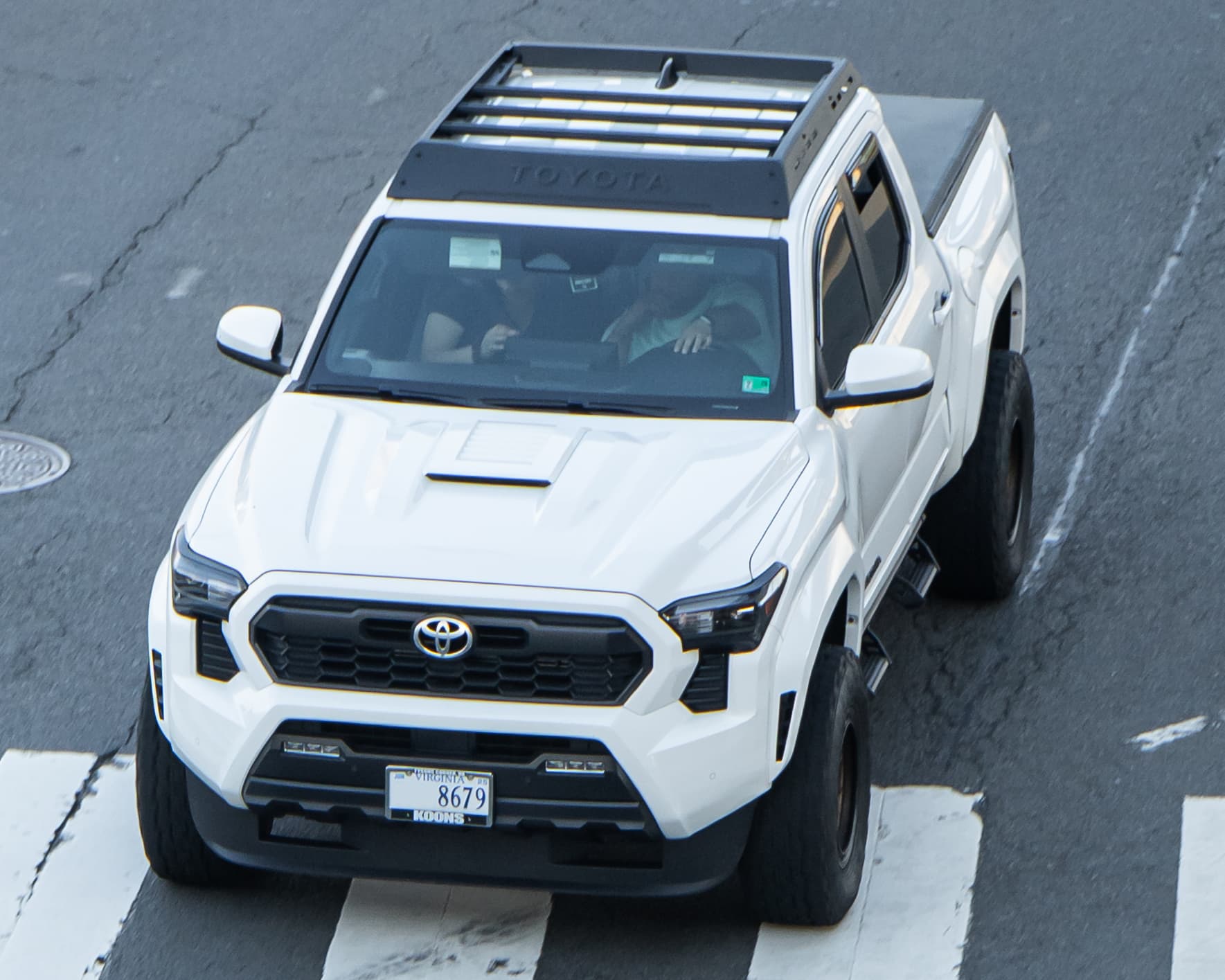
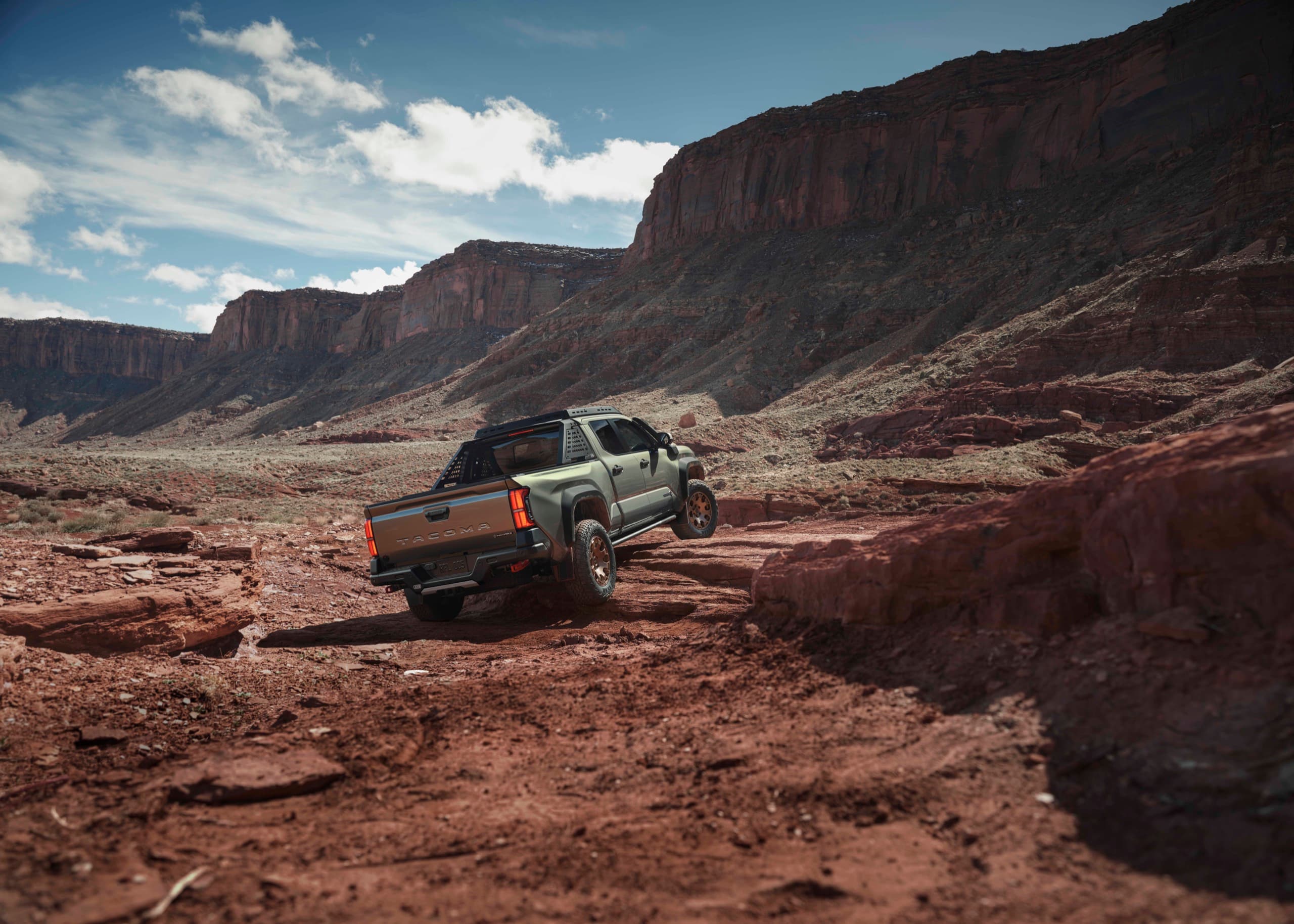
Source Receipts
Source pages, creator credits, and reuse licenses are visible for editorial trust and legal hygiene.
Related Video
2026 Toyota Tacoma Overview | Toyota
Toyota USA
Embedded from Toyota's official Toyota USA YouTube channel as manufacturer reference media for the fourth-generation Tacoma, not an independent MotorRank road test.
Interior
Cabin views before you choose a trim.
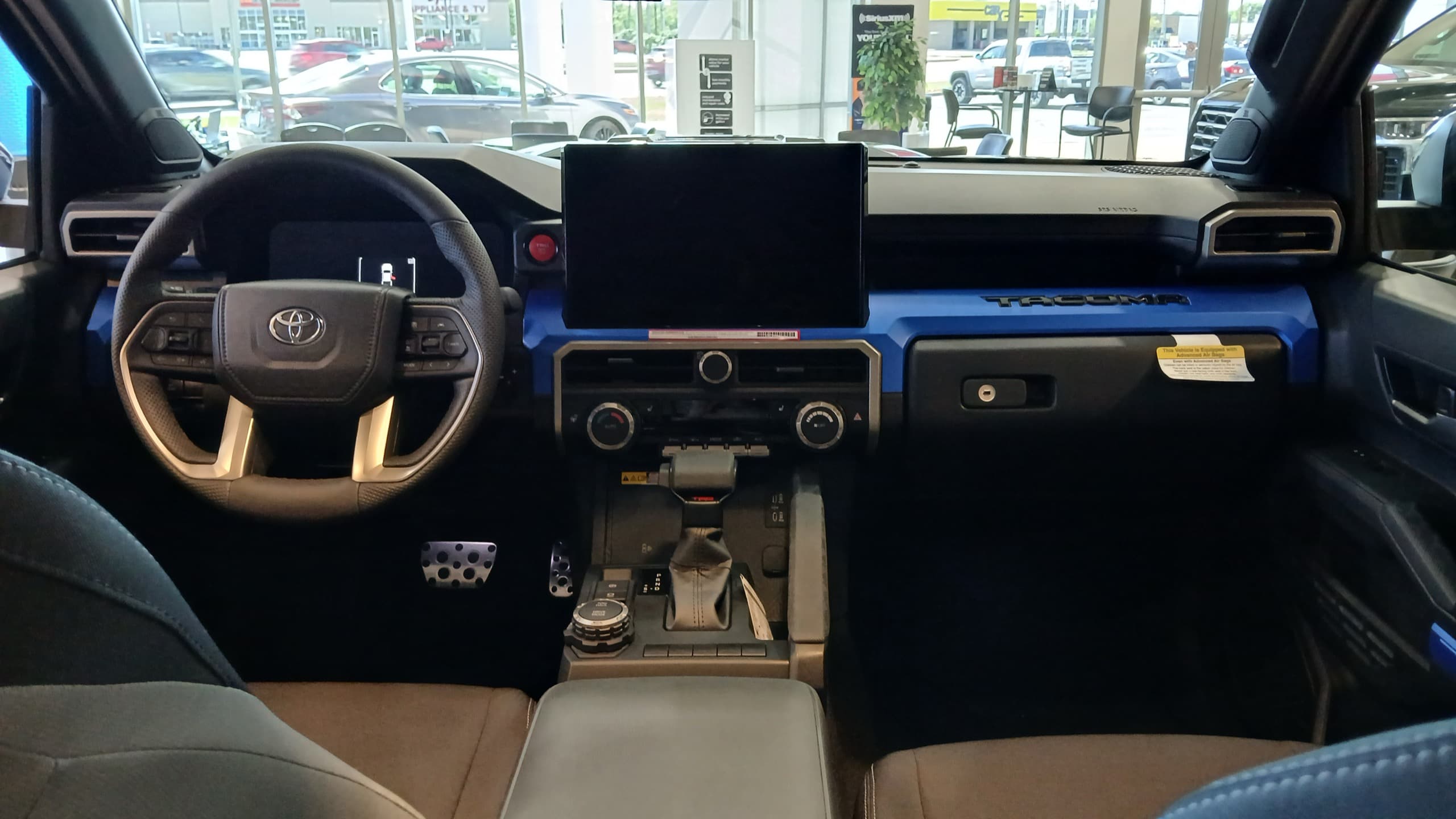
The fourth-generation cabin shares its architecture with the Tundra and 4Runner: an 8-inch standard or 14-inch available touchscreen, wireless Apple CarPlay and Android Auto, and a 12.3-inch digital cluster on hybrids. The honest catches: the Double Cab back seat is tight for adults, the XtraCab seats only two, and Edmunds knocks the basic trims' refinement.
Interior Source Receipts
Research basis
Updated June 10, 2026
Built from Toyota's official 2026 Tacoma pricing and specifications on toyota.com and Toyota's November 2025 press materials, the EPA's published fuel-economy ratings on fueleconomy.gov, NHTSA's recall database, and the attributed test data and impressions of Car and Driver, Edmunds, Consumer Reports, The Car Connection, and Motor Authority. All eleven base MSRPs were verified against toyota.com on June 10, 2026.
MSRP figures are Toyota's published base prices and exclude the $1,745 Delivery, Processing and Handling fee unless stated otherwise. Acceleration and observed-MPG figures are attributed to the outlet that measured them. MotorRank has not yet run its own instrumented road test of the 2026 Tacoma; ride, comfort, and real-world fuel-economy impressions are preview basis.
Update after MotorRank runs an instrumented road test, multi-ZIP dealer-market pricing checks, and real-world fuel sampling for both powertrains, and once complete 2026-specific NHTSA and IIHS crash ratings are confirmed.
Which 2026 TOYOTA TACOMA to Buy
Which trim is right for you?
SR
$32,445
The work-truck entry: a detuned 228-hp i-FORCE turbo, Double Cab or XtraCab, and a tow hitch now standard on XtraCab models for 2026.
SR5
$36,535
The volume value pick: the full 278-hp engine, coil-spring rear suspension on Double Cab models, and your choice of 5- or 6-foot bed.
TRD PreRunner
$39,035
The two-seat desert special: rear-drive only, XtraCab with a 6-foot bed, a suspension lift, 32-inch all-terrain tires, and a locking rear differential.
TRD Sport
$40,315
The street-flavored TRD: sport-tuned suspension and the available 6-speed intelligent manual — Edmunds' editors' pick for the lineup.
TRD Off-Road
$42,715
Our default pick: Bilstein piggyback-reservoir shocks, an electronic locking rear differential, Multi-Terrain Select, CRAWL Control, and an available front sway-bar disconnect.
Our pick
TRD Sport i-FORCE MAX
$47,235
The cheapest way into the 326-hp hybrid, with the sport-tuned suspension and the 2,400-watt onboard power supply.
TRD Off-Road i-FORCE MAX
$47,535
The smarter hybrid for $300 more: the same 326-hp powertrain plus the real trail hardware and 33-inch Falken all-terrain tires.
Limited
$53,470
The comfort trim: full-time 4WD with a locking center differential, Adaptive Variable Suspension, heated and ventilated seats, and the 14-inch screen.
Limited i-FORCE MAX
$56,795
The Limited's luxury kit with the hybrid's 465 lb-ft of torque — the plushest Tacoma, at a price deep into full-size-truck territory.
Trailhunter
$63,650
The factory overlander: Old Man Emu forged shocks, a high-mount air intake, ARB steel rear bumper, 33-inch tires, and the hybrid standard — in a 5- or 6-foot bed.
TRD Pro
$64,650
The Baja flagship: FOX QS3 adjustable shocks, shock-absorbing IsoDynamic front seats, a TRD intake and exhaust, and the hybrid standard.
Performance
- Horsepower
- 278hp
Scorecard
- Performance7.5
- Comfort6.8
- Value7.7
- Ownership9
- Technology8.2
- Safety8.3
- Reliability8.8
- Interior7.4
Shopping Tools
Next steps for 2026 Toyota Tacoma shoppers.
Research tools to help you move from browsing to buying.
Compare rivals
Line up the closest alternatives before you commit.
Check deal signals
Review pricing pressure, incentives, and value angles.
Read owner signal
Balance the expert take with ownership patterns.
Platform sibling
The 4Runner shares the Tacoma's TNGA-F platform and both i-FORCE powertrains in an enclosed SUV body with an available third row. If your cargo rides inside more often than in a bed, read it before you buy the truck.
Open vehicle hub
Keep specs, reliability, rankings, and review links together.
Compare Against
Cross-shop before you commit.
The closest alternatives in this price range, with our read on each.
The all-around scorecard rival
Ford Ranger
The Ranger out-tows the Tacoma at 7,500 pounds, rides more comfortably, and tops Edmunds' segment ranking. The Tacoma answers with a hybrid, a manual, far more trim breadth, and the stronger resale reputation.
The towing and turbo-grunt rival
Chevrolet Colorado
The Colorado's 7,700-pound max tow rating leads the class and its turbo four is a workhorse. The Tacoma counters with the segment's only hybrid, standard safety tech across every trim, and better long-term value retention.
The simple-value alternative
Nissan Frontier
The Frontier's naturally aspirated V6, 7,150-pound rating, and honest pricing appeal to buyers who want a traditional truck without turbos or batteries. The Tacoma offers far more range, more tech, and the stronger ownership story.
Same-platform SUV sibling
Toyota 4Runner
The 4Runner shares the Tacoma's platform and both i-FORCE powertrains in an enclosed body with an available third row. Buy the truck for the bed, payload, and lower entry price; buy the SUV for people and secure cargo.
Buyer FAQ
2026 Toyota Tacoma buyer questions, answered.
29
buyer answers
Question Map
Decision
Should you buy the 2026 Toyota Tacoma?
The lineup is the widest in the segment and the ownership story is the strongest — so the real questions are whether its towing and packaging limits touch your life.
Is the 2026 Toyota Tacoma any good?
Yes — Car and Driver rates it 9/10 — though Edmunds scores it 6.8 and ranks the Ford Ranger above it.+
The fourth-generation Tacoma is a genuinely modern truck: coil-spring rear suspension on most trims, standard Toyota Safety Sense 3.0, strong turbo power, and a 326-hp hybrid option. The expert split is real, though — Car and Driver scores it 9/10 and praises the breadth of trims, while Edmunds lands at 6.8/10, slots it below the Ford Ranger, and knocks the stiff ride on lower trims and the tight back seat. Our research-basis score is 7.9. It is the right truck for ownership value and capability range, and the wrong one if max towing or rear-seat comfort lead your list.
Who should skip the 2026 Tacoma?
Frequent heavy towers, buyers who carry adults in back, and anyone prioritizing the softest ride in the class.+
Skip the Tacoma if you regularly tow more than 6,000 pounds — the Chevrolet Colorado (7,700) and Ford Ranger (7,500) carry meaningfully higher ratings, and the Tacoma hybrid caps at 6,000. Skip it if adults ride in your back seat often; the Double Cab's rear quarters are tight, a criticism Edmunds makes directly, and the Ranger and Honda Ridgeline package people better. And if you want the most comfortable daily-driving truck rather than the most capable lineup, drive the Ranger and Ridgeline before you decide — Edmunds' scorecard ranks the Ranger first for a reason.
Is the 2026 Tacoma different from the 2025?
Barely — 2026 is a colors-and-packages year. The redesign was 2024, so a discounted 2025 is the same truck.+
The 2026 updates are deliberately light: a black front logo on the TRD Off-Road, TRD Sport, and TRD PreRunner, a new TRD Off-Road i-FORCE Premium Package with 18-inch TRD wheels and 32-inch Goodyear all-terrains, Heritage Blue paint replacing Blue Crush Metallic, the TRD Pro-exclusive Wave Maker color that began arriving in March 2026, and a standard tow hitch on SR XtraCab models — all per Toyota's press release. The full redesign happened in 2024. That makes a discounted leftover 2025 mechanically the same vehicle and a legitimate value play if one fits your spec.
Why does the Tacoma matter right now?
It is America's best-selling midsize pickup for over two decades, and the fourth generation finally modernized it.+
By Toyota's own accounting the Tacoma has been America's best-selling midsize pickup for more than two decades, which makes it the default truck everything else is judged against. The fourth generation matters because it fixed the old truck's biggest gaps — ancient cabin, crude ride, thirsty V6 — with modern screens, coil rear suspension, standard active safety, and the segment's only hybrid, while keeping the resale and durability reputation that made it the default. In its third model year the lineup is fully built out, from a $32,445 work truck to a $64,650 Baja flagship.
Gas vs Hybrid
i-FORCE or i-FORCE MAX? The engine decision, resolved
The hybrid brings 465 lb-ft and a 2,400-watt power supply — and a lower tow rating. Here is the whole trade in one place.
Is the 2026 Tacoma i-FORCE MAX hybrid worth it?
Worth it for torque and the onboard power supply — not for fuel economy, and it actually tows less.+
The i-FORCE MAX makes 326 horsepower and 465 pound-feet against the standard engine's 278 and 317 — Toyota-official figures — and every hybrid includes a 2,400-watt AC power supply in the cabin and bed. But the EPA gain is small (23 combined versus 21 for gas 4WD trucks, and gas 2WD models also rate 23), and the hybrid's tow rating drops to 6,000 pounds from the gas truck's 6,500. Car and Driver's blunt take is that the hybrid's benefits do not justify its price. Buy it for the torque and the power export, or because you want a Trailhunter or TRD Pro, where it is standard.
Which Tacoma engine should you buy?
Gas for value, towing, and the manual; hybrid for torque, the power supply, and the flagship trims.+
Buy the standard i-FORCE if you are a value buyer, you tow near the limit (it carries the higher 6,500-pound rating), you want the 6-speed manual, or you mostly drive highway, where the gas 2WD truck's 26-mpg rating leads the lineup. One caveat: the base SR runs a detuned 228-horsepower version, so step to the SR5 for the full 278. Buy the i-FORCE MAX if you want effortless low-rpm pulling power, you will use the 2,400-watt export for tools or camping, or you are buying the Trailhunter or TRD Pro. Do not buy it expecting meaningful fuel savings — the EPA numbers say there are none.
What gas mileage does the 2026 Tacoma get?
EPA: up to 21/26/23 for gas 2WD, about 20/23/21 for gas 4WD, 18/23/20 for the manual, and 22/24/23 for the hybrid.+
Official EPA ratings: gas 2WD trucks rate up to 21 city, 26 highway, 23 combined (the SR posts 20/26/23); gas 4WD models land around 20/23/21 depending on configuration; the 4WD-only manual is the thirstiest at 18/23/20; and the i-FORCE MAX hybrid 4WD rates 22/24/23. Everything runs on regular gas. The honest summary is that every 2026 Tacoma is a low-20s truck and the hybrid buys you almost nothing on paper — Edmunds actually beat its test truck's 21-mpg EPA estimate, averaging 22.6 mpg, so the stickers are realistic rather than optimistic.
Does the hybrid tow more than the gas Tacoma?
No — this is the twist. The hybrid caps at 6,000 pounds; the gas truck is rated to 6,500.+
No, and this is the fact the top-ranking reviews bury: Toyota rates gas Tacomas to a 6,500-pound maximum, while i-FORCE MAX hybrids cap at 6,000 pounds — a limit Car and Driver flags as well. The hybrid's 465 pound-feet makes whatever you tow feel easier, with stronger low-rpm response and standard Tow/Haul mode, but the rated ceiling is lower. If your trailer routinely runs above 6,000 pounds, the hybrid is the wrong tool and, frankly, so is the Tacoma — the Colorado tows 7,700 pounds and the Ranger 7,500. Under 5,500 pounds, either engine handles it comfortably.
Real Cost
Price, destination, and what you will actually pay
Eleven configurations from $32,445 to $64,650 — before the $1,745 fee every Tacoma carries.
How much does the 2026 Toyota Tacoma cost?
Toyota's base MSRPs run $32,445 (SR) to $64,650 (TRD Pro), before the $1,745 destination fee.+
Toyota's official base prices as of June 10, 2026: SR $32,445; SR5 $36,535; TRD PreRunner $39,035; TRD Sport $40,315; TRD Off-Road $42,715; TRD Sport i-FORCE MAX $47,235; TRD Off-Road i-FORCE MAX $47,535; Limited $53,470; Limited i-FORCE MAX $56,795; Trailhunter $63,650; and TRD Pro $64,650. Every figure excludes the $1,745 Delivery, Processing and Handling fee Toyota charges on midsize pickups, so the real entry point is $34,190 and a TRD Pro starts at $66,395 before tax, title, and dealer add-ons. Car and Driver's and Edmunds' destination-inclusive numbers match these to the dollar.
What is the cheapest 2026 Tacoma, and is it enough truck?
The SR at $32,445 — a real work truck, but its engine is detuned to 228 hp, so personal buyers should step to the SR5.+
The SR starts at $32,445 and is an honest work truck: Double Cab or two-seat XtraCab, the 8-inch touchscreen with wireless CarPlay and Android Auto, the full Toyota Safety Sense 3.0 suite, and a newly standard tow hitch on XtraCab models. The catch is under the hood — the SR runs a 228-horsepower version of the turbo four against the 278 horsepower everything else gets. For a fleet or jobsite tool, that is fine. For a personal truck, the $4,090 walk to the SR5 buys the full engine, the coil-spring rear on Double Cabs, and much better resale-spec equipment.
What is the cheapest way into the Tacoma hybrid?
The TRD Sport i-FORCE MAX at $47,235 — but the TRD Off-Road hybrid is only $300 more and far more capable.+
The price floor for the 326-horsepower hybrid is the TRD Sport i-FORCE MAX at $47,235. Spend $300 more and the TRD Off-Road i-FORCE MAX at $47,535 adds the hardware that actually earns the money: Bilstein piggyback-reservoir shocks, the locking rear differential, Multi-Terrain Select, CRAWL Control, 33-inch Falken all-terrains, and the available front sway-bar disconnect. That $300 spread makes the hybrid TRD Sport very hard to recommend. Note the hybrid does not exist below the TRD Sport — Car and Driver's complaint that higher trims force you into the hybrid runs the other way too.
Are dealers charging over sticker on the 2026 Tacoma?
Mostly on the Trailhunter and TRD Pro flagships; volume trims are negotiable, and incentives move monthly.+
Markup pressure concentrates on the hybrid-only flagships — the Trailhunter and TRD Pro, especially early Wave Maker TRD Pros, which only began arriving in March 2026. Volume trims like the SR5, TRD Sport, and TRD Off-Road are far more negotiable. Protect yourself the same way on any trim: get a complete itemized out-the-door quote including the $1,745 destination fee and the dealer's doc fee, ask to see the price without pre-loaded add-ons like paint protection and etching, and check Toyota's current national and regional incentives the same day you take the quote, because offers change monthly and by region.
Trim
Which 2026 Tacoma trim should you buy?
The gas 4WD TRD Off-Road is the smart default; here is the pick for every budget and use case.
Which 2026 Tacoma trim is the best value?
The SR5 at $36,535 for daily drivers; the TRD Off-Road at $42,715 for buyers who will use the capability.+
There are two right answers depending on the mission. If the truck is mostly a commuter that occasionally hauls, the SR5 Double Cab at $36,535 is the value pick — the full 278-horsepower engine, coil-spring rear suspension, and a choice of beds; The Car Connection's buying advice lands there too, with the SR5 Upgrade and Cold Weather packages. If you bought a Tacoma to use it like the ads suggest, the 4WD TRD Off-Road at $42,715 is the cheapest truck with the locking rear differential, Bilstein reservoir shocks, and trail electronics — our default recommendation, $2,400 over a TRD Sport that only looks the part.
What is the TRD PreRunner, and who is it for?
A $39,035 two-seat, rear-drive XtraCab desert runner with a lift, 32-inch tires, and a locking rear diff.+
The TRD PreRunner is the lineup's most distinctive idea: rear-wheel drive only, the two-seat XtraCab body with the 6-foot bed, a front suspension lift, 32-inch all-terrain tires, and an electronically controlled locking rear differential — per Toyota's configurator and Edmunds' price guide. It is a Baja-style prerunner formula for buyers who play in sand and desert washes where momentum matters more than 4-Low, and who do not need back seats. Edmunds clocked one at 7.1 seconds to 60 mph, the quickest gas Tacoma it tested. Niche, but nothing else in the segment offers it.
Trailhunter or TRD Pro — which flagship?
Trailhunter for loaded overlanding; TRD Pro for high-speed desert work. Both are hybrid-only and cost about $65K.+
Both flagships run the i-FORCE MAX standard and cost within $1,000 of each other, so choose by mission. The Trailhunter ($63,650) is the overlander: Old Man Emu forged shocks tuned for load, a high-mount air intake, ARB steel rear bumper and MOLLE sport bar, rock rails, 33-inch Goodyear Rugged-Terrains, and the option of a 6-foot bed for gear. The TRD Pro ($64,650) is the speed tool: FOX QS3 adjustable shocks with IFP bump stops, the IsoDynamic Performance seats that damp your head over whoops, and a TRD intake and exhaust. Overland slow and loaded, Trailhunter; drive fast over rough ground, TRD Pro.
Is the 2026 Tacoma Limited worth it?
Yes for comfort-first buyers — full-time 4WD, adaptive dampers, and real luxury kit — but the hybrid Limited costs half-ton money.+
The Limited at $53,470 is the most livable Tacoma: full-time 4WD with a locking center differential, Adaptive Variable Suspension standard for 2026, heated and ventilated seats, walnut trim, power running boards, head-up display, the 14-inch screen, JBL audio, digital rearview mirror, and a power moonroof. As a gas truck it also keeps the full 6,500-pound tow rating, which makes it the best comfort-and-towing daily in the lineup. The $56,795 hybrid Limited is where the value case thins — at that price plus the $1,745 fee you are shopping against well-equipped full-size trucks, and you should at least look.
Off-Road
How capable is the 2026 Tacoma off-road, really?
Real hardware from $42,715, flagship geometry from Motor Authority, and an honest read on which trims are tools versus trim packages.
What off-road hardware does the Tacoma have?
Locking rear diff on four trims, Multi-Terrain Select, CRAWL Control, and a front sway-bar disconnect on the serious grades.+
Per Toyota: the electronically controlled locking rear differential comes on the TRD PreRunner, TRD Off-Road, Trailhunter, and TRD Pro. Four-wheel-drive trucks get a two-speed transfer case, Multi-Terrain Select works in both 4WD-High and 4WD-Low, next-generation CRAWL Control acts as low-speed off-road cruise, and Downhill Assist Control manages descents. The Stabilizer Disconnect Mechanism — standard on Trailhunter and TRD Pro, available on TRD Off-Road — frees the front sway bar at a button press for more articulation, and even works with Toyota-approved lift kits. Underbody protection and front recovery hooks are standard on every truck.
What are the Tacoma's ground clearance and approach angles?
Flagships per Motor Authority: TRD Pro 11.5 in. and 35.7° approach; Trailhunter 11.0 in. and 35.2°.+
Motor Authority's test of the two flagships reports the TRD Pro at 11.5 inches of ground clearance with a 35.7-degree approach angle, 27.4-degree breakover, and 25.3-degree departure, and the Trailhunter at 11.0 inches with 35.2 approach, 24.0 breakover, and 22.3 departure. Toyota does not publish a complete geometry table for every trim on its consumer site, so we will not invent figures for the lower grades — but the suspension ladder is official: Bilstein reservoir monotubes on TRD Off-Road, FOX QS3 three-way adjustables on TRD Pro, and Old Man Emu forged monotubes on Trailhunter.
Which Tacoma should a real off-roader buy?
TRD Off-Road for 90% of trail use at $42,715; the flagships only if their specialty matches yours.+
The TRD Off-Road is the answer for most genuine off-roaders: locking rear differential, Bilstein piggyback-reservoir shocks with an end-stop control valve, Multi-Terrain Select, CRAWL Control, and the available sway-bar disconnect, at $21,000 less than the flagships — with 33-inch Falkens standard on the hybrid version and the new i-FORCE Premium Package putting 32-inch Goodyears on the gas truck. Step to the Trailhunter only for built-out overlanding, or the TRD Pro for sustained high-speed work its FOX shocks and IsoDynamic seats are designed around. The TRD Sport is street tuning with the badge — treat it as styling, not capability.
Daily Use
Living with it: ride, back seat, cab choice, and the bed
More livable than any Tacoma before it — with three honest caveats the spec sheet hides (preview basis).
Is the 2026 Tacoma comfortable to daily drive?
Far better than the old truck on coil-spring trims, but lower trims ride stiff and the engine sounds coarse (attributed).+
On preview basis, attributed to the outlets that have driven it: the coil-spring multi-link rear suspension on most trims makes this the most livable Tacoma ever, and Car and Driver credits it directly in its 9/10 review. The caveats are equally consistent: Edmunds calls the ride stiff on lower trims — leaf-sprung SR and XtraCab configurations especially — and Consumer Reports describes the turbo four as gritty and unrefined under load even while praising its midrange torque. The Limited's adaptive dampers are the comfort ceiling. We will replace these attributed impressions with our own measured results after a full MotorRank road test.
Is the Tacoma's back seat usable for adults?
The Double Cab seats adults in a pinch; the XtraCab has no back seat at all — it is a two-seater with storage.+
Set expectations honestly. The Double Cab's rear seat works for kids and shorter trips, but Edmunds lists the limited rear room among its main criticisms, and adults will find the Ford Ranger and Honda Ridgeline roomier in back. The XtraCab is not a smaller back seat — it is no back seat: two seats total, with a lockable storage area and a fold-flat front passenger seat that doubles as a workspace behind them. If regular adult rear passengers are part of your life, sit in the back of a Double Cab before you buy, and cross-shop the Ridgeline.
XtraCab or Double Cab — which should you buy?
Double Cab if anyone ever rides in back; XtraCab if the rear seat in your current truck is really a parts shelf.+
The Double Cab is the default: four real doors, five seats, the 5-foot bed standard, and the 6-foot bed available on SR5 and Trailhunter. The XtraCab — offered on SR, SR5, and TRD PreRunner — trades the back seat for lockable storage, pairs exclusively with the 6-foot bed, and now includes a standard tow hitch on the SR for 2026. It is the honest work configuration most rivals have abandoned. Choose by passenger reality, not truck tradition: if the back seat would carry people even monthly, Double Cab; if it would carry tools, the XtraCab is the better-designed tool.
How much can the 2026 Tacoma tow and haul day to day?
Up to 6,500 lbs towing and 1,705 lbs payload (gas, official); hybrids cap at 6,000 lbs.+
Toyota's official maximums are 6,500 pounds of towing and 1,705 pounds of payload on gas configurations, with hybrids rated to 6,000 pounds. Remember both numbers are config-specific maximums, and payload is the budget people actually blow: passengers, gear, accessories, and trailer tongue weight all draw from it, so a family of four plus a loaded bed can max a truck that is nowhere near its tow rating. The tow tech is genuinely useful — available trailer brake controller, Trailer Back Up Guide with Straight Path Assist, a wireless trailer camera option, and a digital rearview mirror — and hybrids add standard Tow/Haul mode.
Ownership
Reliability, recalls, warranty, and resale
The segment's strongest ownership reputation, a clean 2026 recall record we actually checked, and the honest new-powertrain caveat.
Is the 2026 Toyota Tacoma reliable?
The nameplate's reputation is the segment benchmark, and the 2026 shows zero NHTSA recalls as of June 10, 2026 — but the turbo-hybrid era is still young.+
We publish only what we can source. The Tacoma's durability reputation is the benchmark of the midsize segment and the structural reason its resale stays strong. For the 2026 specifically, NHTSA's database showed zero recalls and just four complaints as of June 10, 2026 — we checked that day. The honest context: the fourth generation's turbocharged and hybrid powertrains are far newer designs than the old V6, and the first-year 2024 trucks logged four NHTSA recall campaigns, including brake-line and instrument-panel fixes. Three model years in, the platform is maturing well, but a cautious buyer waiting for high-mileage hybrid data is being reasonable, not paranoid.
Does the Tacoma hold its value?
Resale strength is the Tacoma's defining ownership trait, though we do not publish percentages we cannot source.+
Strong resale is the Tacoma's signature — used examples have historically stayed expensive relative to the class, which is exactly why the buy-new math works better than the sticker suggests for long-term owners. We will not invent a specific residual percentage for the 2026 model since we have not sourced verified figures for this generation, but the structural drivers — durability reputation, demand, the Toyota badge, and a huge enthusiast and work-buyer market — all carry over. If you keep trucks eight or more years, resale plus the warranty picture below is the strongest argument on this page.
What warranty does the 2026 Tacoma have?
3yr/36k basic, 5yr/60k powertrain, 8yr/100k hybrid components, and a 10yr/150k transferable hybrid battery.+
Toyota's official 2026 coverage: a 36-month/36,000-mile basic warranty, 60-month/60,000-mile powertrain warranty, and 60 months of corrosion protection with no mileage limit, plus ToyotaCare's two years or 25,000 miles of factory-scheduled maintenance and two years of unlimited-mileage roadside assistance. Hybrid buyers get the strong terms: 8 years/100,000 miles on hybrid components and 10 years/150,000 miles on the battery, transferable across owners — which materially de-risks the i-FORCE MAX for long keepers. The paper terms trail Kia and Hyundai's famous coverage, but neither of those brands sells a midsize pickup.
Compare
What should you cross-shop before signing?
Straight choose-this-if verdicts against the Ranger, Colorado, Frontier — and the SUV wearing the same platform.
2026 Tacoma vs Ford Ranger — which is better?
Ranger for ride, rear seat, and towing — Edmunds ranks it first; Tacoma for lineup breadth and resale.+
Choose the Ford Ranger if daily comfort, rear-seat space, and towing lead your list — it is rated to 7,500 pounds, rides more calmly, and Edmunds ranks it above the Tacoma in the segment. Choose the Tacoma for everything the Ranger does not offer: a hybrid powertrain, a manual gearbox, the two-seat PreRunner, a factory overlander, and the segment's strongest resale story. The Ranger Raptor and the TRD Pro both chase desert speed at the top of their ranges; below that, the Ranger is the comfortable generalist and the Tacoma is the broader, better-investment specialist.
2026 Tacoma vs Chevrolet Colorado or Nissan Frontier?
Colorado for max towing (7,700 lbs) and turbo grunt; Frontier for simple V6 value; Tacoma for range and resale.+
The Chevrolet Colorado is the tow champion at up to 7,700 pounds and its turbo four pulls hard — if trailering is the truck's main job, it is the rational pick. The Nissan Frontier counters with simplicity: a naturally aspirated V6, traditional truck feel, a 7,150-pound rating, and aggressive pricing, appealing if you distrust turbos and hybrids on principle. The Tacoma beats both on lineup breadth, standard safety tech, hybrid availability, and historical resale. If you keep trucks a long time, the Tacoma's ownership economics are the tiebreaker; if you tow heavy weekly, the Colorado's rating is.
Should you buy a Tacoma or a Toyota 4Runner?
Same platform, same engines — buy the bed or buy the enclosed cargo bay and available third row.+
The 4Runner shares the Tacoma's TNGA-F platform and both i-FORCE powertrains, so this is a body decision. Take the Tacoma if your cargo is dirty, bulky, or towed: it starts $9,625 lower, offers the XtraCab and the manual, and out-tows the SUV at 6,500 pounds versus 6,000. Take the 4Runner if people and weatherproof cargo space matter more — enclosed bay, available third row, and a quieter family mission. One asymmetry worth knowing: the 4Runner hybrid gives up no towing capacity, while the Tacoma hybrid drops 500 pounds. Our full 2026 Toyota 4Runner review resolves its trim ladder the same way this page does.
Ready to buy?
Configure your 2026 Toyota Tacoma.
Get matched with a Toyota dealer or build your spec sheet from scratch.