

REVIEWS / Hybrid SUVs
NEW2026 Honda CR-V Hybrid Review
The CR-V Hybrid remains the mainstream compact SUV default, but the smart buy is the Sport Hybrid unless you genuinely need TrailSport hardware or Sport Touring luxury.
Published June 1, 2026 / Updated June 4, 2026
Expert verdict
Buy the 2026 Honda CR-V Hybrid for balanced family usefulness, strong resale logic, and Honda's mature 204-hp hybrid system. Do not let the dealer or the trim ladder turn it into a $45K answer to a $36K problem.
HIGHS
- 204-hp hybrid system is the CR-V powertrain to buy
- Sport Hybrid keeps the value story clean
- Available AWD and new TrailSport Hybrid widen the use case
- Useful cargo room and easy cabin controls support real family duty
- Official Honda media and current video context support the page
LOWS
- Honda warranty is shorter than Hyundai/Kia coverage
- TrailSport Hybrid gives up MPG for image and light-trail hardware
- Sport Touring can become expensive enough to invite stronger rivals
- No plug-in hybrid option for buyers who can charge at home
AT A GLANCE
- Score
- 8.6
- Price
- $35.6K - $42.6K
- Horsepower
- 204 hp
- 0-60
- 7.8s
- Drivetrain
- AWD
- Body
- SUV
Buyer Verdict
The fast answer before you compare specs.
Built for shoppers who want the recommendation first and the details right after.
Buy it if
- Buy the 2026 Honda CR-V Hybrid if you want the safest compact hybrid SUV answer for family use: 204 hp, no plug-in routine, useful cargo space, Honda resale confidence, and official EPA ratings as high as 43 city / 36 highway / 40 combined on FWD hybrid trims. The trim to buy is Sport Hybrid unless TrailSport hardware solves a real road or weather problem. The kill shot against the current ranking pages is discipline: do not buy the top trim just because the CR-V is the default; buy the trim whose official Honda price, MPG, and AWD setup match your real use.
- Best for: Compact SUV shoppers who want Honda resale confidence, real family utility, strong hybrid efficiency, and no plug-in routine.
- Our trim pick: Sport Hybrid from $35,630.
Skip it if
- Honda warranty is shorter than Hyundai/Kia coverage
- TrailSport Hybrid gives up MPG for image and light-trail hardware
- Sport Touring can become expensive enough to invite stronger rivals
Closest rivals
- Toyota RAV4 Hybrid
Toyota hybrid benchmark
- Hyundai Tucson Hybrid
Warranty and equipment threat
- Kia Sportage Hybrid
Value and tech alternative
Quick take
The 2026 Honda CR-V Hybrid is the compact hybrid SUV most shoppers should price before they buy anything else in this class. It is not the flashiest choice, and it is not the cheapest, but it sits in the part of the market where families, commuters, empty nesters, and long-term owners all start making practical sense of one vehicle.
This review is a MotorRank buyer-research review, not an instrumented MotorRank road test. Honda official pages supply the pricing, trim, powertrain, cargo, AWD, and EPA data; current SERP competitors show what shoppers are already being told; our job is to make the actual purchase call sharper.
Driving impressions
Why the CR-V Hybrid matters
The CR-V Hybrid matters because compact SUV buyers are no longer shopping only for room. They want fuel economy without a plug, enough power for highway merging, useful cargo space, strong safety tech, and a warranty/resale story that feels safe over a long loan. The CR-V Hybrid hits those needs without asking the buyer to learn EV charging or accept a cramped subcompact body.
What to watch before you buy
Watch the trim walk and the out-the-door quote. Honda lists four hybrid trims from Sport Hybrid through Sport Touring Hybrid, and the gap between the value trim and the top trim is big enough to change the comparison set. A clean Sport Hybrid quote is a smart family-SUV buy. A marked-up Sport Touring can run into Toyota RAV4 Hybrid, Hyundai Tucson Hybrid, Kia Sportage Hybrid, and even larger used-SUV territory.
SERP audit: how to beat the current CR-V Hybrid leader
The current ranking field for 2026 Honda CR-V Hybrid review is led by high-authority model pages and buyer guides, with Car and Driver visible at the top of the web results and Edmunds, KBB, and video walkarounds close behind. Those pages are strong on authority, quick specs, and top-line impressions. The gap is that many of them stop short of the hard purchase rule: which trim should a buyer actually sign for, and when does the CR-V stop being the rational choice?
A shopper landing on a CR-V Hybrid page is not just asking whether Honda builds a good compact SUV. They are comparing Sport Hybrid against TrailSport Hybrid, Sport-L Hybrid, and Sport Touring Hybrid. They are also comparing CR-V Hybrid against RAV4 Hybrid, Tucson Hybrid, Sportage Hybrid, Forester Hybrid, Corolla Cross Hybrid, and maybe a Civic Hybrid if they do not truly need SUV height. The current #1 page can describe the car; this page has to close the decision.
The kill shot is disciplined trim guidance tied to official Honda data. Honda lists Sport Hybrid at $35,630, TrailSport Hybrid at $38,800, Sport-L Hybrid at $38,725, and Sport Touring Hybrid at $42,550 before normal fees. That pricing makes Sport Hybrid the default, TrailSport a use-case trim, Sport-L a comfort step that needs a quote, and Sport Touring a luxury choice that must survive cross-shopping against bigger or more premium alternatives.
Official pricing and the trim to buy
Honda's official 2026 CR-V trim comparison places the first hybrid, Sport Hybrid, at $35,630. That is the version most buyers should start with because it gets the 204-hp two-motor hybrid system without forcing the most expensive equipment bundle. It also keeps the CR-V where it belongs financially: a smart compact SUV, not a stretched luxury substitute.
TrailSport Hybrid is the interesting new fork. It starts at $38,800 and gives the CR-V a more rugged look, standard AWD, all-terrain tires, and the low-speed traction image that shoppers want from a soft-roader. It is worth pricing if your normal life includes dirt roads, wet campsites, trailheads, gravel driveways, and winter weekends. It is not worth paying for if the most rugged thing in your life is a grocery-store curb.
Sport-L Hybrid and Sport Touring Hybrid are where restraint matters. Sport-L adds comfort and can make sense for long-term owners who care about leather-trimmed seating and a nicer cabin. Sport Touring adds the richest package and standard AWD, but at $42,550 before fees it has to justify itself against better-equipped rivals and larger SUVs. Our default answer is Sport Hybrid, then TrailSport only for actual use, then Sport Touring only for buyers who would rather pay Honda money than shop a luxury badge.
MSRP, destination, and real dealer math
MSRP is not the deal. The CR-V Hybrid is popular enough that some stores can protect gross through accessories, protection products, doc fees, or thin discounts. A buyer should ask for a written out-the-door quote on the exact VIN or incoming allocation, with destination, taxes, title, registration, documentation fee, accessories, protection products, and finance terms separated line by line.
The trim comparison is especially sensitive because the prices are close in the middle. TrailSport Hybrid at $38,800 and Sport-L Hybrid at $38,725 can flip order after dealer inventory, accessories, discounts, and local demand. A buyer who assumes one trim is automatically cheaper can miss the better real deal. Quote both if you are shopping that part of the ladder.
Do not let a monthly payment hide the decision. A CR-V Hybrid at a long term with dealer products can look manageable while becoming bad value. Compare total cost against RAV4 Hybrid, Tucson Hybrid, Sportage Hybrid, Forester Hybrid, and one non-SUV option such as Civic Hybrid or Camry Hybrid. If the Honda still wins after paperwork, buy it. If it only wins before fees, keep shopping.
Hybrid powertrain: why this is the CR-V to buy
Honda's official spec page lists the CR-V Hybrid at 204 total system horsepower. That is enough to make the hybrid feel like the stronger everyday CR-V, not just the efficient one. It gives better low-speed response than the gas turbo, keeps the engine calmer in city driving, and makes the SUV feel more expensive in normal commuting.
The gas CR-V still has a role for buyers who need the lowest entry price, but the hybrid is the powertrain that best matches the CR-V mission. Compact SUV shoppers spend huge time in traffic, school lines, suburban errands, and moderate highway use. A conventional hybrid is built for exactly that pattern: low-speed electric assist, regenerative braking, no plug, and no charging routine.
The right way to frame performance is not fake sportiness. The CR-V Hybrid is not a Mazda CX-50 Turbo or a performance SUV. It is a smoother, quieter, more confident version of a family crossover. If you want speed, shop elsewhere. If you want the CR-V to feel less strained while burning less fuel, buy the hybrid.
MPG and AWD: understand the Honda split
Honda's official table lists Sport Hybrid and Sport-L Hybrid at 43 city / 36 highway / 40 combined mpg with front-wheel drive. The AWD versions of those trims are listed at 40 city / 34 highway / 37 combined. Sport Touring Hybrid is AWD-only and carries the 40/34/37 rating. TrailSport Hybrid is also AWD-only and drops to 38 city / 33 highway / 35 combined because of its tire and hardware package.
That MPG split is the reason Sport Hybrid FWD is the efficiency pick. If you live somewhere mild and do not need AWD, the FWD hybrid gives the cleanest fuel-economy story. If you deal with regular snow, steep wet roads, gravel, or rural driveways, AWD is worth the MPG penalty. But the penalty is real, and shoppers should not buy AWD as a badge if their use case does not need it.
TrailSport is the biggest MPG trade. Its 38/33/35 rating is still efficient for an AWD compact SUV, but it gives away economy to look and act more rugged. That is fine for buyers who use it. It is weaker for buyers who mostly commute and simply like the visual package. If fuel cost is the reason you came to the hybrid, start with Sport Hybrid before TrailSport.
Cargo, cabin, and family usability
The CR-V's family argument is not complicated: it has the size, visibility, rear-seat comfort, and cargo opening that make daily errands easier than they would be in a sedan. Honda lists the hybrid at 36.3 cubic feet behind the second row and 71.8 cubic feet behind the first row. That is less than the gas CR-V's official cargo figure, but still strong enough for normal family duty.
The interior is one of Honda's best mainstream cabins because it does not bury everything behind software. The driving position is easy, the sightlines are useful, the rear doors make child-seat loading easier than most sedans, and the cargo floor is low enough to matter. The CR-V is not trying to look like a luxury lounge; it is trying to make each week frictionless.
Test the cabin with your real gear. Bring the stroller, travel crate, cooler, sports bag, work case, or folding chair if those items define your week. A spec sheet tells you the cargo number. A loading test tells you whether the CR-V replaces a larger SUV, whether you need a minivan, or whether a Civic Hybrid would already be enough.
TrailSport Hybrid: useful trim or expensive costume
TrailSport Hybrid is not a hardcore off-roader, and Honda does not need it to be. The useful version of the pitch is simple: standard AWD, all-terrain tires, tougher visual cues, and extra confidence on loose or messy surfaces. That can be meaningful for buyers who actually use campsites, trailheads, gravel access roads, light snow, and unpaved weekend routes.
The weak version of the pitch is image. A TrailSport that lives only on pavement gives up fuel economy and costs more than Sport Hybrid. It also does not turn the CR-V into a Bronco Sport Badlands, Jeep Cherokee Trailhawk, or Subaru wilderness-style vehicle. Buyers should not overestimate the hardware because the badge sounds adventurous.
Our recommendation is use-case based. Choose TrailSport if you like the look and your normal routes make the tire/AWD setup valuable. Skip it if you only need the CR-V Hybrid's efficiency and space. In that case, Sport Hybrid or Sport-L Hybrid keeps the ownership story cleaner.
Sport Touring: when the top trim makes sense
Sport Touring Hybrid is for buyers who keep cars long enough to care about daily touch points. Better audio, richer cabin trim, standard AWD, and the most complete Honda feature bundle can feel worthwhile if the CR-V will be the main household vehicle for seven or eight years. A top trim can make sense when comfort is used every day.
The problem is the price. At $42,550 before normal fees, Sport Touring moves past the simple value argument. It starts to overlap larger, more powerful, or more premium-feeling options depending on incentives. A shopper should compare it against RAV4 Hybrid Limited, Tucson Hybrid Limited, Sportage Hybrid SX Prestige, Forester Hybrid Touring, and certified luxury compact SUVs before assuming the Honda is the automatic answer.
If Sport Touring wins after that comparison, it is a defensible buy. Honda resale, cabin simplicity, and the CR-V's practical size are real advantages. But if the buyer is stretching just to get the top badge, the better move is Sport Hybrid or Sport-L with a cleaner loan.
Warranty and ownership honesty
Honda's official 2026 warranty booklet lists new-vehicle limited coverage at 3 years or 36,000 miles. The high-voltage battery capacity language from Honda's warranty material covers degradation below the specified threshold during 8 years or 100,000 miles. Honda's mainstream warranty is not the longest in the class, so the ownership case depends on reputation, dealer familiarity, resale, and a mature hybrid system.
We are not publishing a made-up reliability score or repair-cost forecast. The honest CR-V ownership argument is that Honda has long hybrid experience, the CR-V is a known family-SUV quantity, and the demand side should support resale. The honest risk is that a bad purchase price or unnecessary add-ons can erase those advantages.
Quote insurance, ask the dealer for the warranty booklet, and keep service records. Hybrid ownership is not fragile, but the battery, cooling, tires, brake service, software updates, and maintenance documentation still matter. Long-term confidence is built through real paperwork, not forum mythology.
Rivals: RAV4 Hybrid, Tucson Hybrid, Sportage Hybrid, and Forester Hybrid
Toyota RAV4 Hybrid is the obvious resale and hybrid-trust rival. It is the one to shop if you want Toyota's long hybrid reputation and a harder-edged value story. The CR-V counters with a smoother cabin, strong everyday packaging, and a less rugged-feeling ride. The better buy depends on the quote, not only the badge.
Hyundai Tucson Hybrid and Kia Sportage Hybrid are equipment-and-warranty threats. They often give buyers more screen, more warranty, and more visual drama for the money. The CR-V counters with simplicity, resale confidence, and a cabin that many buyers find easier to live with over time. If you value warranty length above all, Hyundai and Kia deserve a serious drive.
Subaru Forester Hybrid is the AWD-safety rival. It plays to buyers who want standard AWD culture and outdoors credibility. Corolla Cross Hybrid is smaller and cheaper, but less roomy. The CR-V Hybrid is the middle answer: bigger and more polished than subcompact hybrids, less expensive and easier than moving into a three-row or luxury crossover.
Lease, finance, or cash: how to structure the buy
Leasing a CR-V Hybrid can work if Honda sets a strong residual and the money factor is clean, but popular Hondas are often better for owners who keep them. Ask for the lease worksheet, not just the payment. You need residual, money factor, acquisition fee, due at signing, mileage allowance, disposition fee, and total of payments before comparing it to a finance offer.
Financing should be judged by total cost, not monthly comfort. A buyer should compare APR, term, down payment, dealer products, and the exact selling price before approving the loan. A CR-V Hybrid is a strong long-term vehicle, but a 72- or 84-month term with extra products can make even a sensible SUV financially heavy.
Cash buyers should still negotiate like finance buyers. Paying cash does not make destination, dealer accessories, protection packages, or documentation fees irrelevant. The CR-V Hybrid is strongest when the transaction is boring: right trim, transparent price, no forced products, and no emotional upgrade into equipment the buyer will not use.
Buyer scenarios: who should pick each CR-V Hybrid
The normal family buyer should start with Sport Hybrid. It gets the hybrid system, keeps the price controlled, and leaves room in the budget for taxes, insurance, and normal ownership costs. This is the best version for commuting, school duty, grocery runs, and road trips when the buyer does not need the top luxury package.
The weekend-outdoors buyer should price TrailSport Hybrid. The key is honesty. If the buyer regularly sees mud, gravel, snow, wet fields, or camp roads, TrailSport's standard AWD and tire package can make the CR-V feel more useful. If those conditions are fantasy, Sport Hybrid is better math.
The long-term comfort buyer should consider Sport-L or Sport Touring. Sport-L is the rational comfort step if the quote is clean. Sport Touring is the loaded version for buyers who want the best Honda cabin and standard AWD, but it should be compared against every rival's loaded trim before signing.
Test-drive checklist
A proper CR-V Hybrid test drive should include a cold start, a low-speed neighborhood loop, stop-and-go traffic, a highway merge, rough pavement, and a parking-lot maneuver. Listen for engine noise during acceleration, road noise over coarse pavement, and whether the hybrid handoff feels natural. The CR-V should feel easy immediately.
Test the braking feel and driver-assist behavior. Hybrids can vary in how natural the brake transition feels, and driver-assist systems can feel different by brand. Try adaptive cruise and lane assistance on a clearly marked road if conditions allow. Pair your phone, use voice control, change audio, and adjust climate settings while parked.
For family buyers, load real items. Put a child seat in the back, fold the seats, lift the tailgate, and confirm garage fit. The CR-V is not bought on engine specs alone. It is bought because the car makes repetitive weekly tasks easier. If it does not do that in person, the spec sheet does not save it.
Dealer worksheet: the CR-V number that matters
The CR-V Hybrid is popular enough that the cleanest buying advice has to include the dealership worksheet. Ask for the selling price before taxes, the destination charge, the documentation fee, accessory line items, protection products, finance products, registration, title, tax, and total amount financed. If the store will only talk monthly payment, the buyer does not yet have a deal.
Compare trims using the same worksheet format. A Sport Hybrid with a small discount can beat a TrailSport Hybrid with accessories by thousands. A Sport-L that looks similar to TrailSport on MSRP can become the better or worse buy depending on inventory and dealer packages. Sport Touring needs the hardest check because it has the largest emotional pull and the most room for a payment to hide the real price.
The right closing question is whether the CR-V still wins after every fee is visible. If the answer is yes, Honda's balance, efficiency, and resale story are strong. If the answer is no, there is no shame in driving the RAV4 Hybrid, Tucson Hybrid, Sportage Hybrid, Forester Hybrid, or Mazda CX-50 Hybrid the same day. The CR-V is a default recommendation, not permission to stop negotiating.
When the CR-V Hybrid is the wrong size
The CR-V Hybrid can replace a lot of vehicles, but it cannot replace all of them. Families with three children across, large strollers, sports equipment, a dog crate, and weekend luggage may still need a Pilot, Highlander, Sienna, Odyssey, or another larger family vehicle. A compact SUV can look huge on a dealer lot and feel small after six months of real cargo.
The opposite mistake is also common. Some buyers shop CR-V because everyone recommends it, then discover they mostly commute alone and rarely fill the cargo area. Those shoppers should drive Civic Hybrid, Accord Hybrid, Camry Hybrid, Prius, and Corolla Cross Hybrid. A lower, lighter hybrid can be cheaper, more efficient, and more enjoyable if the SUV shape is not actually needed.
The CR-V Hybrid earns its recommendation when its size is used. Rear-seat access, hatchback cargo, upright visibility, and easy ingress are the reasons to pay more than a compact hybrid sedan. If those advantages matter every week, Honda makes sense. If they matter only in theory, the buyer may be paying compact-SUV money for a job a car could do better.
Long-loan and resale logic
A CR-V Hybrid is often financed by buyers who plan to keep the vehicle a long time. That can be smart because Honda demand and hybrid efficiency should support ownership value, but a long loan still needs discipline. A 72-month or 84-month term should not be used to normalize a trim, warranty product, or accessory bundle the buyer would reject at a shorter term.
Resale confidence is strongest when the car is mainstream, maintained, and bought correctly. Sport Hybrid and Sport-L are easier to defend than an over-accessorized top trim because they keep the vehicle close to the center of buyer demand. TrailSport can also hold appeal if the rugged look remains popular, but the buyer should still assume condition, tires, service records, and accident history will matter more than the badge.
The most conservative ownership move is simple: choose the trim that fits, avoid dealer extras, keep service records, and protect the car from avoidable damage. Honda's brand strength helps, but it cannot rescue a bad contract. The CR-V Hybrid is a strong long-term vehicle only when the purchase structure is as sensible as the vehicle itself.
CR-V Hybrid deal-breaker checklist
Walk away from a CR-V Hybrid quote if the store will not remove mandatory accessories, will not itemize the out-the-door number, or keeps moving the conversation back to payment instead of price. The CR-V is popular, but it is not rare enough to justify a confusing transaction. A clean Honda deal should be boring and easy to explain.
Pause the purchase if the chosen trim is solving a problem the buyer does not have. AWD is useful in real weather and terrain. TrailSport hardware is useful on rougher access roads. Sport Touring equipment is useful for buyers who will enjoy the loaded cabin every day. None of those upgrades are useful if they only make the window sticker feel more impressive.
Also pause if the CR-V is being asked to do a bigger vehicle's job. A family that needs third-row flexibility, heavy towing, or constant cargo packing should not force the answer just because the CR-V Hybrid is efficient. The best compact SUV is still the wrong purchase when the household actually needs a larger tool.
Final sign-or-walk rule
Sign for the CR-V Hybrid only when three things are true at the same time: the trim matches the real use case, the written out-the-door price is transparent, and the buyer has driven at least one serious rival. If one of those conditions is missing, the Honda advantage is not proven yet.
The Sport Hybrid passes that rule most often because it gives the hybrid powertrain without overcomplicating the deal. TrailSport passes when the buyer can point to actual roads, weather, or weekend use. Sport Touring passes when comfort and standard AWD are worth the money after a direct comparison. Anything else is just a more expensive CR-V.
That is the practical reason this page recommends Honda without treating Honda as untouchable. The CR-V Hybrid is excellent, but it is not magic. The right trim and a clean deal make it one of the strongest compact SUV buys of 2026. The wrong trim and a padded worksheet make it average quickly.
The verdict: Sport Hybrid first, TrailSport only with a reason
The 2026 Honda CR-V Hybrid remains one of the safest compact hybrid SUV recommendations because it is useful, efficient, familiar, and easy to understand. It does not need fake excitement to win. It wins because it answers the daily ownership problem better than most alternatives.
Sport Hybrid is our default pick. It keeps the CR-V Hybrid affordable enough to defend and gives the buyer the core powertrain. TrailSport Hybrid is the use-case pick for buyers who actually benefit from its tires, AWD setup, and outdoors tuning. Sport-L is the comfort step. Sport Touring is the premium Honda answer, but only if the buyer has compared stronger value alternatives.
The final rule is simple: buy the CR-V Hybrid for its balance, not for status. Keep the trim disciplined, keep the quote transparent, and make sure AWD, TrailSport, or Sport Touring equipment solves a real problem. When bought that way, the CR-V Hybrid is hard to beat. When bought as a loaded impulse purchase, it becomes just another expensive compact SUV.
Specs Snapshot
The numbers shoppers compare first.
Key numbers to compare against alternatives before you commit.
| Base price | $35.6K - $42.6K |
|---|---|
| Horsepower | 204 hp |
| 0-60 mph | 7.8 sec |
| Drivetrain | AWD |
| Transmission | Automatic |
| Fuel type | Hybrid |
| Combined MPG/MPGe | 40 |
Media Proof
Exterior and interior visuals with source receipts.
Every asset shown here links back to its source and license so the page can gain trust without borrowing competitor media.

Source Receipts
Source pages, creator credits, and reuse licenses are visible for editorial trust and legal hygiene.
Related Video
2026 Honda CR-V Hybrid Review
YouTube
Embedded as third-party video context for shoppers who want a walkaround and driving perspective alongside MotorRank's source-backed trim and ownership guidance.
Interior
Cabin views before you choose a trim.
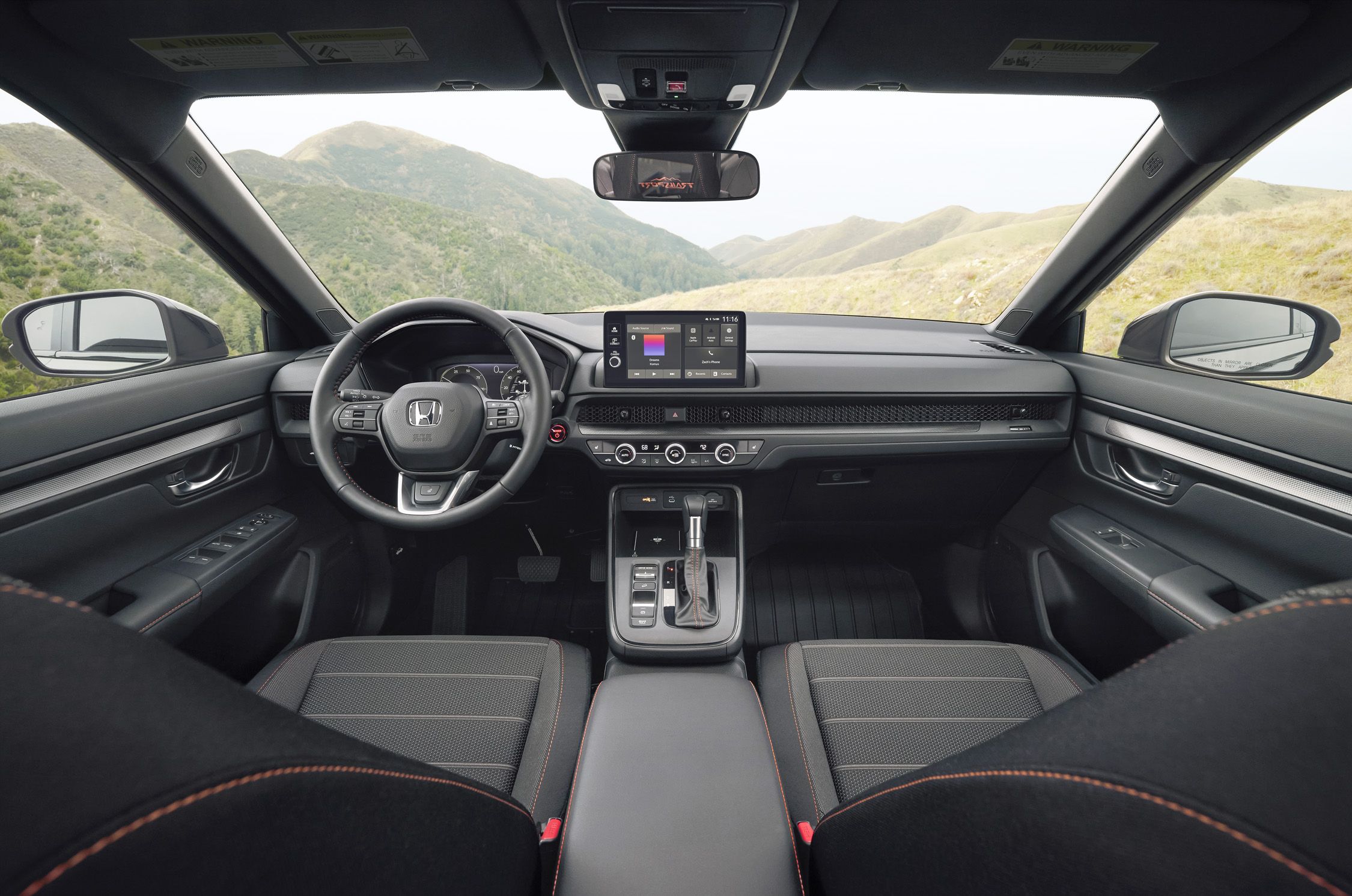
The CR-V cabin is the reason the hybrid stays the default compact SUV recommendation: easy sightlines, practical rear-seat access, physical controls, a large cargo opening, and enough comfort to make family duty feel normal.
Interior Source Receipts
Research basis
Updated June 18, 2026
Built from Honda's official 2026 CR-V and CR-V specifications/trim comparison pages, Honda's 2026 warranty booklet, current SERP checks for '2026 Honda CR-V Hybrid review', and competitor coverage from Car and Driver, Edmunds, KBB, and YouTube.
This is a MotorRank buyer-research review, not an instrumented road test. Honda official data supplies prices, MPG, cargo, AWD, powertrain output, and warranty references; third-party pages identify the ranking field and video context.
Refresh after Honda changes offers or destination-fee language, after new safety-test updates, and after MotorRank obtains its own measured road-test and MPG data.
Which 2026 HONDA CR-V HYBRID to Buy
Which trim is right for you?
Sport Hybrid
$35,630
The value hybrid: 204 hp, available AWD, and the best price discipline in the hybrid CR-V range.
Our pick
TrailSport Hybrid
$38,800
Standard AWD, all-terrain tires, and the outdoors look; useful if light trail confidence matters more than max MPG.
Sport-L Hybrid
$38,725
The comfort step with leather-trimmed seating and available AWD, but close enough to TrailSport and Sport Touring to require a written quote.
Sport Touring Hybrid
$42,550
The loaded hybrid with standard AWD and the richest cabin, but it pushes into bigger-SUV and luxury-adjacent money.
Performance
- Horsepower
- 204hp
- 0–60 mph
- 7.8s
Scorecard
- Performance8.1
- Comfort8.7
- Value8.5
- Ownership8.6
- Technology8.2
- Safety8.9
- Reliability8.7
- Interior8.5
Shopping Tools
Next steps for 2026 Honda CR-V Hybrid shoppers.
Research tools to help you move from browsing to buying.
Compare rivals
Line up the closest alternatives before you commit.
Check deal signals
Review pricing pressure, incentives, and value angles.
Read owner signal
Balance the expert take with ownership patterns.
Open vehicle hub
Keep specs, reliability, rankings, and review links together.
Compare Against
Cross-shop before you commit.
The closest alternatives in this price range, with our read on each.
Toyota hybrid benchmark
Toyota RAV4 Hybrid
The resale and hybrid-trust rival; compare exact trim pricing before choosing the Honda.
Warranty and equipment threat
Hyundai Tucson Hybrid
Longer warranty and rich equipment, but Honda counters with simplicity and resale confidence.
Value and tech alternative
Kia Sportage Hybrid
More visual drama and features; CR-V is the more conservative long-term play.
Driver-focused hybrid rival
Mazda CX-50 Hybrid
More design and steering appeal, but less obvious family-cargo logic than the CR-V.
Buyer FAQ
2026 Honda CR-V Hybrid buyer questions, answered.
18
buyer answers
Question Map
Decision
Should you buy the CR-V Hybrid?
The CR-V Hybrid is the safe default for compact hybrid SUV shoppers, but only if the trim is kept under control.
Is the 2026 Honda CR-V Hybrid worth buying?
Yes - Sport Hybrid is the version most shoppers should start with.+
Yes. The CR-V Hybrid gives you 204 hp, strong official fuel economy, no charging routine, and the practical cabin shape that makes the CR-V a default family SUV. Sport Hybrid is the clean buy because it gets the powertrain without forcing the most expensive trim.
Who should skip it?
Skip it if you need the cheapest SUV, the longest warranty, or serious off-road hardware.+
Budget shoppers should price gas compact SUVs and smaller hybrids. Warranty-focused shoppers should compare Hyundai and Kia. Off-road buyers should not confuse TrailSport with a true trail SUV. The CR-V Hybrid is built for everyday family use, bad-weather confidence, and low fuel stops.
Is it better than the gas CR-V?
For most buyers, yes - the hybrid is stronger and more efficient.+
The gas CR-V is cheaper at the entry point, but the hybrid is the better daily powertrain if the budget allows. It feels smoother around town, has more total system power, and returns much better city economy.
Price
What does it really cost?
Honda lists Sport Hybrid at $35,630 and Sport Touring Hybrid at $42,550 before normal fees. That spread is big enough to change the recommendation.
How much is the 2026 CR-V Hybrid?
Sport Hybrid starts at $35,630; Sport Touring Hybrid starts at $42,550.+
Honda's official trim comparison lists Sport Hybrid at $35,630, TrailSport Hybrid at $38,800, Sport-L Hybrid at $38,725, and Sport Touring Hybrid at $42,550 before normal taxes, fees, and dealer charges. The written out-the-door quote matters more than the MSRP headline.
Which trim should I buy?
Sport Hybrid for most buyers; TrailSport only with a real reason.+
Buy Sport Hybrid if you want the best value. Buy TrailSport if you actually use dirt roads, bad-weather routes, and light adventure access. Buy Sport-L for comfort. Buy Sport Touring only if the loaded cabin and standard AWD matter enough to survive cross-shopping against rivals.
Is Sport Touring worth it?
Only if you will use the luxury equipment every week.+
Sport Touring can be worth it for long-term owners who want the richest Honda cabin, but it is expensive enough to compare against loaded Tucson, Sportage, RAV4, and Forester hybrids. If the top trim stretches the loan, stay lower.
MPG
How efficient is it?
FWD Sport Hybrid is the efficiency pick. AWD and TrailSport trims trade some MPG for traction and hardware.
What MPG does the 2026 CR-V Hybrid get?
Up to 43 city / 36 highway / 40 combined on FWD hybrid trims.+
Honda lists Sport Hybrid and Sport-L Hybrid FWD at 43 city / 36 highway / 40 combined. AWD versions are listed at 40/34/37, while TrailSport Hybrid is listed at 38/33/35. Real-world results depend on tires, speed, weather, terrain, and load.
Should I get AWD?
Get AWD for real weather or road needs, not for image.+
AWD is worth it if you deal with snow, steep wet roads, rural driveways, gravel, or trailhead access. It is not free: Honda's own MPG table shows a penalty. Mild-climate commuters should strongly consider FWD Sport Hybrid.
Is TrailSport bad on fuel?
No, but it is the least efficient hybrid CR-V.+
TrailSport's 38/33/35 rating is still efficient for an AWD compact SUV, but it gives up economy compared with the FWD hybrid trims. Buy it for the actual TrailSport use case, not just because the badge looks tougher.
Daily Use
Will it work for family duty?
The CR-V Hybrid's practical cabin and cargo shape are the core reasons to choose it over smaller and flashier hybrids.
Is the CR-V Hybrid roomy enough?
Yes for most compact SUV families.+
Honda lists hybrid cargo space at 36.3 cubic feet behind the second row and 71.8 cubic feet behind the first row. That is enough for most family, commuter, and road-trip routines, though shoppers with heavy gear should test-load before signing.
Is it better than a smaller Corolla Cross Hybrid?
Yes if space matters; no if parking and low price matter more.+
The CR-V Hybrid is larger, more comfortable, and more family-ready. The Corolla Cross Hybrid is cheaper, easier to park, and more efficient in a smaller package. Choose by size need, not badge loyalty.
Does the CR-V Hybrid need to be plugged in?
No - it is a conventional hybrid.+
The CR-V Hybrid charges its battery through the gas engine and regenerative braking. There is no plug, no home charger, and no range planning. That simplicity is one reason it is so easy to recommend.
Ownership
What should you know before keeping one?
Honda's warranty is normal-length, so the ownership case depends on hybrid maturity, resale, clean paperwork, and disciplined pricing.
What warranty does it have?
Honda lists 3/36 new-vehicle coverage and 8/100 high-voltage battery capacity coverage.+
Honda's 2026 warranty material lists 3 years / 36,000 miles new-vehicle coverage and high-voltage battery capacity coverage for 8 years / 100,000 miles. Ask the dealer for the exact warranty booklet and state-specific coverage before signing.
Will it hold value?
The CR-V name should help, but transaction price still matters.+
CR-V resale confidence is one of the model's strengths, but paying a markup or loading the deal with add-ons can erase that advantage. The safest ownership path is a clean trim, clean quote, and complete service records.
Is the hybrid system risky?
It is a mature Honda hybrid setup, but maintenance records still matter.+
Honda has deep two-motor hybrid experience, which supports confidence. Still, buyers should keep records, understand battery warranty terms, and avoid assuming any hybrid is maintenance-free.
Compare
What should you compare it against?
RAV4 Hybrid, Tucson Hybrid, Sportage Hybrid, and Forester Hybrid are the real cross-shop set. Smaller hybrids matter if you do not need CR-V space.
CR-V Hybrid or RAV4 Hybrid?
CR-V for cabin ease; RAV4 for Toyota hybrid culture.+
The RAV4 Hybrid is the obvious Toyota rival with strong resale and hybrid reputation. The CR-V Hybrid counters with smoother daily packaging and a cabin many families prefer. Compare exact trims and out-the-door quotes.
CR-V Hybrid or Tucson Hybrid?
Honda for resale and simplicity; Hyundai for warranty and equipment.+
The Tucson Hybrid gives standard AWD and longer warranty coverage, often with a rich feature set. The CR-V Hybrid is the more conservative, resale-friendly default. Drive both because the cabin and control philosophy are very different.
CR-V Hybrid or Mazda CX-50 Hybrid?
CR-V for family utility; Mazda for feel and design.+
The Mazda is the more emotional choice with richer design and a more premium vibe. The CR-V is the easier family answer with stronger packaging. If cargo and rear-seat ease matter most, Honda wins. If you want the car to feel special, Mazda deserves a look.
Ready to buy?
Configure your 2026 Honda CR-V Hybrid.
Get matched with a Honda dealer or build your spec sheet from scratch.