
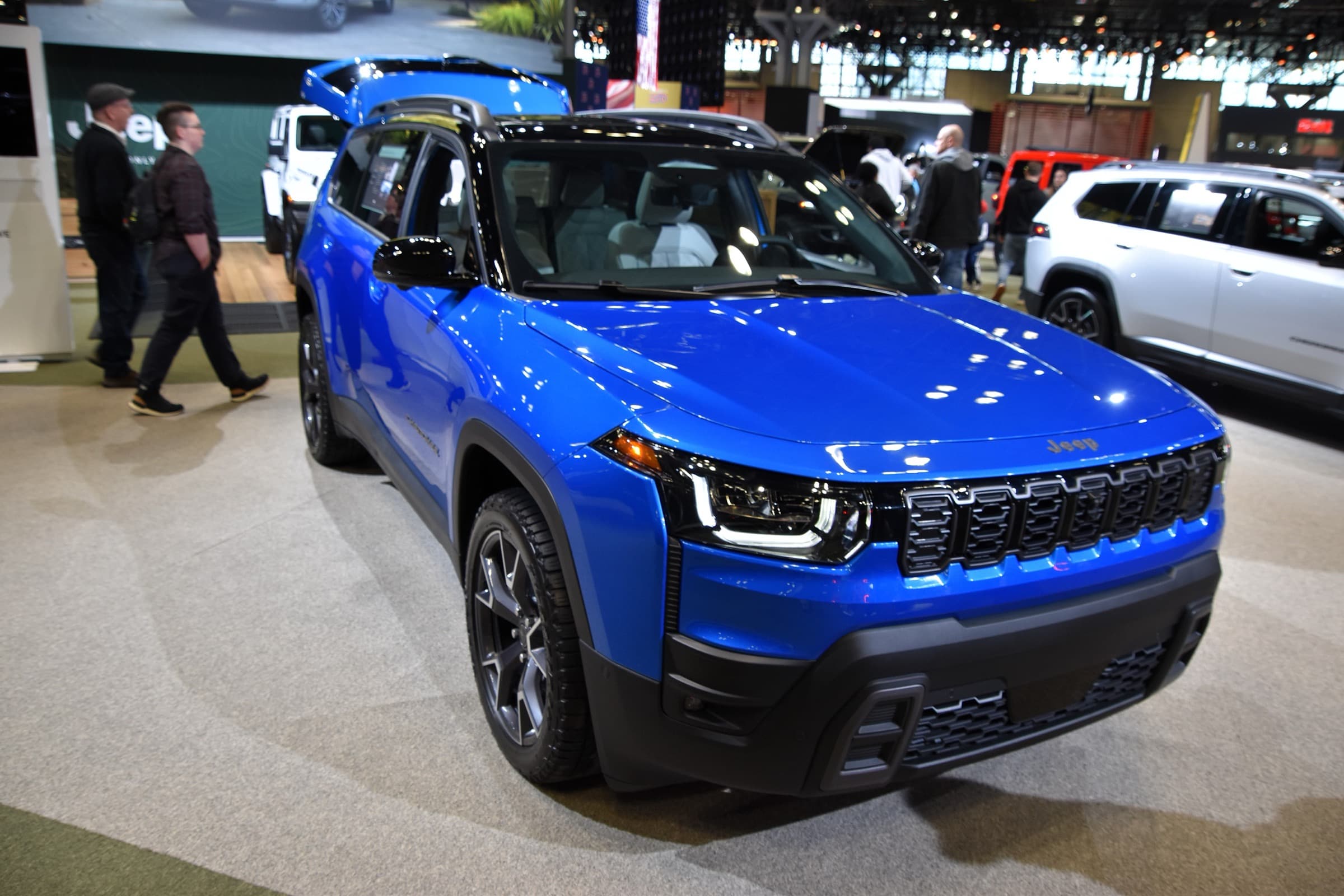
REVIEWS / Compact SUVs
NEW2026 Jeep Cherokee Review
The Cherokee is back after a two-plus-year gap as a hybrid-only, 4x4-standard compact SUV with 37 mpg and a 500-mile tank — but the 2026 buying decision is whether Jeep's comeback beats the RAV4, CR-V, and Sportage hybrids it now has to outrun.
Published June 1, 2026 / Updated June 4, 2026
Expert verdict
The 2026 Jeep Cherokee is a genuinely competitive comeback: an all-new hybrid-only compact SUV on the STLA Large platform with 210 horsepower, standard Active Drive I 4x4, an EPA-rated 37 mpg combined, more than 500 miles of range, and a 3,500-pound tow rating. Jeep's pricing runs from $36,995 to $44,995 — and unusually, those figures already include the $1,995 destination fee. It rides comfortably, the cabin won a Wards 10 Best Interiors award, and the Laredo is the smart buy. What it is not is quick, proven, or a traditional trail Jeep: MotorTrend measured 9.4 seconds to 60, there is no Trailhawk or low range yet, the new powertrain has no long-term record, and NHTSA already lists two recalls. We resolve who should buy it — and who should buy the RAV4 or CR-V instead — below.
HIGHS
- EPA-rated 37 mpg combined and 500+ miles of range with standard 4x4 — every trim, no efficiency penalty
- Wards 10 Best Interiors award-winning cabin (Overland) with 33.6-68.3 cu ft of cargo
- Strong standard equipment: 12.3-inch Uconnect 5, Level 2 Active Driving Assist, full safety suite on the $36,995 base trim
- 3,500-lb tow rating matches the segment's best hybrids
- Advertised prices include the $1,995 destination fee, and a $2,500 bonus cash offer was live in June 2026
- Composed, quiet ride that Autoblog calls excellent for the class
LOWS
- Slow when pushed: MotorTrend measured 9.4 seconds to 60 and called it 'Subaru-slow'
- No Trailhawk, low range, or locking differentials — the trail-Jeep version does not exist yet
- Two NHTSA recalls and a brand-new, unproven hybrid powertrain in its first year
- Warranty terms (3yr/36k basic, 5yr/60k powertrain) trail Hyundai and Kia
- Edmunds warns option-heavy builds push too close to $45K against strong rivals
- No crash-test ratings from NHTSA or IIHS as of June 10, 2026
AT A GLANCE
- Score
- 7.5
- Price
- $37K - $45K
- Horsepower
- 210 hp
- Drivetrain
- AWD
- Body
- SUV
- Fuel
- Hybrid
Buyer Verdict
The fast answer before you compare specs.
Built for shoppers who want the recommendation first and the details right after.
Buy it if
- The 2026 Jeep Cherokee is the comfort-and-equipment pick among hybrid compact SUVs: 210-hp hybrid, standard 4x4, EPA 37 mpg, a 500-plus-mile tank, 3,500-pound towing, and a Wards-award interior, from $36,995 with destination included. The smart buy is the $39,995 Laredo. Skip it if you need trail hardware (no Trailhawk or low range exists yet) or a proven powertrain — the first-year hybrid already has two NHTSA recalls, and a RAV4 or CR-V Hybrid is the certainty play.
- Best for: Comfort-and-efficiency buyers who want a quiet, well-equipped compact SUV with standard 4x4, real towing, and a 500-mile tank — and who are honest that they need all-weather capability, not low-range trail hardware.
- Our trim pick: Laredo from $39,995.
Skip it if
- Slow when pushed: MotorTrend measured 9.4 seconds to 60 and called it 'Subaru-slow'
- No Trailhawk, low range, or locking differentials — the trail-Jeep version does not exist yet
- Two NHTSA recalls and a brand-new, unproven hybrid powertrain in its first year
Closest rivals
- Toyota RAV4
The proven default
- Honda CR-V Hybrid
The packaging benchmark
- Kia Sportage Hybrid
The value hybrid
Quick take
If you are searching for a 2026 Jeep Cherokee review, you have probably found plenty of comeback coverage and very little decision help. The Cherokee returned for 2026 after being discontinued in 2023, and it returned transformed: an all-new fourth generation (Jeep's KM series) built on the STLA Large platform, powered exclusively by Stellantis' first North American full hybrid — a 1.6-liter turbocharged four-cylinder with two electric motors making a combined 210 horsepower and 230 pound-feet — with Jeep Active Drive I 4x4 standard on every trim. Jeep prices it from $36,995 for the base Cherokee to $44,995 for the Overland, with destination included, and the EPA rates every version at 39 mpg city, 35 highway, and 37 combined. This Research Desk review answers the three questions the news cycle skips: which trim to buy, whether the hybrid delivers in the real world, and whether a loyal Jeep owner or a RAV4/CR-V cross-shopper should actually sign for one.
This is a buyer-research review built from Jeep's official specifications, pricing, and press materials, the EPA's published ratings on fueleconomy.gov, NHTSA's recall and complaint databases, and the published test results and impressions of Car and Driver, MotorTrend, Edmunds, Consumer Reports, and Autoblog — each attributed to the outlet that produced it. It is not a MotorRank instrumented road test. We have not independently measured acceleration, braking, real-world fuel economy, or cabin noise, and we do not publish reliability scores, repair costs, or resale percentages we cannot source. Where a number is Jeep-official we say so; where it is a third party's measured result we name them; where it is unverified, we label it.
Driving impressions
Why the Cherokee matters
The Cherokee matters because it is Jeep's bid to win back the largest vehicle segment in America with efficiency instead of trail theater — and because the nameplate still pulls enormous loyalty. The old KL Cherokee sold on V6 torque and available real off-road hardware; this one sells on 37 mpg, a 500-plus-mile tank, standard all-wheel drive with a fuel-saving rear-axle disconnect, and a cabin good enough that Wards named the Overland's interior one of its 10 Best for 2026. Consumer Reports notes the new truck grew 5 inches in length and 6 inches in wheelbase versus the old Cherokee, giving it a size advantage over the Honda CR-V while undercutting two-row midsizers on price. In a segment where the RAV4 went hybrid-only this same year, Jeep is finally fighting the fight buyers actually shop.
What to watch before you buy
Watch three things before you sign. First, acceleration: Jeep cites an 8.7-second 0-60 (as reported by Edmunds), but MotorTrend measured 9.4 seconds in its instrumented test and called the Cherokee 'Subaru-slow' — fine in town, modest at full throttle. Second, the early-build record: NHTSA lists two recalls for the 2026 Cherokee already — a trailer tow module fix (campaign 26V059000) and a brake-system control module software update affecting ABS and stability control (26V223000) — plus a handful of early owner complaints; both recalls have free dealer remedies, but a brand-new powertrain deserves a careful pre-delivery check. Third, the price math: Jeep's sticker includes the $1,995 destination fee, which makes it look pricier than rivals' before-destination quotes than it really is — and a $2,500 retail bonus cash offer was running through June 30, 2026, so never compare stickers without normalizing both.
SERP audit: what the ranking 2026 Cherokee reviews leave unanswered
Before writing, we audited the live Google results for '2026 jeep cherokee review.' The organic leaders are GreenCars' hybrid-angle review and Car and Driver's model hub (an 8/10 rating, ranking the Cherokee #7 among compact SUVs), followed by MotorWeek's first look, a Consumer Reports first-drive video and article, MotorTrend's buyer's guide (7.5/10), KBB, The Drive, TheTruthAboutCars, Autoblog (8.3/10), Motor1, and Edmunds. The rest of page one is Reddit threads, forum posts, and YouTube walkarounds — plenty of comeback enthusiasm, little structured decision help.
Here is the gap. Car and Driver's page gives one sentence of trim advice and lists prices without explaining that Jeep folds the destination fee into its advertised numbers — a detail that changes every cross-brand comparison a shopper makes. Nobody on page one reconciles Jeep's 8.7-second 0-60 claim with MotorTrend's measured 9.4 seconds. Nobody covers the two NHTSA recalls already on file, the early owner complaints, or what the unproven 1.6-liter hybrid means for a buyer who keeps vehicles ten years. And no ranking page gives a straight verdict for the two buyers who matter most: the loyal Cherokee/Grand Cherokee owner deciding whether this is still their Jeep, and the RAV4/CR-V/Sportage hybrid shopper deciding whether the Jeep badge is worth the price walk.
So this review is organized to close exactly those gaps: destination-normalized pricing for every trim, the hybrid's real-world numbers with sources, the recall record stated plainly, a trim verdict per buyer type, and cross-shop calls that end in a decision. Every Jeep-official figure was checked against jeep.com and Stellantis' press materials, every fuel-economy number against the EPA, and the recall record against NHTSA's database on June 10, 2026.
Bottom line up front: is the 2026 Cherokee worth buying?
Yes — for the buyer who wants a comfortable, efficient, all-weather compact SUV with more standard equipment than the segment norm and genuinely likes what the Jeep badge stands for. The hybrid is smooth, the EPA numbers are real (Autoblog observed roughly 36 mpg in mixed real-world driving), the cabin is a legitimate strength, and standard 4x4 plus a 3,500-pound tow rating beat what most rivals include at the price. The honest counterweights: it is one of the slower vehicles in the class, there is no Trailhawk or low-range hardware for actual off-roaders yet, and a first-year powertrain from a brand with a mixed recent reliability record carries real uncertainty that two early recalls do nothing to shrink.
Our research-basis score is 7.5 out of 10, sitting deliberately between Car and Driver's 8/10 and Autoblog's 8.3 on the optimistic end and Edmunds' more reserved 6.4 on the skeptical end. The scorecard rewards the interior (8.5), comfort (8.3), and technology (8.2), and marks down performance (6.6) and reliability confidence (6.9) — the latter being editorial judgment about an unproven powertrain, not a measured owner-data score, because no such data exists yet for this generation. For most shoppers the buy is the $39,995 Laredo; the Overland is the one to choose if you want the award-winning cabin fully realized.
Official pricing — and the destination-fee twist every comparison gets wrong
Here is the 2026 Cherokee price ladder as listed by Car and Driver and Edmunds in June 2026, and confirmed against Jeep's own configurator: Cherokee $36,995; Laredo $39,995; Limited $41,995; 85th Anniversary $42,900; Overland $44,995. The critical fine print: those figures already include Jeep's $1,995 destination charge. On jeep.com the same trims show base MSRPs of $35,000, $38,000, $40,000, and $43,000 before destination. Almost every rival brand advertises before destination, so a sticker-to-sticker comparison quietly penalizes the Jeep by about two grand. Normalize before you compare.
Two more pricing facts the news coverage missed. First, prices have actually come down since launch: Stellantis' August 2025 announcement listed the Limited at $42,495 and the Overland at $45,995 with destination, while today's listings show $41,995 and $44,995 — $500 and $1,000 lower. Second, Jeep was running a $2,500 retail bonus cash allowance on 2026 Cherokee models through June 30, 2026 (per jeep.com's offers page on June 10, 2026), and Car and Driver's page showed an advertised lease around $630 a month for 36 months expiring the same day. Incentives change monthly and vary by region — check Jeep's current offers the same day you collect dealer quotes — but the pattern matters: this is a launch-year vehicle that is already negotiable, not a markup car.
What does the money actually buy? Consumer Reports' purchase is a useful benchmark: CR bought a Laredo for testing at $38,000 base plus a $495 compact spare tire and the $1,995 destination fee — $40,490 all in before tax and title. CR also called out the destination fee itself, noting Stellantis' fees are outpacing many competitors. That is the honest framing: the Cherokee's advertised prices are more transparent than most, but the underlying fee is on the high side, and the spare tire — something a Jeep buyer might assume is standard — costs extra.
The hybrid system, explained: how Jeep's first true hybrid works
The 2026 Cherokee is the first regular, non-plug-in hybrid Jeep — and the first for all of Stellantis in North America. The system pairs a turbocharged 1.6-liter four-cylinder (177 horsepower, 221 pound-feet on its own, per Jeep's spec sheet) with two electric motors and a small 1.03-kilowatt-hour lithium-ion battery, for a combined 210 horsepower and 230 pound-feet. Power flows through an electronically controlled continuously variable transmission, and the engine is built at Stellantis' Dundee plant in Michigan while the vehicle is assembled in Toluca, Mexico.
Two engineering details matter to buyers. First, per Consumer Reports, the Cherokee can run on electric power alone for short distances at up to 62 mph, which is why city economy (39 mpg) beats highway (35 mpg) — the reverse of a gas SUV. Second, the standard Active Drive I 4x4 system drives the rear axle through a real mechanical connection, not just an electric rear motor, and can disconnect that rear axle entirely to save fuel until traction is needed. Consumer Reports describes it operating as a front-driver until the system detects slip. You get all-weather security without the usual AWD fuel penalty — every Cherokee carries the same 37-mpg combined rating.
There is no plug-in version and none planned, per Car and Driver's reporting — Jeep says a PHEV is not in the cards, though it has not ruled out other powertrains or a more rugged trim later. If you want a plug, the Compass-sized and Grand Cherokee 4xe models are the Jeep answers; if you want a traditional gas engine in this size, Jeep no longer sells one — Car and Driver's advice is that gas-only loyalists have to step up to the Grand Cherokee.
Fuel economy and the 500-mile tank: the numbers that sell this truck
The EPA rates every 2026 Cherokee at 39 mpg city, 35 highway, and 37 combined on regular gas — official figures from fueleconomy.gov, and a transformation versus the old V6 Cherokee's low-20s reality. With the 13.7-gallon tank, that works out to just over 500 miles of EPA-cycle range, which is the basis for Jeep's 'more than 500 miles to a tank' claim. The math checks out: 13.7 gallons times 37 mpg is 507 miles.
Real-world evidence so far supports the sticker. Autoblog's reviewer observed 6.6 L/100km — roughly 36 mpg — across a week of mixed driving in a Limited 4x4 and called the efficiency genuinely impressive for a standard-AWD SUV. Car and Driver had not yet published its 75-mph highway test result as of this writing, so treat highway figures as EPA-basis for now. For segment context: a 2026 RAV4 hybrid and CR-V hybrid both post EPA numbers in the high-30s to low-40s depending on configuration, so the Cherokee is competitive but not the class economy king — its pitch is matching the efficiency leaders while including 4x4, more standard equipment, and more cargo room than the CR-V.
Performance, honestly: Jeep says 8.7 seconds, MotorTrend measured 9.4
This is the section where the Cherokee asks for honesty rather than enthusiasm. Jeep cites a 0-60 time of 8.7 seconds — a figure Edmunds reported from Jeep and immediately noted is more than a full second slower than the last RAV4 hybrid Edmunds tested. The only published instrumented test as of June 10, 2026, is MotorTrend's: an Overland 4x4 ran 0-60 in 9.4 seconds and the quarter mile in 17.1 seconds at 80.8 mph, weighing 4,381 pounds as tested. MotorTrend's braking (122 feet from 60) and grip (0.79 g) results were mid-pack. Their judges' summary was blunt: adequate pickup around town, 'but it's Subaru-slow.' Car and Driver estimates 8.1 to 8.3 seconds but has not tested one yet; we will update when more instrumented results publish.
The everyday experience is better than the drag strip numbers. Because the electric motors deliver torque instantly, every outlet that has driven the Cherokee — Edmunds, Autoblog, Car and Driver, The Drive — describes city response as smooth, quiet, and entirely adequate, with seamless handoffs between electric and gas power. The weakness appears at full throttle: highway merges and two-lane passes expose the modest 210 horsepower moving roughly 4,300 to 4,400 pounds, and the engine gets noisy when pushed (Car and Driver's note). Handling is secure rather than fun — TheTruthAboutCars found the steering a touch light but body roll well controlled, Edmunds calls the steering numb — and Autoblog flagged one practical annoyance the spec sheet hides: a wide turning circle that makes tight parking garages genuinely irritating. If driving enjoyment tops your list, the Mazda CX-5 remains the segment's driver's car; the Cherokee is tuned for calm.
Ride, comfort, and noise: where the Cherokee quietly excels
If the powertrain is the Cherokee's asterisk, the ride is its signature. Autoblog rates the ride quality 'composed and comfortable... excellent for its class' and credits the STLA Large platform's inherent solidity; Edmunds highlights how quiet the cabin stays around town, helped by the hybrid running electric at low speeds; Car and Driver lists 'comfortable over the road' among its highs. This is a compact SUV tuned the way family buyers actually use one — soft enough to absorb broken pavement, quiet enough for conversation, settled at highway speed.
The preview-basis caveats, attributed: Car and Driver notes the brake pedal feel is numb (a common hybrid trait, from regenerative blending) and some interior materials below the beltline are cheaper than the design suggests. Edmunds' editors griped about the thick, squared-off steering wheel rim feeling odd in the hands. None of these are deal-breakers; all are worth a minute of attention on your test drive. We have not yet measured cabin noise or ride frequency ourselves, so treat this section as a synthesis of attributed third-party impressions until MotorRank runs its own evaluation.
Choosing a trim, part 1: Cherokee vs Laredo — where the value sits
The base Cherokee at $36,995 delivered is not a stripped teaser. Every 2026 Cherokee — including this one — gets the full hybrid powertrain, Active Drive I 4x4, the 12.3-inch Uconnect 5 touchscreen with wireless Apple CarPlay and Android Auto, a 10.25-inch digital cluster, passive entry, rain-sensing wipers, and the complete safety suite: automatic emergency braking with pedestrian and cyclist detection, Intersection Collision Assist, blind-spot monitoring with rear cross path detection, drowsy-driver detection, rear park assist with reverse automatic braking, and the Level 2 Active Driving Assist system with adaptive cruise. That standard-equipment list, straight from Stellantis' release, is the strongest base-trim argument in the segment.
The Laredo at $39,995 is our recommendation and Car and Driver's named sweet spot. The $3,000 step buys 18-inch wheels, fog lamps, heated front seats, a 10-way power driver's seat, and upgraded cloth — the comfort items most buyers actually notice daily — plus access to the Arctic white interior option. Consumer Reports bought a Laredo for its own test program because it expects it to be the most common configuration, which tells you where the market is settling. If your budget stops at base, you give up comfort, not capability; nothing mechanical changes anywhere on the ladder.
Choosing a trim, part 2: Limited, 85th Anniversary, and Overland
The Limited at $41,995 is the trim Edmunds recommends, and the case is comfort: leatherette upholstery, the option of the 10-speaker premium audio (nine speakers plus subwoofer), and the bigger option groups — ventilated front seats, heated rear seats, the foot-activated power liftgate, 360-degree camera, and digital rearview mirror all live in the upper half of the lineup, per Stellantis' equipment list. The 85th Anniversary edition at $42,900 (as listed by Car and Driver and Edmunds) is a Limited-based appearance celebration of Jeep's 85th birthday; buy it if you love the look, but know it adds badge and trim rather than hardware.
The Overland at $44,995 is the flagship and the one with the award: Wards named the Cherokee Overland's interior and user experience to its 10 Best Interiors and UX list for 2026, citing the sharp style and functional technology. The Overland gets a unique perforated upholstery pattern in both color motifs, a standard dual-pane sunroof, and standard premium audio. Edmunds' warning applies here, though: option a Limited or Overland hard and 'the Cherokee can get too close to $45K for our liking' — at which point you are shopping against well-equipped RAV4s, CR-V hybrids, and even base two-row midsizers. Our advice: Laredo for value, Overland only if the cabin is the reason you chose the Cherokee in the first place, and skip the in-between steps unless a specific option you need lives there.
The trim verdict, by buyer type
Best value for most shoppers: the Laredo at $39,995, for the heated seats, power driver's seat, and 18-inch wheels at a $3,000 walk. Best budget buy: the base Cherokee at $36,995 — identical drivetrain and safety, and the only sub-$38,000 entry; remember it arrived at dealers in early 2026, later than the upper trims, so inventory was still building through spring. Best comfort-per-dollar: the Limited, especially with the premium audio. Best if the interior sold you: the Overland, the Wards-award cabin fully realized with the dual-pane roof. Skip unless smitten: the 85th Anniversary, which is styling rather than substance.
Two structural notes for every trim. There is no efficiency penalty anywhere on the ladder — all five trims carry the same 210-hp hybrid, the same 4x4 system, and the same 37-mpg rating, which makes this one of the simplest trim walks in the segment. And there is no capability step either: no trim adds low range, locking differentials, or extra ground clearance, because no Trailhawk exists yet. If you are waiting for the trail-rated version, that is a real reason to wait — covered in the 'who should wait' section below.
4x4 capability and the missing Trailhawk: what 'Jeep' means here
Let's be precise about what the 2026 Cherokee can and cannot do, because the badge invites assumptions. Standard on every trim is Jeep Active Drive I — an on-demand 4x4 system with a true mechanical rear-axle connection and automatic rear-axle disconnect — plus Selec-Terrain traction management with Auto, Sport, Snow, and Sand/Mud modes. Jeep's official geometry: 8 inches of ground clearance, a 19.6-degree approach angle, 18.8-degree breakover, and 29.4-degree departure — and Jeep claims best-in-class approach and departure angles for the segment. That is genuinely more capable than a front-drive-based crossover on a muddy launch ramp, a snowed-in driveway, or a rutted forest road.
What it is not is a trail vehicle in the old Cherokee Trailhawk sense: there is no low-range gearing, no locking differential, and no off-road-specific trim — Car and Driver notes both the absence and Jeep's hint that more rugged versions may come. MotorTrend's SUV of the Year judges drove it on- and off-road and delivered the sharpest verdict in this review: 'This Cherokee is a perfectly fine compact SUV, but it just isn't a great Jeep.' We would frame it less harshly — most compact-SUV buyers never use more capability than this — but if your purchase is about the trail identity, today's Cherokee asks you to wait for a Trailhawk that is not yet announced, or step to a Wrangler, a used KL Trailhawk, or the electric Jeep Recon.
Towing and payload: 3,500 pounds, with one caveat nobody prints
Jeep rates the 2026 Cherokee to tow 3,500 pounds — a figure Jeep calls unsurpassed in the segment, and one that matches the new RAV4's maximum rating. For a hybrid compact SUV it is a genuinely useful number: a small camper, a pair of jet skis, a utility trailer, or a lightweight boat are all in play, and the electric motors' 230 pound-feet of combined torque arrives instantly, which helps more in real towing than the horsepower figure suggests. Context for returning Cherokee owners: the old KL with the V6 towed up to 4,500 pounds, so this generation trades 1,000 pounds of rating for roughly 15 mpg of efficiency — per Car and Driver's comparison of the two generations.
The caveat is payload. Jeep's spec sheet lists 850 pounds for the Limited — and payload is people plus cargo plus tongue weight, all at once. Four adults and luggage can consume that before a trailer's tongue weight enters the math. If you plan to tow near the 3,500-pound limit with the family aboard, run the numbers with your dealer against the specific trim's door-jamb sticker rather than assuming the headline rating covers your use. We flag this because no ranking review mentions it, and it is exactly the kind of detail that turns a happy owner into a warranty dispute.
Interior and cargo: the Wards-award cabin, measured
The cabin is the Cherokee's headline achievement, and it has third-party validation: Wards named the Cherokee Overland to its 10 Best Interiors and UX list for 2026, after judges lived with each finalist in daily driving. Jeep's design team built it around four motifs — active, playful, practical, progressive — with sustainability choices like non-leather materials and recycled carpet fiber. Autoblog calls the cabin 'genuinely premium, well-assembled, thoughtfully laid out'; MotorTrend's counterpoint is that it lacks the playful easter eggs Jeep fans expect and resembles the Charger's dash — both fair, both attributable.
The official measurements, from Jeep's spec sheet: 107 cubic feet of passenger volume, 41.3 inches of front legroom, 38.5 inches of rear legroom, and headroom of 40.3 front and 40.2 rear. Cargo space is 33.6 cubic feet behind the rear seats and 68.3 with them folded — Jeep says 30 percent more than the old Cherokee, which it illustrates as roughly one extra large dog crate. That cargo hold outmeasures a RAV4's and runs close to the class-leading CR-V, in a footprint that grew 5 inches longer on a 6-inch-longer wheelbase per Consumer Reports. A practical touch CR appreciated: a compact spare tire is available (a $495 option on their test car) instead of an inflator kit — worth ordering on a vehicle with any gravel-road ambitions.
Color and materials by trim: Global Black is standard everywhere; the Arctic white motif is optional on Laredo, Limited, and Overland; leatherette arrives on Limited and the Overland's unique perforation pattern tops the range. A rotary gear selector frees up console storage. The honest gaps: Car and Driver notes some hard, cheap plastics survive below the beltline, and ventilated front seats and heated rear seats remain optional rather than standard even at the top of the ladder.
Technology: Uconnect 5, a 12.3-inch screen, and ten years of updates
Every 2026 Cherokee ships with the same core tech, which is unusual and welcome at the base price: a 12.3-inch Uconnect 5 touchscreen with wireless Apple CarPlay and Android Auto, a 10.25-inch digital instrument cluster, and Stellantis' Connect One connected-services bundle, which includes ten years of over-the-air update service, the Jeep smartphone app, and automatic SOS calling at no extra cost. Uconnect 5 also carries an AppMarket with in-screen apps (Geocaching, The Dyrt, games) and optional add-ons like a Wi-Fi hotspot. Autoblog judges the system's responsiveness and layout a genuine generational improvement for Jeep, and Edmunds' complaints focus on the steering wheel shape rather than the software.
The available upgrades cluster in the upper trims: 10-speaker premium audio (standard on Overland, optional on Limited), a 360-degree camera, digital rearview mirror, front tire-to-curb camera view, turn-signal-activated blind-spot cameras, Alexa in-vehicle assistant, a foot-activated power liftgate with adjustable height, and a windshield wiper de-icer. Strategy advice: the standard screen and connectivity are good enough that you do not need to climb trims for the tech itself — climb only if you want the comfort and camera features bundled around it.
Safety: a long standard list, but no crash ratings yet
Jeep counts 140 standard and available safety and security features on the 2026 Cherokee, and the standard list is genuinely deep: automatic emergency braking with pedestrian and cyclist identification, Intersection Collision Assist, blind-spot monitoring with rear cross path detection, drowsy-driver detection, rain-sensing wipers, rear park assist with rear automatic emergency braking, and — notably — the Active Driving Assist system, a Level 2 hands-on highway assistant with adaptive cruise control, standard on every trim including the $36,995 base car. Most rivals charge for an equivalent suite or reserve it for upper trims.
What we cannot tell you yet is how it crashes. As of June 10, 2026, NHTSA's database returns no crash-test ratings for the 2026 Cherokee — we checked directly — and full IIHS results had not been published either. That is normal for a vehicle this new and not a red flag, but safety-first buyers who require a Top Safety Pick badge or a five-star overall rating before purchase have a concrete reason to wait a few months. We will update this section when either agency publishes. Our 8.0 safety score reflects the equipment, not crash performance, and we say so plainly.
Recalls, complaints, and reliability: the honest first-year picture
Here is the record the comeback coverage skips, verified against NHTSA's databases on June 10, 2026. The 2026 Cherokee has two recalls. Campaign 26V059000 (February 2026): an improperly designed trailer tow module can keep trailer lights and trailer brakes from working; dealers replace the module free, and the fix matters if you bought the Cherokee to tow. Campaign 26V223000: the brake-system control module software can fail, causing a loss of ABS and electronic stability control; dealers update the software free, with owner letters mailed April 28, 2026. NHTSA also lists three early owner complaints, including a vehicle that would not shut off and needed a 12-volt battery reset at 78 miles, an intermittent traction-control grinding noise, and a fuel-gauge/range misread that left an owner stranded. Three complaints is a small number in absolute terms — but this is a low-volume launch year, so treat it as a signal to watch, not a verdict either way.
On reliability we will not pretend to data that does not exist. The 1.6-liter turbo hybrid is a brand-new engine family, the Cherokee is its first application, and no owner survey — Consumer Reports' or anyone's — has had time to score this generation. Jeep as a brand has ranked below average in recent CR and J.D. Power dependability studies, which is context, not destiny: the hybrid architecture (a small battery, two motors, no conventional stepped transmission) is mechanically simpler in some ways than a turbo with a nine-speed. Our 6.9 reliability score is editorial judgment about that uncertainty, not a measured result. A cautious buyer's playbook: confirm both recalls are closed on the specific VIN before delivery, keep the first-year software updated, and consider the certainty of a RAV4 or CR-V if a decade of predictable ownership is your top priority.
Warranty and ownership costs: what Jeep actually covers
Jeep's official coverage on the 2026 Cherokee, from its published specifications: a 3-year/36,000-mile basic limited warranty, a 5-year/60,000-mile powertrain warranty, 5 years of corrosion coverage with no mileage limit, and 5-year/60,000-mile roadside assistance. Car and Driver's warranty summary adds 8-year/100,000-mile coverage for the hybrid battery and notes complimentary maintenance runs two years — confirm the exact battery and maintenance terms in the warranty booklet for your build, since hybrid-component coverage can vary by state emissions rules. Those terms match Toyota's basic coverage and beat nothing: Hyundai and Kia still publish 5-year/60,000 basic and 10-year/100,000 powertrain terms that comfortably exceed Jeep's.
Running-cost structure, without invented numbers: fuel is the Cherokee's strong suit — the EPA estimates about $1,800 a year at its assumptions, and 37 mpg on regular gas undercuts any gas-only competitor; insurance and maintenance for a first-year model are unknowns we will not guess at; and resale for this generation has no track record yet, so we will not quote a residual percentage. What we can say structurally: the old Cherokee's resale was middling for the segment, and this generation's value retention will hinge on whether the hybrid proves durable and whether a Trailhawk arrives to lift the nameplate's image. If you keep cars past the warranty, the unknowns concentrate exactly where the coverage ends at year five.
Cross-shop: Cherokee vs RAV4, CR-V Hybrid, Sportage Hybrid, and CX-5
Against the 2026 Toyota RAV4 — now hybrid-only itself — the decision is proven versus polished. The RAV4 counters with Toyota's hybrid track record, a stronger resale story, and a Woodland-flavored option for light trail duty; the Cherokee answers with more cargo room, a quieter and nicer cabin, more standard driver assistance, and a matching 3,500-pound tow rating. Choose the RAV4 for long-term certainty; choose the Cherokee for comfort, equipment, and space. Our full RAV4 review covers its own trim traps.
Against the Honda CR-V Hybrid, the math is tighter than the badges suggest: the CR-V is the segment's packaging benchmark with a more engaging drive and Honda's reliability reputation, but AWD costs extra, its tow rating is 1,000 pounds lower, and a comparably equipped Sport Touring lands within sight of the Cherokee Limited once you normalize destination fees. Choose the CR-V for resale and drive quality; the Cherokee for 4x4-standard value and towing. Against the Kia Sportage Hybrid — our segment value benchmark — the Kia wins on price (it starts around $30,500) and on warranty (10-year powertrain), while the Cherokee wins on standard 4x4, towing, cargo, and cabin quality; if budget leads, read our Sportage Hybrid review before paying Jeep's premium. And against the Mazda CX-5, the trade is simple: the Mazda is the driver's car and the style pick, the Jeep is the efficiency and equipment pick — the CX-5's non-hybrid drivetrain cannot approach 37 mpg.
One more comparison matters for loyalists: the Grand Cherokee. If you are a returning Cherokee owner who tows heavier, wants available V6-era muscle, or simply cannot accept a CVT hybrid, Car and Driver's advice is the honest one — the Grand Cherokee is now the traditional-Jeep path, at a meaningfully higher price. The new Cherokee is the rational commuter Jeep; it no longer tries to be the junior trail rig.
Who should wait
Wait if you need the trail version: Jeep has not ruled out more rugged variants, Car and Driver expects the possibility, and buying a street-spec Cherokee today when a Trailhawk could appear within a product cycle is how off-roaders end up with the wrong truck. Wait if crash ratings gate your purchase: NHTSA and IIHS results did not exist as of June 10, 2026, and should arrive within months. Wait if first-year reliability risk is unacceptable: two recalls in the first six months of sales are both fixed by free dealer remedies, but they are also exactly the early-build pattern cautious buyers avoid by shopping the second model year. And wait — or at least negotiate hard — if you can let the incentive cycle work for you: with bonus cash already on the hood in June 2026 and base trims still ramping at dealers, the Cherokee's transaction prices are heading in the buyer's direction.
Do not wait if the current package already fits: a comfortable, efficient, well-equipped 4x4 family SUV at a destination-honest price, with the segment's best standard tech and an award-winning cabin. The things that might improve — a Trailhawk, crash ratings, owner data — do not change what the Laredo is today, and the $2,500 bonus cash plus post-launch price cuts mean early adopters are not paying the usual comeback tax.
The verdict: which Cherokee to buy, and who should look elsewhere
The 2026 Jeep Cherokee is a real comeback, not a nostalgia act: hybrid-only, 4x4-standard, EPA-rated at 37 mpg with 500-plus miles of range, rated to tow 3,500 pounds, and built around a cabin good enough to win a Wards 10 Best Interiors award. It is also slow against the stopwatch, unproven against the calendar, and — for now — un-Jeeplike on the trail, with no Trailhawk, no low range, and two early recalls on its record. Both halves of that sentence are true, and which half matters more depends entirely on which buyer you are.
Our buying advice in one breath: most shoppers should buy the Laredo at $39,995 delivered, after confirming both NHTSA recalls are closed on the VIN and stacking the current month's incentives. Cabin-first buyers should go straight to the Overland; budget buyers lose nothing mechanical in the $36,995 base car; and nobody needs the 85th Anniversary except for the badge. Cross-shoppers who value a proven decade more than a nicer today should buy the RAV4 or CR-V Hybrid and not look back; driving enthusiasts should buy the CX-5; budget hybrid shoppers should price the Sportage Hybrid first. This is a research-basis review built from Jeep, EPA, and NHTSA data and attributed third-party testing; we will update it with MotorRank instrumented results, crash ratings, owner-reliability data, and Trailhawk news as they land.
Specs Snapshot
The numbers shoppers compare first.
Key numbers to compare against alternatives before you commit.
| Base price | $37K - $45K |
|---|---|
| Horsepower | 210 hp |
| Drivetrain | AWD |
| Transmission | Automatic |
| Fuel type | Hybrid |
| Combined MPG/MPGe | 37 |
Media Proof
Exterior and interior visuals with source receipts.
Every asset shown here links back to its source and license so the page can gain trust without borrowing competitor media.
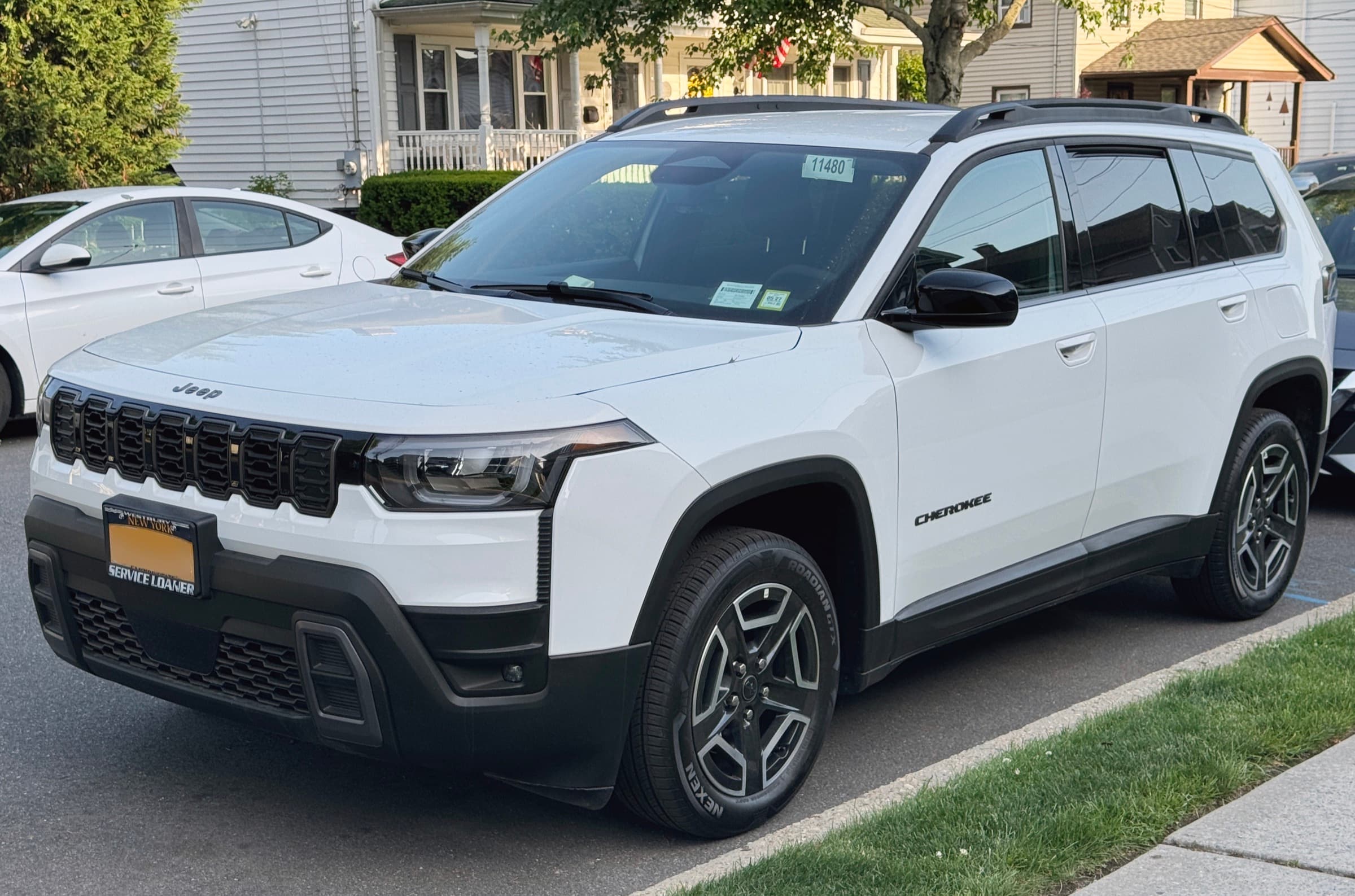
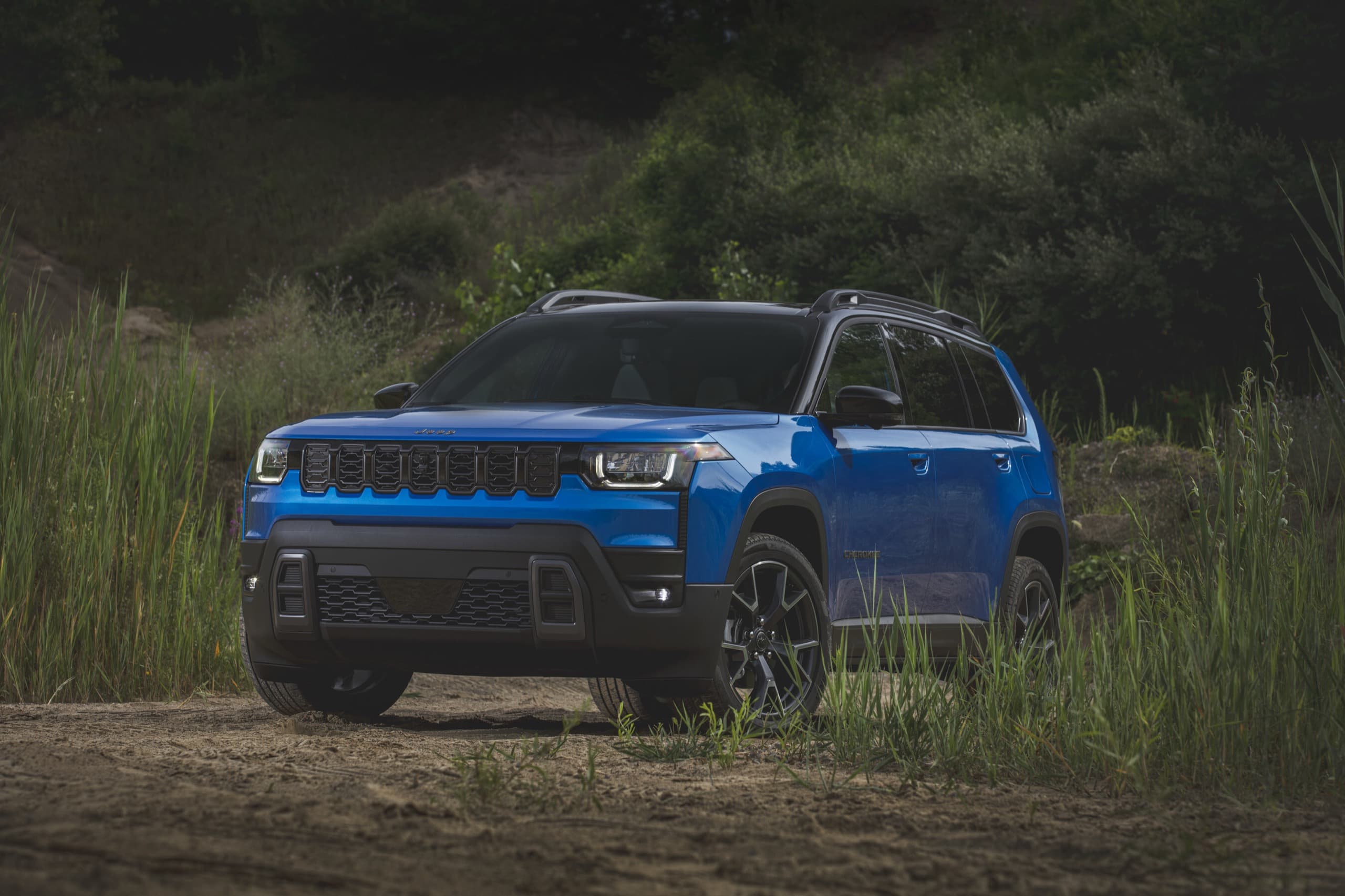
Source Receipts
Source pages, creator credits, and reuse licenses are visible for editorial trust and legal hygiene.
Interior
Cabin views before you choose a trim.
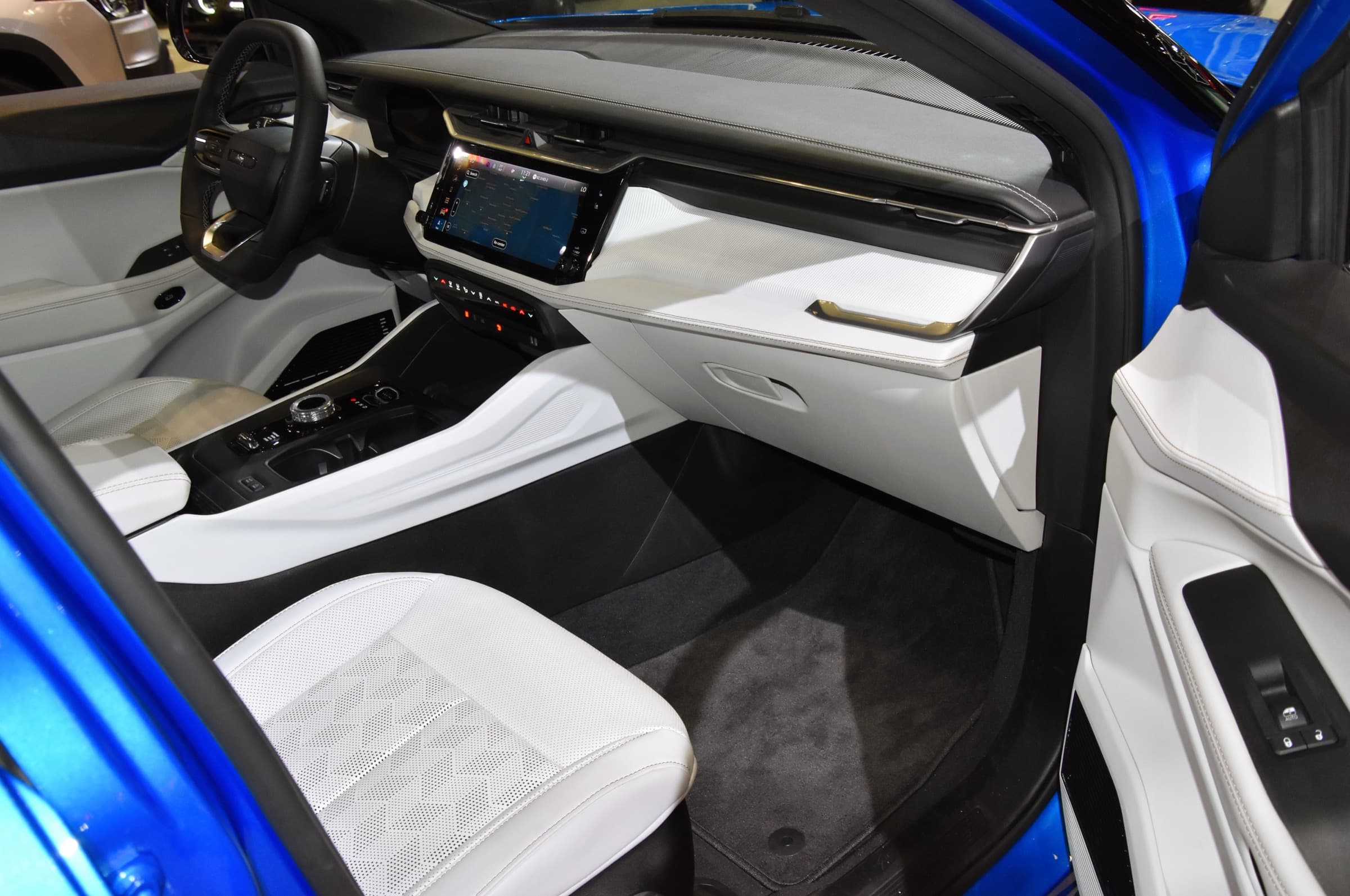
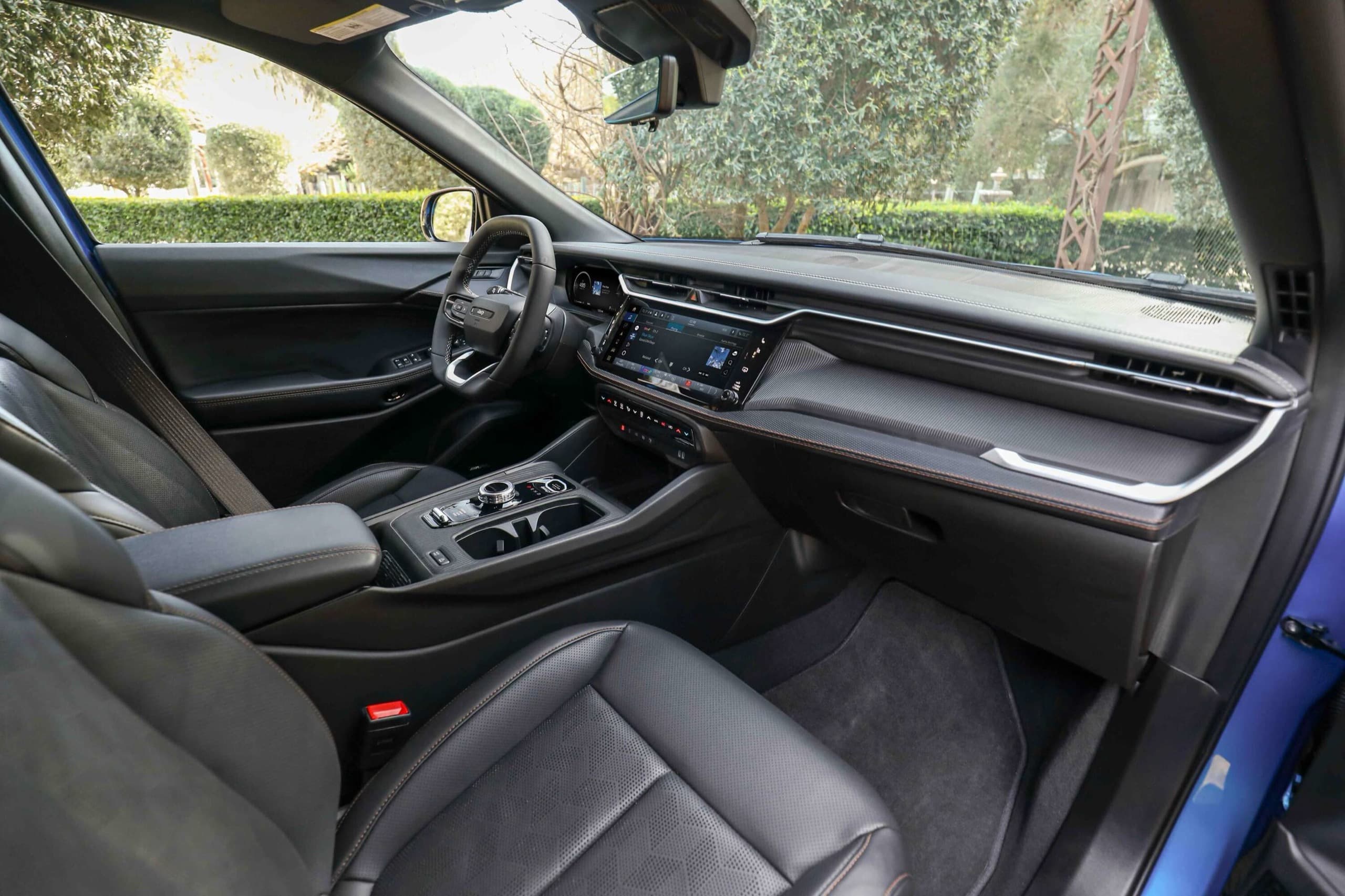
The cabin is the Cherokee's strongest card: Wards named the Overland's interior and user experience to its 10 Best list for 2026. Every trim gets a 12.3-inch Uconnect 5 touchscreen, a 10.25-inch digital cluster, and wireless Apple CarPlay and Android Auto; cargo space grows 30 percent over the old Cherokee to 33.6 cubic feet behind the rear seats and 68.3 with them folded. The honest catches: some hard plastics below the beltline (per Car and Driver) and a thick, squared steering wheel rim that Edmunds' editors disliked.
Interior Source Receipts
Research basis
Updated June 10, 2026
Built from Jeep's official 2026 Cherokee specifications and pricing on jeep.com, Stellantis' press materials, EPA ratings on fueleconomy.gov, NHTSA's recall and complaint databases (checked June 10, 2026), and the published test results and impressions of Car and Driver, MotorTrend, Edmunds, Consumer Reports, and Autoblog. Trim prices were cross-checked across jeep.com, Car and Driver, and Edmunds and include Jeep's $1,995 destination fee.
Advertised Cherokee prices include the $1,995 destination charge unless stated otherwise — the opposite of most rivals' quoting convention. The 9.4-second 0-60 time is MotorTrend's measured result; Jeep's own claim is 8.7 seconds. MotorRank has not yet instrumented-tested the 2026 Cherokee; ride, noise, and real-world fuel impressions are attributed to the named outlets and labeled preview basis.
Update when NHTSA/IIHS crash ratings publish, when MotorRank runs an instrumented test and real-world fuel sampling, when first owner-reliability data lands, and if Jeep announces a Trailhawk or additional powertrains.
Which 2026 JEEP CHEROKEE to Buy
Which trim is right for you?
Cherokee
$36,995
The value entry: the same 210-hp hybrid, standard 4x4, 12.3-inch screen, and full safety suite as every other trim — and the only Cherokee under $38,000 delivered.
Laredo
$39,995
Our pick and Car and Driver's sweet spot: 18-inch wheels, fog lamps, heated front seats, and a 10-way power driver's seat for $3,000 over base.
Our pick
Limited
$41,995
The comfort climb and Edmunds' recommended trim: leatherette upholstery and access to the 10-speaker premium audio and bigger option groups.
85th Anniversary
$42,900
Limited-based birthday edition marking Jeep's 85th year, listed at $42,900 by Car and Driver and Edmunds — buy it for the look, not extra hardware.
Overland
$44,995
The loaded flagship: unique perforated upholstery, standard dual-pane sunroof and premium audio, and the cabin that won a Wards 10 Best Interiors award.
Performance
- Horsepower
- 210hp
Scorecard
- Performance6.6
- Comfort8.3
- Value7.3
- Ownership7
- Technology8.2
- Safety8
- Reliability6.9
- Interior8.5
Shopping Tools
Next steps for 2026 Jeep Cherokee shoppers.
Research tools to help you move from browsing to buying.
Compare rivals
Line up the closest alternatives before you commit.
Check deal signals
Review pricing pressure, incentives, and value angles.
Read owner signal
Balance the expert take with ownership patterns.
Cross-shop first
The RAV4 went hybrid-only the same year the Cherokee returned, and it is the certainty play: proven powertrain, stronger resale story, same 3,500-pound towing. Read it before deciding whether the Jeep's nicer cabin and equipment are worth the reliability unknowns.
Open vehicle hub
Keep specs, reliability, rankings, and review links together.
Compare Against
Cross-shop before you commit.
The closest alternatives in this price range, with our read on each.
The proven default
Toyota RAV4
Hybrid-only for 2026 just like the Cherokee, with Toyota's track record, stronger resale, and the same 3,500-pound towing. The Jeep counters with a nicer cabin, more cargo, and more standard tech. Certainty buyers take the Toyota.
The packaging benchmark
Honda CR-V Hybrid
The CR-V drives better and carries Honda's reliability reputation, but AWD costs extra and it tows 1,000 pounds less. Comparably equipped, it lands close to a Cherokee Limited — the Jeep wins on standard 4x4 and equipment per dollar.
The value hybrid
Kia Sportage Hybrid
Thousands cheaper to start and backed by a 10-year powertrain warranty, the Sportage Hybrid is the budget play. The Cherokee answers with standard 4x4, more towing, more cargo, and a clearly nicer cabin. Budget-led buyers read our Sportage review first.
The driver's pick
Mazda CX-5
The CX-5 is the one that is actually fun to drive and feels premium for less money — but its gas-only drivetrain cannot touch 37 mpg. Enthusiasts take the Mazda; efficiency and equipment shoppers take the Jeep.
Buyer FAQ
2026 Jeep Cherokee buyer questions, answered.
29
buyer answers
Question Map
Decision
Should you buy the 2026 Jeep Cherokee?
The comeback is real — hybrid-only, 4x4-standard, award-winning cabin — so the decision turns on speed, proof, and what you need the badge to mean.
Is the 2026 Jeep Cherokee any good?
Yes — Car and Driver scores it 8/10 and Autoblog 8.3/10 — though Edmunds is cooler at 6.4, and it is slow when pushed.+
The major outlets broadly agree on the strengths: a smooth, efficient hybrid (EPA 37 mpg combined), a comfortable and quiet ride, a genuinely premium cabin that won a Wards 10 Best Interiors award for the Overland, and strong standard equipment. Car and Driver rates it 8/10 and ranks it #7 among compact SUVs; Autoblog calls it 'a genuinely impressive comeback' at 8.3/10; MotorTrend gives it 7.5; Edmunds is the skeptic at 6.4, citing price and sluggish maximum acceleration. Our research-basis score is 7.5. It is a good SUV for comfort-first buyers — not for speed, trails, or proven-record shoppers.
Who is the 2026 Cherokee right for?
Commuters and families who want efficiency, comfort, standard 4x4, and real towing — without trail ambitions.+
The target buyer drives daily in mixed traffic (where the hybrid shines and the cabin stays quiet), faces real weather (standard Active Drive I 4x4 with no fuel penalty), occasionally tows up to 3,500 pounds, and values interior quality and tech over driving excitement. The 500-plus-mile tank suits road-trippers who hate fuel stops. It also fits returning Jeep loyalists who have honestly aged out of trail use. It is wrong for off-roaders (no low range or Trailhawk), for anyone needing quick passing power, and for buyers who require a decade-long reliability record before signing.
Who should skip the 2026 Cherokee?
Off-roaders, speed-sensitive drivers, and certainty-first buyers — the RAV4 and CR-V Hybrid carry proven records.+
Skip it if the trail is the point: there is no low-range gearing, no locking differential, and no Trailhawk yet — MotorTrend's judges concluded it 'just isn't a great Jeep' off-road, however good a crossover it is. Skip it if you regularly need brisk merging or passing: MotorTrend measured 9.4 seconds to 60 and called it 'Subaru-slow.' And skip it — at least for a year — if first-year risk bothers you: the powertrain is brand new, two NHTSA recalls are already on file, and no owner-reliability data exists. A RAV4 or CR-V Hybrid buys certainty instead.
Why does the 2026 Cherokee matter right now?
It is Jeep's return to America's biggest segment after a two-plus-year gap — hybrid-only, and aimed straight at the RAV4.+
The Cherokee nameplate was discontinued after 2023, leaving Jeep absent from the largest vehicle segment in the country while the RAV4, CR-V, and Sportage sold in enormous volume. The 2026 comeback is Stellantis' first North American full hybrid and the company's bid to win commuters on efficiency rather than trail image — 37 mpg, 500-plus miles of range, standard 4x4, and pricing that includes destination. Jeep's CEO called it the vehicle meant to 'take back our place in North America's largest vehicle segment.' That is why search interest is heavy — and why the buying decision deserves more than comeback coverage.
The Comeback
What changed: new Cherokee vs the old one
Bigger, boxier, hybrid-only, and built on a new platform — here is what a returning KL owner actually gains and gives up.
What is new about the 2026 Jeep Cherokee?
Everything — all-new generation on the STLA Large platform, hybrid-only power, and a 30 percent bigger cargo hold.+
The 2026 Cherokee (the KM generation) is all-new from the ground up: Stellantis' STLA Large platform, a first-ever standard hybrid powertrain (1.6-liter turbo four plus two motors, 210 hp), standard Active Drive I 4x4, and a boxy design that finally resembles the Grand Cherokee. Per Consumer Reports it grew 5 inches in length and 6 inches in wheelbase, and Jeep says cargo capacity rose 30 percent. Every trim gets a 12.3-inch Uconnect 5 screen, a 10.25-inch digital cluster, and a Level 2 driving assistant standard. Production moved to Toluca, Mexico, with the engine built in Dundee, Michigan.
What does a loyal Cherokee owner give up trading in a KL?
Towing (4,500 down to 3,500 pounds), the V6, real off-road trims, and proven mechanicals — in exchange for ~15 mpg.+
Be clear-eyed about the trade. The old KL with the V6 towed up to 4,500 pounds; the new one tops out at 3,500. The Trailhawk trim, low-range-style Active Drive II hardware, and locking rear differential are gone — nothing in the 2026 lineup replaces them yet. And the familiar, long-proven Pentastar V6 gives way to a first-year hybrid with no track record. What you get back: roughly 15 more mpg, a 500-mile tank, a far nicer and roomier cabin, vastly better technology, and a quieter, more comfortable ride. If your KL was a trail or towing tool, the Grand Cherokee is now your Jeep; if it was a commuter, this is a huge upgrade.
Is the 2026 Cherokee bigger inside than the old one?
Yes — 30 percent more cargo (33.6/68.3 cu ft), an inch more rear legroom, and a size edge over the CR-V per Consumer Reports.+
Jeep's official numbers: 107 cubic feet of passenger volume, 41.3 inches of front legroom, 38.5 inches of rear legroom, 33.6 cubic feet of cargo behind the rear seats and 68.3 with them folded — the latter a 30 percent jump over the previous Cherokee, which Jeep illustrates as fitting an extra large dog crate. Car and Driver notes rear legroom grew about an inch, meaningful because the old second row was tight. Consumer Reports says the growth gives the Cherokee a size advantage over the spacious Honda CR-V, repositioning it between compact and midsize two-rows like the Outback and Murano.
When did the 2026 Cherokee actually go on sale?
Limited and Overland reached dealers in late 2025; the base Cherokee and Laredo followed in early 2026.+
Per Stellantis' launch announcement, the rollout was staged: the upper Limited and Overland trims arrived at dealerships in late 2025, with the entry Cherokee and volume Laredo following in early 2026. That matters for shoppers in two ways. First, used and demo inventory skews toward Limiteds and Overlands, so early 'deals' are mostly upper trims. Second, base and Laredo inventory was still building through spring 2026 — if a dealer claims the $36,995 car is unobtainable, check other stores before paying a trim walk you did not want. By June 2026, Jeep was already layering bonus cash on all trims.
Real Cost
Price, destination, and what you will actually pay
Five trims from $36,995 to $44,995 — with the destination fee already inside the sticker, and cash on the hood by June 2026.
How much does the 2026 Jeep Cherokee cost?
$36,995 (Cherokee), $39,995 (Laredo), $41,995 (Limited), $42,900 (85th Anniversary), $44,995 (Overland) — destination included.+
As listed by Car and Driver and Edmunds in June 2026: base Cherokee $36,995, Laredo $39,995, Limited $41,995, 85th Anniversary $42,900, and Overland $44,995 — and unusually, those figures already include Jeep's $1,995 destination charge (jeep.com shows the same cars at $35,000 to $43,000 before destination). Most rivals advertise before destination, so normalize before comparing. Note prices have drifted down since launch: Stellantis' August 2025 announcement had the Limited at $42,495 and Overland at $45,995 delivered, $500 and $1,000 above today's listings.
Are there deals on the 2026 Cherokee?
Yes — jeep.com showed $2,500 retail bonus cash through June 30, 2026, and prices have already slipped below launch levels.+
As of June 10, 2026, jeep.com's offers page listed a $2,500 retail bonus cash allowance on 2026 Cherokee models expiring June 30, 2026, and Car and Driver's page carried an advertised $630/month, 36-month lease expiring the same day. Combined with the post-launch price reductions on Limited and Overland, the pattern is clear: this is a negotiable launch, not a markup car — Stellantis is buying back market share. Incentives change monthly and vary by region, so pull Jeep's current national and regional offers the same day you collect dealer quotes, and get every quote as an itemized out-the-door figure.
What does a realistic out-the-door price look like?
Consumer Reports paid $40,490 for a Laredo with the spare tire — before tax, title, and any bonus cash.+
Consumer Reports' own purchase is the cleanest benchmark: a Laredo at $38,000 base, plus a $495 compact spare tire (the only option they added), plus the $1,995 destination fee — $40,490 before tax, title, and registration, and before any incentive. CR also criticized the destination fee itself, noting Stellantis' fees are outpacing many competitors. Practical advice: ask for the itemized out-the-door number, confirm whether the quote already includes destination (Jeep's advertising does; some dealer quotes restate it), apply the current bonus cash, and decline pre-loaded add-ons. The $495 spare is the one option we would actually order.
Is the 2026 Cherokee priced well against its rivals?
Mid-pack once you normalize destination — richer standard kit than rivals, but Edmunds warns loaded builds near $45K get hard to defend.+
At sticker the Cherokee looks expensive — $36,995 against a circa-$33,500 RAV4 or $30,500 Sportage Hybrid — but those rivals quote before destination and charge extra for AWD and the driver-assist tech the Jeep includes. Normalized, the base Cherokee is competitive: standard 4x4, Level 2 assist, and the 12.3-inch screen close most of the gap. The value case weakens up the ladder: Edmunds' verdict is that an optioned Limited or Overland gets 'too close to $45K for our liking,' where proven RAV4 and CR-V hybrids and even two-row midsizers await. Buy low or mid in the lineup for the strongest math.
Trim
Which 2026 Cherokee trim should you buy?
Same powertrain, same 4x4, same 37 mpg on all five trims — so buy comfort, not capability.
Which 2026 Cherokee trim is the best value?
The Laredo at $39,995 — heated seats, power driver's seat, and 18-inch wheels for $3,000, and C/D's sweet spot too.+
The Laredo is our pick and Car and Driver's named sweet spot. Its $3,000 walk over base buys the comfort gear you touch daily — heated front seats, a 10-way power driver's seat, upgraded cloth, fog lamps, 18-inch wheels — plus access to the Arctic white interior. Consumer Reports bought a Laredo for testing because it expects it to be the most common configuration. Nothing mechanical changes anywhere in the lineup, so the Laredo gives up zero capability to the $44,995 Overland. Unless the Wards-award cabin in full Overland trim is the reason you want this vehicle, stop here.
Is the base $36,995 Cherokee enough car?
Yes — it has the identical powertrain, 4x4, 12.3-inch screen, and full safety suite; you give up comfort items only.+
The base Cherokee is the rare entry trim with nothing missing that matters: the same 210-hp hybrid, the same Active Drive I 4x4 and Selec-Terrain modes, the same 12.3-inch Uconnect 5 with wireless CarPlay/Android Auto, the 10.25-inch digital cluster, and the complete safety and Level 2 driver-assist suite — all standard, per Stellantis' equipment list. What you forgo is comfort: cloth stays basic, seats are manual and unheated, wheels are smaller, and the interior is black only. If the budget is firm, buy it without anxiety — and consider adding the $495 compact spare tire.
Is the Overland worth $44,995 — and what about the 85th Anniversary?
Overland: yes, if the award-winning cabin is your priority. 85th Anniversary: styling only — skip unless you love the look.+
The Overland is the trim Wards actually honored: unique perforated upholstery in both color motifs, a standard dual-pane sunroof, standard 10-speaker premium audio, and the full equipment book. If the interior is why you chose the Cherokee, it is worth the money — but Edmunds' warning applies, because at $45K you are deep in proven-rival territory. The 85th Anniversary ($42,900, per Car and Driver and Edmunds listings) is a Limited-based birthday appearance package for Jeep's 85th year; it adds identity, not hardware. Between them sits the Limited at $41,995, Edmunds' own recommendation for the leatherette-and-audio buyer.
Hybrid & MPG
The hybrid, the mpg, and the 500-mile tank
Stellantis' first North American full hybrid is the Cherokee's whole argument — here is what it returns and how it drives.
What gas mileage does the 2026 Jeep Cherokee get?
EPA: 39 city / 35 highway / 37 combined on regular gas — every trim, with 4x4 standard.+
The EPA rates every 2026 Cherokee at 39 mpg city, 35 highway, and 37 combined on regular gasoline — one rating for the whole lineup, because all five trims share the same hybrid and the same standard 4x4. City beats highway because the hybrid can run electric-only at low speeds (up to 62 mph briefly, per Consumer Reports). Real-world evidence so far backs the sticker: Autoblog observed roughly 36 mpg (6.6 L/100km) across a week of mixed driving. With the 13.7-gallon tank, the EPA math works out to just over 500 miles of range — Jeep's headline claim, and it checks out.
How does the Cherokee hybrid system work?
A 1.6L turbo four plus two electric motors and a 1.03-kWh battery — 210 hp combined through a CVT, with a disconnecting rear axle.+
The system pairs a turbocharged 1.6-liter four-cylinder (177 hp and 221 lb-ft by itself, per Jeep) with two electric motors and a small 1.03-kWh lithium-ion battery for a combined 210 hp and 230 lb-ft, driving through an electronically controlled CVT. It is a full hybrid, not a plug-in: the battery charges itself, and there is no charging port. The rear axle has a genuine mechanical connection — not just an electric motor — and disconnects automatically to save fuel until slip is detected, per Consumer Reports. Around town the handoffs between electric and gas power are smooth enough that Edmunds and Autoblog both describe the system as essentially seamless.
Is the 2026 Cherokee fast enough?
Adequate in town, slow flat-out: Jeep claims 8.7 seconds to 60, MotorTrend measured 9.4 and called it 'Subaru-slow.'+
Manage expectations: instant electric torque makes city driving feel responsive, and every outlet praises the around-town smoothness. But at full throttle, 210 hp moving a 4,381-pound SUV (MotorTrend's as-tested weight) is modest. Jeep cites 8.7 seconds to 60, as reported by Edmunds — which noted that is over a second behind the RAV4 hybrid Edmunds last tested. MotorTrend's instrumented result was slower still: 9.4 seconds, with a 17.1-second quarter mile. Car and Driver estimates 8.1-8.3 but has not tested one. If you routinely make aggressive merges or mountain passes, test-drive exactly that before buying.
Is there a plug-in hybrid or gas-only Cherokee?
No — hybrid-only, with no PHEV planned per Car and Driver. Gas loyalists must step up to the Grand Cherokee.+
The 2026 Cherokee comes one way: the 210-hp full hybrid. Car and Driver reports Jeep says a plug-in hybrid version is not planned, though other powertrains and more rugged variants have not been ruled out. There is no gas-only engine at any price, and no diesel or V6 successor. If you want a plug, Jeep's 4xe models (Wrangler, Grand Cherokee) carry the brand's PHEV tech; if you want a traditional gas Jeep SUV of this size or larger, the Grand Cherokee is the path Car and Driver points to. For most commuters, the standard hybrid's 37 mpg with no charging required is the practical sweet spot.
Capability
4x4, towing, and the Trailhawk question
Standard 4x4 and segment-best angles — but no low range, no lockers, and no trail trim yet.
How capable is the 2026 Cherokee off-road?
Good for snow, mud, and forest roads — 8.0 inches of clearance and best-in-class angles per Jeep — but no low range or lockers.+
Every Cherokee gets Active Drive I 4x4 with a real mechanical rear-axle connection, Selec-Terrain modes (Auto, Sport, Snow, Sand/Mud), 8 inches of ground clearance, and what Jeep claims are best-in-class approach and departure angles of 19.6 and 29.4 degrees, with an 18.8-degree breakover. That comfortably covers bad weather, gravel, ruts, and launch ramps. What it cannot do is rock-crawl: there is no low-range gearing, no locking differential, and no skid-plate trail trim. MotorTrend's off-road verdict — 'perfectly fine compact SUV... just isn't a great Jeep' — is the honest summary for trail-first buyers.
Will there be a 2026 Cherokee Trailhawk?
Not yet — Jeep has not announced one but has not ruled out more rugged versions; trail buyers should wait or shop elsewhere.+
No Trailhawk exists in the 2026 lineup, and Jeep has announced nothing. Car and Driver reports Jeep 'has not ruled out a Trail-Rated variant or alternative powertrain options in the future,' and the brand hints more rugged versions may come. Until one does, no Cherokee trim adds capability hardware — the five trims differ only in comfort and appearance. If trail capability is your purchase reason, the rational moves are waiting for an announcement, buying a Wrangler or the electric Recon, or finding a clean used KL Cherokee Trailhawk with the old Active Drive II hardware. Buying today's street-spec Cherokee and hoping is the one move we advise against.
How much can the 2026 Jeep Cherokee tow?
3,500 pounds — which Jeep calls unsurpassed in class and matches the RAV4 — but check the recall and the 850-lb payload.+
Jeep rates every 2026 Cherokee at 3,500 pounds, matching the new RAV4's maximum and beating the CR-V Hybrid's 1,000-pound-lower rating. Two fine-print items the headline hides. First, NHTSA recall 26V059000 covers an improperly designed trailer tow module that can disable trailer lights and brakes — dealers replace it free; confirm it is done before you tow. Second, payload is 850 pounds (Jeep's Limited spec), and passengers, cargo, and tongue weight all count against it — four adults plus luggage can consume it before the trailer hooks up. Towing near the limit with a full cabin needs a door-jamb math check, not just the brochure number.
Daily Use
Living with it: comfort, space, and the annoyances
Quiet, comfortable, and roomy — with a wide turning circle and a strange steering wheel as the daily nitpicks.
Is the 2026 Cherokee comfortable to drive every day?
Yes — Autoblog calls the ride excellent for the class and Edmunds praises the quiet cabin; the trade is numb steering.+
Comfort is the Cherokee's calling card, on attribution: Autoblog rates the ride 'composed and comfortable... excellent for its class,' Edmunds highlights how quiet it stays around town running on electric power, and Car and Driver lists over-the-road comfort among its highs. The flip side is engagement: steering is light and numb (Edmunds, TheTruthAboutCars), the brake pedal feels artificial (Car and Driver), and the engine gets coarse at full throttle. Two daily-life nitpicks worth testing yourself: Autoblog found the wide turning circle a 'genuine and persistent irritant' in parking situations, and Edmunds' editors disliked the thick, squared-off steering wheel rim.
How much cargo space does the 2026 Cherokee have?
33.6 cu ft behind the rear seats, 68.3 max — 30 percent more than the old Cherokee, and more than a RAV4.+
Jeep's official figures: 33.6 cubic feet behind the second row and 68.3 with the seats folded, a 30 percent improvement over the previous generation. That out-measures the RAV4 and runs near the class-leading CR-V, in a body that grew 5 inches longer on a 6-inch-longer wheelbase (Consumer Reports). The boxy, upright tailgate shape helps with bulky items — CR specifically praises the squared-off back for large cargo. Available practicality features include a foot-activated power liftgate with adjustable height and the $495 compact spare tire option, which we would order: it replaces the inflator kit and suits a vehicle with gravel-road ambitions.
Is the 2026 Cherokee good for families?
Yes for two-row needs: 38.5 inches of rear legroom, standard Level 2 driver assist, and a quiet cabin — no third row exists.+
As a five-seat family vehicle the Cherokee makes a strong case: 38.5 inches of rear legroom (about an inch more than the old model), 107 cubic feet of passenger volume, a quiet ride, standard rear park assist with automatic braking, drowsy-driver detection, and the full Level 2 Active Driving Assist suite on every trim — equipment most rivals reserve for upper trims. Heated rear seats and a dual-pane sunroof are available on upper trims. There is no third-row option; families needing seven seats should look at the Grand Cherokee L or a midsize three-row. Crash-test ratings were not yet published as of June 10, 2026 — safety-first parents may want to wait for them.
Ownership
Recalls, reliability, and warranty — the first-year truth
Two recalls, three complaints, a brand-new powertrain, and average warranty coverage: this is the section to read twice.
Does the 2026 Jeep Cherokee have any recalls?
Yes — two as of June 10, 2026: a trailer tow module replacement and a brake-control software update. Both free fixes.+
NHTSA lists two recalls for the 2026 Cherokee, verified June 10, 2026. Campaign 26V059000 (reported February 2026): a misdesigned trailer tow module can prevent trailer lights and trailer brakes from working; dealers replace the module free, with owner letters mailed from March 17, 2026. Campaign 26V223000: the brake-system control module may fail, risking loss of ABS and stability control; dealers update the software free, letters mailed April 28, 2026. Neither is a park-it order, but both touch safety systems. Before delivery, run the VIN through NHTSA's recall lookup and require written confirmation both campaigns are closed.
Is the 2026 Jeep Cherokee reliable?
Unknown — the powertrain is brand new, no owner data exists, and Jeep's recent brand record is below average. We won't invent a score.+
Honest answer: nobody knows yet, and we do not publish reliability scores we cannot source. The 1.6-liter turbo hybrid is a new engine family in its first application; no Consumer Reports or J.D. Power owner data covers this generation. Context cuts both ways: Jeep as a brand has scored below average in recent dependability studies, but full-hybrid drivetrains with CVTs are mechanically simpler in key ways than turbo-plus-9-speed setups, and the engine is US-built in Dundee, Michigan. NHTSA's three early complaints (a no-shut-off incident, a traction-control noise, a fuel-gauge misread) are worth watching, not panicking over. Cautious buyers should wait for year-two data.
What warranty does the 2026 Cherokee come with?
3yr/36k basic, 5yr/60k powertrain, 5yr corrosion and roadside — plus 8yr/100k hybrid-battery coverage per Car and Driver.+
Jeep's published terms: 3-year/36,000-mile basic, 5-year/60,000-mile powertrain, 5-year unlimited-mile corrosion, and 5-year/60,000-mile roadside assistance. Car and Driver's summary adds 8-year/100,000-mile hybrid battery coverage and two years of complimentary maintenance — confirm both in the warranty booklet for your specific build, since hybrid-component terms can vary by state emissions rules. The competitive picture: this matches Toyota and Honda but trails Hyundai and Kia's 5-year/60,000 basic and 10-year/100,000 powertrain coverage. Given the new powertrain, the battery term is the one to get in writing.
Will the 2026 Cherokee hold its value?
No track record exists for this generation — we won't quote a residual; the hybrid's durability and a future Trailhawk will decide it.+
We will not invent a resale percentage for a vehicle that has been on sale for months. The structural factors: the previous Cherokee's resale was unremarkable for the segment; hybrid versions of mainstream SUVs have generally held value well in recent years; and Jeep is already discounting ($2,500 bonus cash in June 2026, plus post-launch price cuts), which historically pressures used values. Working in its favor are the nameplate's recognition and the efficiency story. If resale certainty is a priority, the RAV4's and CR-V's track records are the safer bet, and we say so plainly in the cross-shop verdicts.
Ready to buy?
Configure your 2026 Jeep Cherokee.
Get matched with a Jeep dealer or build your spec sheet from scratch.